




Non-voters told to stay away tomorrow
The contest for the Permatang Pauh parliamentary seat is the most unusual by-election ever witnessed in this country, according to Home Minister Syed Hamid Albar today.
The contest for the Permatang Pauh parliamentary seat is the most unusual by-election ever witnessed in this country, according to Home Minister Syed Hamid Albar today.
"I have never seen a by-election that is as militant, aggressive and violent as this one," he told a press conference in the Parliament lobby.
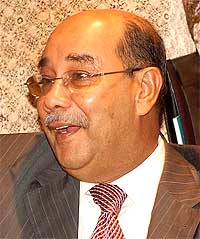 "We have got about 70 police reports and 26 are being investigated (thus) far… this is unusual in Malaysia as it has never happened like this (before)," he added.
The minister said as important as the by-election may be, supporters should not be impelled or provoked unnecessarily by sentiments.
"(There is) no need for us to be provoked by our feelings or be provoked to defend our own ideologies by the means of threatening or hitting anyone… these acts are not healthy for the development of democracy in Malaysia," said Syed Hamid.
He also commented on the rumours that PKR is planning to bring over 25,000 outsiders to Permatang Pauh to aid with the polls.
"That place is small and if anything happens it could interfere with the journey of people who are going there to vote.
"That is why the police have released a statement to all those who are not voters to not come into Permatang Pauh on by-election day as to prevent any traffic congestion or any untoward incidents like the one on nomination day," he said.
"So my hope is for – the people who love and appreciate our democracy – to evade the incidents from recurring by coming in huge crowds in order to disrupt the situation in Permatang Pauh," he added.
In order to maintain peace and security, Syed Hamid said more than 5,000 police personnel have been mobilised to the area.
Over the past two days, police have erected roadblocks along major highways leading to Permatang Pauh, including the Jalan Duta toll heading north of Kuala Lumpur.
"In this by-election alone so many issues have already been brought up… there are 26 cases involving the use of violence, verbal insults, threats, stopping people from going to campaign and removing campaign posters and uttering seditious claims," he said.
"I have never seen any election or by-election in this way," he reiterated.
DNA Act is not to convict a person
Moving on to the DNA Act tabled last week, the minister said it is not to criminalise a person but to ensure that the innocent will not be punished for any crime.
"The Act will aid us in establishing a DNA data bank that would help Malaysia be on par with other countries which use collections of DNA samples to identify the guilty and for us to refrain from unjustly accusing an innocent person," he said.
Syed Hamid emphasised that DNA evidence does not have to be the deciding factor in verifying a criminal.
"DNA is only part of a chain of evidence… it is used to identify the certainty of a sample whether it is intimate or not intimate," he explained.
"So I wonder why so many people come up with their own assumptions that the DNA Act is proposed under bad intention and linked to Anwar Ibrahim and the case he is facing now," he said.
According to the minister, the provision of the Act has been in discussion since year 2000 and in 2001 a special driving committee resided by experts and policymakers was setup to study the matter.
 "(Therefore) this Act has got nothing to do with Anwar at the moment… the case filed on him is based on police investigations and prosecutors who had reasonable grounds to indict him in court under the Penal Code," he said.
"Anwar’s sodomy case is categorised as a sub judice matter – and in sub judice cases a person is liable to be charged with contempt – if the matter is discussed.
"Let the court decide… Anwar is innocent until proven guilty – whatever you want to do in court - don't bring it to the elections," he said.
"In my opinion, no innocent person can suddenly become a criminal just because of this Act.
"And I think that should be very clear – I have been asked by many whether the Act is retroactive or retrospective – it does not matter as long as the case has been investigated and there is a prima facie case… because if there is a prima facie case, and if the prosecution is satisfied, (then) they are not dependent on the DNA Act," he added.
Syed Hamid highlighted that the DNA Act would aid in tidying up the current investigation system and be a useful tool in other cases such as kidnapping, identification of victims after disasters and many more.
“That is the craft – and it has to be looked at a macro level - it facilitates cases but it is not used to summarise a case,” he said.


Are you sure you want to delete this comment?
This action cannot be undone.