




Anwar's takeover - king or Parliament?
As expected Prime Minister Abdullah Ahmad Badawi has flatly rejected the request for a special meeting of the Dewan Rakyat made by Opposition Leader Anwar Ibrahim.
As expected Prime Minister Abdullah Ahmad Badawi has flatly rejected the request for a special meeting of the Dewan Rakyat made by Opposition Leader Anwar Ibrahim.
But this is not surprising as - despite the polite way the latter put it - the request was virtually asking Abdullah to put himself on the chopping block: two days before Anwar claimed that he had the numbers to take over the government.
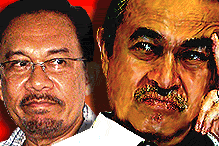 What happened on Thursday revealed the problem with the formula; namely taking over the government through the vote of no-confidence on the floor of the house.
Of course this approach is both democratic and constitutional. But given the legal and political culture prevalent in this country, it is doubtful if this can take place.
From the point of view of state governing, Malaysia belongs to the Westminster category whereby the office of the head of state is separated from the head of government.
Although the former plays a largely symbolic role the holder may assume active role in relevant and critical circumstances.
It seems that the option preferred by Anwar was recommended by advisers close to the palace.
Sources told that they had some misgivings about Anwar going straight the Yang di-Pertuan Agong, the king, to get the permission to form the new government.
It was pretty obvious that they wanted to avoid the king from being dragged into the murky waters of politics.
The advisers have apparently ignored the guardianship role of the king; something that is common in all Westminster democracies.
And this is not only limited to kings or sultans: even in republics like India ceremonial head of states may assume some extraordinary powers in crisis situations. Indeed some allusions to such a role were also apparent in the Reid Commission Report.
However given that this is the first time we have a regime change at the federal level such apprehension was quite natural.
Petitioning the king
Be that as it may true to his maverick tag Anwar, in his press conference, did not discount the option of going straight to the palace.
Now that Prime Minister Abdullah has declined his request Anwar has thereby been put on a better footing with it: he now has a legitimate ground to petition direct to the king.
After all Anwar has virtually exhausted the means which would have avoided any involvement of the king.
As the law stands it is not clear whether to have the regime change through Parliament is the only way.
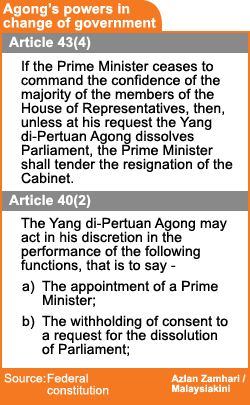 Indeed the wording of Article 43(4) of the Federal Constitution seems to suggest that it can be done outside Parliament; namely the majority group simply tells the Yang di-Pertuan Agong that they have withdrawn their support from the sitting government.
As the provision has made it mandatory upon the prime minister who has lost the support resigning, the king then can appoint an MP who enjoys the support of the majority in the house as the new prime minister.
That notwithstanding the practice of throughout the Commonwealth has consistently shown the manner by which the withdrawal of support is indicated; namely through the motion of no confidence or censure.
But as we have seen such was difficult to do here in Malaysia: Umno has been deploying all sorts of tricks to prevent the tabling of the motion, the most recent being the outright rejection by Abdullah.
The view which insists on the parliamentary approach seems to be oblivious to this.
In any case it is doubtful if the constitution really envisaged the sitting prime minister to have the final say over the summoning of Parliament as claimed by Speaker Pandikar Amin Mulia.
For one thing the premier is the head of the executive branch and to put the legislature under the control of the executive would run counter to the notion of separation of powers inherent in the system.
Apart from that, as we have seen, there would be situations whereby it involves the very survival of the government itself.
To fortify his position, the speaker cited a provision from the Standing Orders. But as matter of law, this provision is subservient to the constitution - the rules regulating the parliamentary procedures have been framed by virtue of Article 62(1) of the federal constitution.
An untenable proposition
The speaker was virtually saying that a law inferior to the constitution prevails over the supreme law. This is no a tenable proposition.
It appears that given the ideals of the constitution the king is the right authority to summon the emergency session.
And one may cite Article 55 for it is quite unthinkable to say that while he is allowed the power to prorogue or dissolve the house, he is not in a position to summon it.
Furthermore this is done with a view to install a truly responsible government as required by the constitution.
Given the position of the government on the matter, it could be argued that it could not impose its advice on the king.
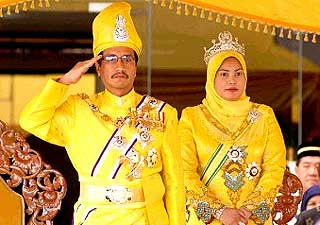 Furthermore as a matter of law Article 40(1) is a general provision which may admit exceptions and the current political impasse seems to fall under this category.
Having gone through all these arguments, it is quite clear that whichever way, the king still need to play a major role.
But this is quite natural, for, occasionally the system has to rely on something extraordinary in order for it to function - the king, as it were, has to jumpstart the system which otherwise would not work or deliver.
Although the constitution is silent, we know that there were times when its operation ended in a cul-de-sac and failure to act on his part would tantamount to abdicating his duties.
As other public functionaries the king owes a duty to the taxpayers who borne the cost of maintaining the institution.
Anwar seems to have that in mind when he said that he did not rule out the possibility of going to king direct in order for him to form the new government.
Given the mechanics of Westminster system, it is actually not the end of the road for Abdullah. He can always challenge or even throw Anwar out of the government via the same manner: a vote of no confidence.
As such it is necessary for Abdullah to allow the system to function as it should be. As for Anwar since he has promised to uphold the constitution perhaps he could do that by putting in place some major changes such as allowing a free election for the speaker.
Those wanting to see this would want to have somebody from the opposition benches to preside the proceedings in the house. Without doubt this is one of the benchmarks of a first class Parliament.
Two approaches
From the legal standpoint, there is reason for the prevalence of the two approaches; namely forming government through the tabling of censure motion and the one to be done through the indication of support outside the house. It appears that both approaches can be accommodated within the framework of Article 43(4).
As was said above the first approach is the most ideal as it is more democratic.
This approach has its roots in the Stephen Kalong Ningkan case, a decision by the Kuching High Court in 1966.
But this can only happen in a political system that is open and democratic. And one wonders whether this can take place in Malaysia now.
We have seen how the Barisan Nasional government staged various maneuverings to avoid the motion.
Some of these, such as the threat to use the legal but somehow undemocratic Internal Security Act, are difficult to reconcile with the very ideals of the constitution.
The second approach is the result of literal reading of Article 43(4) together with Article 40(2)(a).
Obviously this - inspired by a Privy Council decision in Adegbenro case in 1966 - is more straightforward and faster than the first approach. Given all the undemocratic maneuverings this seems to be the more viable option.
But more importantly this approach would be able to pre-empt all the undemocratic attempts to resist regime change by the sitting government.
But the problem is that it very much dependant on the willingness of the king to take a more proactive role. As things stand this does not seem to be the case now.
Perhaps it is worth mentioning that some of the more stable democracies in Europe are monarchies. Meanwhile outside that continent we have seen how some monarchs took a leading role in restoring and strengthening their nascent democracies.
This is what happened in Spain, Thailand and to some extent, Jordan. It is not clear whether our monarchy would like to join the list.
Dr ABDUL AZIZ BARI is professor of law at the International Islamic University Malaysia.


Are you sure you want to delete this comment?
This action cannot be undone.