




Abdullah - short stay and weak legacy
Despite a relatively short stay in power - just about five years - and a weak legacy, Prime Minister Abdullah Ahmad Badawi will be remembered by Malaysians for a number of reasons.
Despite a relatively short stay in power - just about five years - and a weak legacy, Prime Minister Abdullah Ahmad Badawi will be remembered by Malaysians for a number of reasons.
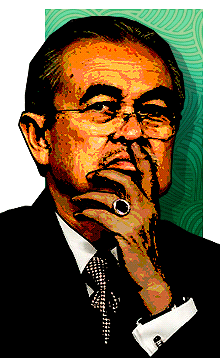 The 68-year old, better known as Pak Lah, today agreed not to defend his Umno presidency and to step down as premier by next March. This paves the way for new blood to contest the topmost post in his party and pundits are predicting his deputy, Najib Abdul Razak, will be the frontrunner to succeed him.
Abdullah, the country’s fifth prime minister, inherited his position from predecessor Dr Mahathir Mohamad on Nov 1, 2003.
However, he won his own mandate the very next year.
He claimed early glory, scoring the biggest ever victory for Umno and the Barisan Nasional coalition on promises to rid the country of endemic corruption and to increase the democratic space in the rapidly modernising nation.
In the fight against corruption, he failed. Despite launching numerous high-profile and much-publicised anti-graft campaigns, Malaysia slipped further in the worldwide Corruption Perception Index, down four slots to 47th place in the 2008 survey that ranked 180 countries.
But he will be remembered for further liberalising democracy in the country, despite resorting to an oppressive law to jail several civilians, including five Hindu rights activists, two journalists and an opposition politician at the tail-end of his career.
“He was popular and well-liked but he disappointed the country because he could not push through the changes he promised,” said Ramon Navaratnam, president of Transparency International Malaysia.
“It would be better if he could do something solid during his last months to strengthen his legacy. The most pressing of course would be the release of all Internal Security Act detainees.”
Strengthening his legacy
Abdullah was born in Kepala Batas in northern Penang state to a prominent religious family and graduated from the University of Malaya in 1964 with a Bachelor of Arts in Islamic Studies.
He joined the Malaysian Administrative and Diplomatic Corps upon graduation, beginning a career in the civil service that has seen him serve in several ministries, including defence, education and foreign before assuming the premiership and finance portfolio in 2003.
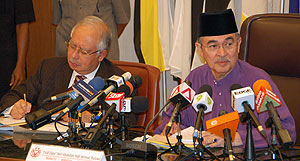 Just last month, Abdullah - sensing the wind might be blowing against him - relinquished the finance portfolio to Najib in a bid to pacify dissenters in his party and to maintain his deputy’s loyalty.
Abdullah had come under siege following the March 2008 general election, which saw the BN relinquish its two-thirds parliamentary majority to the Pakatan Rakyat alliance led by Opposition Leader Anwar Ibrahim.
Things came to a head last month when several Umno leaders, led by International Trade and Industry Minister Muhyiddin Yassin, called for him to step down in favour of Najib.
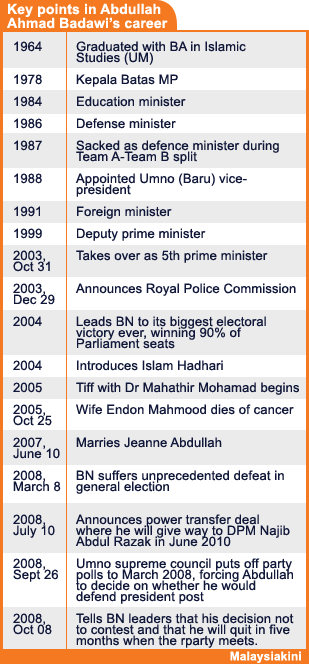 The groundswell of demand for him to take responsibility for the poor electoral performance forced him to abandon a controversial pact to transfer power to Najib in 2010.
At an emergency Umno supreme council meeting held on Sept 26, Abdullah finally agreed to consider making way for new blood, promising to let the nation know if he would step down by Oct 9.
“In all my years of service, I have always been guided by my conscience. I have always placed the interests of the nation above all else. It is with this in mind that I announce I will not stand for the presidency of Umno," Abdullah said in a statement released this evening.
"I do not want a divided party and governing coalition, but one that is united and harmonious. A united Barisan Nasional is vital in order for the country to face the global challenges ahead and for Malaysia to become a fully developed nation, with prosperity and fairness for all.”
All eyes are now on him as he finishes his last few months in power.
While he has pledged to eradicate poverty, and there are calls from business groups for him to push through his economic projects such as the Iskandar growth corridor, social activists and political observers believe his best contribution might be to set in motion decisive moves to bring to an end the country's infamous ISA, which allows for prolonged detention without trial.


Are you sure you want to delete this comment?
This action cannot be undone.