




Sabah police make presence felt along borders
Sabah police have stepped up patrols in seven areas with high traffic movement from across the maritime borders.
Sabah police have stepped up patrols in seven areas with high traffic movement from across the maritime borders.
They are also maintaining a presence on 49 islands along the east coast of the state, including Pulai Sebatik, Sandakan, Tunkku, Semporna and three undisclosed areas.
This is said to have dented any plans by militant groups in the southern Philippines - such as the Abu Sayyaf and factions of the Moro Islamic Liberation Front - and others from slipping into Sabah.
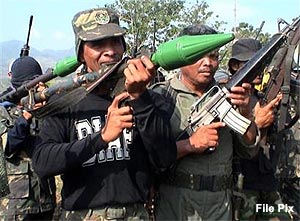 Fighting has flared up again between armed groups and Philippine government forces following the recent breakdown of a truce.
“We have re-programmed our patrolling details along the east coast to ensure our presence is felt. Under the new patrolling regime, shorter distances were covered, similar to the beat system on land,” said Sabah Police Commissioner Noor Rashid Ibrahim.
“This will be a deterrent to any group. Previously, the larger patrol area gave a sense of non-security.”
He was providing an update on the security situation after taking delivery of five new speedboats worth RM300,000 from the state government.
“We are also working with the military which covers the more outlying islands. We have made several arrests of illegal immigrants trying to slip into the state.
“Police analysis of the situation shows that the armed groups are too far away from Sabah. The probability of their coming to Sabah from the main island of Mindanao is very low. Their ethnicity also made it difficult for them to flee to other islands within the Philippines.”
There are still close cultural ties between those living on the eastern seaboard of Sabah and the people of the Sulu islands and Mindanao.
Apart from militant groups, police have identified illegal immigrants, smugglers, Filipinos who illegally farm mangrove swamps, pirates and kidnappers among the infiltrators.
The last major kidnapping incidents reported in Sabah were on Sipadan and Pandanan islands in April and September 2000 respectively.
Illegal immigrants nabbed
Brigader-Commander Paramasivam Arunasalam said the General Operations Force (GOF) is working with the marine police, navy and the Malaysian Maritime Enforcement Agency.
The GOF recently intercepted three tempel (small boats) packed with 46 illegal immigrants off Semporna, he said.
“A team from the 14th Battalion (Tawau) stopped the boats off Labuan Haji, Semporna, and found (the) individuals, including 15 women, all believed to be from the Philippines,” he said.
On Nov 19, marine police had intercepted a fishing boat with 46 Filipinos from the island of Cagayan, close to the border with Sandakan. The fishing boat was heading for Batu Putih near Mile 7 Jalan Airport at about 3.45am.
“The boat was then escorted to the marine police base and referred to the Immigration Department for further action,” disclosed marine police commanding officer, Chief Inspector Sri Vikneswaran Renganathan.
“The boat was registered in Malaysia. We are trying to determine if any local individual or agent was responsible for trying to bring in these Filipinos illegally.”
A few days earlier, marine cops had nabbed 77 Filipinos trying to sneak into Sandakan in one pump boat and two jongkong (long boats).
Theft from mangrove forests
The authorities have since discovered that many infiltrators have been making for the mangrove forests stretching from Paitan to Beluran, to strip bark off the trees for a home-made liquor called Tanduay , soda and varnish.
Marine police seized 1,800 units of detonators earlier this month from a Philippine pump boat at Pulau Mantaban in Semporna, along with eight rolls of wire, 35 bottles of Tanduay and 24, 440 pesos in cash. The detonators are generally used for fish-bombing activities.
Forestry Department director Sam Mannan said monthly aerial surveys will be stepped up from the Bengkoka peninsula and Pitas, to Jambongan Island, Sugut and Beluran “to pinpoint the locality of these people”.
Sabah has about 57 percent of the 583,036 ha of mangrove swamps in Malaysia, of which 317,273 ha have been gazetted as permanent forests. Mangrove trees act as buffers against storms and protect coastlines from flooding.
Illegal felling of mangrove trees and possession of forest products, including tree bark, are offences under the Forest Enactment Act 1968 and those found guilty could be jailed for up to 20 years.
“Illegal felling of mangrove forests trees is not restricted to the upper reaches of the east coast,” said Sabah Environment Protection Association president Wong Tack.
“Our members have informed us about the destruction of mangrove forest in Tawau and Lahad Datu.”


Are you sure you want to delete this comment?
This action cannot be undone.