




Growing opposition to demolition of KK's general hospital
Engineers, architects, the medical community and the Health Ministry are at loggerheads over the uncertain fate of the largely abandoned Queen Elizabeth Hospital (QEH), Kota Kinabalu’s General Hospital, which resembles a ghost town in most parts.
Engineers, architects, the medical community and the Health Ministry are at loggerheads over the uncertain fate of the largely abandoned Queen Elizabeth Hospital (QEH), Kota Kinabalu’s General Hospital, which resembles a ghost town in most parts.
Many of the stakeholders want to study for themselves in detail the various engineering and structural reports on the QEH prepared by the Health Ministry, the Public Works Department and contractor Kumpulan Ikram (Sabah) Sdn Bhd.
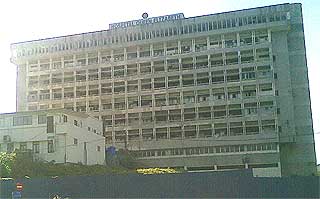 They include Kota Kinabalu MP Dr Hiew Hing Cheu, an engineer himself, and three professional bodies - the Association of Consulting Engineers Malaysia, Institution of Engineers Malaysia and the Malaysian Institute of Architects.
Hiew told a public forum, ‘Structural Safety of QEH Tower Block’ yesterday at the Postgraduate Medical Centre - next door to the emptied out QEH Tower Block - that the majority of concerned professionals in Sabah are not in favour of the demolition of the QEH.
“We would support the demolition if the whole building was crumbling. The extent of damage is not at a critical stage yet. Only certain portions are structurally damaged and these can be salvaged,” said Hiew.
“From the engineer’s point of view, the beams can be repaired. We need to keep the building as there is no replacement as yet.
“The smaller single storey structures behind the Tower Block should be replaced with proper structures. Also, we would urge that the proposed Twin Tower Block on an adjacent site go ahead without any further delay.”
Hiew disputed Ikram Sabah’s figure of RM23.76 million to undertake structural repair work at QEH and alleged that the figure “may have been exaggerated since we don’t need that kind of money to repair partial damages”.
Ikram Sabah in a report completed on Nov 5 for the Health Ministry had also stressed that the re-construction option would only be RM820,000 more than the repair option which would be a losing battle since the whole structure at present used the more corrosive sea sand, which has a high chloride content.
“If the repair option is exercised, another RM4.5 million at current prices would be needed in another 10 years, to re-appraise the building (for continued occupation),” warned Ikram Sabah director Vincent Tan in the report.
“The building would need continued maintenance and would not be able to withstand vibrations and stresses including horizontal forces that may be introduced by earthquakes and other natural disasters.”
‘My mother once sleep on hospital’s floor’
Hiew, acting as the spokesman, said “all stakeholders should have a say since this is a matter of public interest”.
“The government has money to buy the first SMC (Sabah Medical Centre), the second SMC and perhaps even the third SMC but no money to build a proper hospital for the state capital,” decried Hiew on the sidelines of the forum before hopping on a flight to Kuala Lumpur for the current sitting of Parliament.
“My mother once slept on the floor at QEH because there weren’t enough beds. I will have a word with Health Minister Liow Tiong Lai about the QEH.”
There are lingering questions over the Health Ministry’s purchase of the Sabah Medical Centre, which has since been turned into the Likas Hospital for Women. SMC went on to build a brand new hospital in Luyang, Kota Kinabalu.
After the evacuation of QEH, the ministry raised the possibility of buying the second SMC to replace the QEH but has had second thoughts after public expressions of unease over history repeating itself.
The first SMC, now the Likas Hospital, was built by Chief Minister Harris Salleh at only RM5 million but changed hands at several multiples of this amount when the government took it over under a previous health minister.
The QEH was largely evacuated in mid-October after the Health Ministry, allegedly after years of foot-dragging under several ministers, finally ruled that the 27-year-old hospital was largely unsafe for continued occupation.
The picture got murkier at the public forum when Sabah Health director Dr Marzukhi Mohd Isa dropped a bombshell that the proposed new hospital in Kinarut, Kota Kinabalu, would not completely replace the QEH as first announced but would instead supplement and complement existing facilities at the General Hospital.
“What we are planning (at Kinarut) is in addition to the existing hospital (QEH) to improve the health services,” said Marzukhi. “At QEH, we have had patients sleeping on the floor. We don’t want that to happen anymore in Sabah.”
He gave an assurance that nothing has been finalised as yet over the fate of the QEH and that discussions are still continuing at the Health Ministry in Kuala Lumpur, “and so things will take a longer time”.
All options being explored
In a statement issued after the public forum, Marzukhi added that all options for QEH have been studied in detail by MOH, JKR and Ikram and the final decision would hinge on “which option is the most beneficial to all parties in the long run”.
One option is to abandon and demolish the Tower Block to build the Twin Tower Block to accommodate 600 beds and 20 operating theatres.
But no matter what the option, “QEH would not be shifted elsewhere”.
“Even the Twin Tower Blocks is not to replace QEH but to supplement and complement it,” said Marzukhi.
“But obviously, now QEH is in a bad shape and we cannot retain that kind of building indefinitely. We need 1,700 hospital beds in Sabah but have only 1,200 beds at the moment. We need to also address the shortfall of 500 beds.”
Giving the current status of QEH, Marzukhi said “the current priority is to provide health services to all patients by whatever means including buying services at private hospitals but when it comes to money, it is not within our control”.
Meanwhile, the decanting of QEH has been almost completed. The last patient moved out on Nov 14.
As at yesterday, 124 QEH patients are at the Likas Hospital, 88 at the Sabah Medical Centre and three at the Beaufort Hospital.
Surgeries are being done at both Likas and SMC, the latter paid by the government for its contract services and major emergency operations. QEH is maintaining two ICU (intensive care units) at SMC for surgical cases.
QEH director Dr Zuraidah Ahmad Babji added that medical wards with 300 beds for medical cases that do not require surgery – hypertension, diabetes, heart problems, among others – are still available at the old block which used to have 262 beds.
There’s one ICU at this block for medical patients. All emergencies are still being treated at QEH’s Accident and Emergency Department. There are also a minimum number of personnel at the Diagnostic Imaging Department at the Tower Block.


Are you sure you want to delete this comment?
This action cannot be undone.