




It's been a rough ride
Dozens of cyclists promoting workers' rights are on an extraordinary odyssey across the country, which came to a climax with the handing over of memorandums in Parliament today.
It has been a rough ride, with arrests and police harassment constantly threatening to bring their journey to a premature end.
Dozens of cyclists promoting workers' rights are on an extraordinary odyssey across the country, which came to a climax with the handing over of memorandums in Parliament today.
It has been a rough ride, with arrests and police harassment constantly threatening to bring their journey to a premature end.
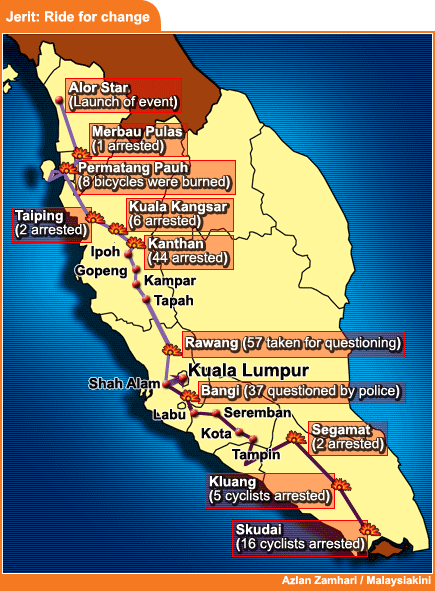
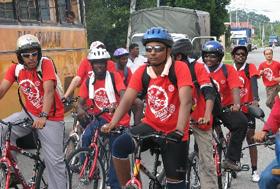 Two cycling teams - four dozen from the north of the peninsula and three dozen from the south - each accompanied by a dozen or so activists have been pedaling their way to Kuala Lumpur since early December. Along the way, they have met with almost daily police action including road blocks, detentions and arrests.
Organisers, cyclists and those distributing leaflets have been hauled up, bicycles have been carted to police stations, and dozens of arrests made as police continue to look for possible violations of the law.
 In one mysterious incident on mainland Penang, eight bicycles were torched - three of them badly damaged - by arsonists at dawn.
The ‘People, the Force of Change’ cycling campaign is organised by the Oppressed People's Network, known by its Malay acronym 'Jerit'. The Jerit network brings together factory workers, plantation workers, students and youths, urban settlers and civil society groups.
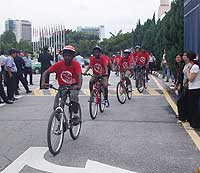 The memos, to be presented to Prime Minister Abdullah Ahmad Badawi and Opposition Leader Anwar Ibrahim, contain economic demands such as calls for the enactment of a Minimum Wage Act, adequate housing for all, price controls for essential goods, and an end to the privatisation of water supply, health care, education and other basic services.
There are also pro-democracy demands such as the repeal of oppressive laws and the re-introduction of local town council elections, which were suspended in the 1960s and 70s.
The bicycle campaign has been endorsed by 47 civil society groups, federal-level opposition political parties belonging to the opposition Pakatan Rakyat and some of their parliamentarians and state assembly members.
Confronted by cops, both north and south
On Monday, the teams encountered police action typical of the sort they experienced since the start of their journey. Both cycling teams were confronted by police as they approached Kuala Lumpur from the north and south.
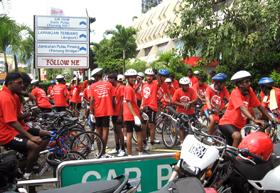 Of the 59-member northern team, about 30, including organisers, were arrested for illegal assembly. Another 27 cyclists below 18 years of age were held by police for their parents to collect them. Police are also holding on to their bicycles, says one of the Jerit organisers.
Selangor police chief Khalid Abu Bakar said the arrests were made to stop children from being exploited or misused by irresponsible groups.
"When giving their statements, these children said they did not know why they were asked to participate in the cycling event," he was quoted as saying by the national news agency Bernama.
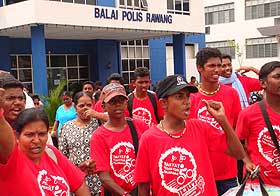 Organisers disagree. ''Many of those below 18 are children from areas where there have been struggles - land struggles, plantation workers fighting eviction from their homes or other similar struggles,'' says Rani Rasiah, a Jerit coordinator.
''Others are children of activists, like my son who is taking part, and there are also cyclists from the public who have joined in.''
By Tuesday afternoon the 27 teenage riders were released but only after their parents turned up to vouch for them. Nearly all of them said they wanted to continue cycling, but the last leg of the journey could be scaled down to avoid further delay.
''The children are saying they won't leave until all the organisers and their colleagues are released,'' said Rani. ''They are very spirited and angry with the harassment.''
Tailed by police cars
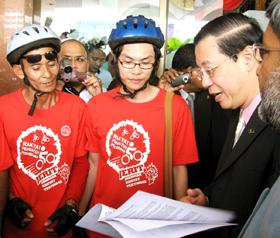 Over in the south, some 20 organisers and 37 cyclists, about 20 of them below 18, were threatened with arrests after a convoy of a dozen police vehicles had tailed them in the morning. After a five-hour stand-off in the afternoon near the town of Bangi, the cyclists were 'released'.
"All the youths have consent letters from the parents," Kohila Yanasekaran, national coordinator of Jerit told IPS. Organisers lodged a police report against the police on Tuesday, while the parents are expected to make a similar complaint.
One text message, making the rounds, jokes that all these arrests are a bit late: they should have been made 67 years ago, when Japanese forces on bicycles were invading Malaya on their way to Singapore during World War Two.
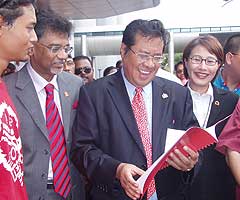 Along their way to Parliament, the Jerit teams have already submitted memorandums to the state governments in Kedah, Penang and Perak - all ruled by Pakatan Rakyat - as well as Negeri Sembilan and Johor, both of which come under the ruling Barisan Nasional coalition.
So far, chief ministers of three Pakatan-ruled states - Penang, Perak and Selangor - have personally endorsed the campaign.
Widest income disparity in Southeast Asia
The onset of the global economic stagflation has added to the workers worries in this export-oriented economy. Neo-liberal economic policies since the 1980s had already taken their toll among workers, especially marginalised communities who are finding it hard to make ends meet. Privatisation of essential services has added to the burden of ordinary workers.
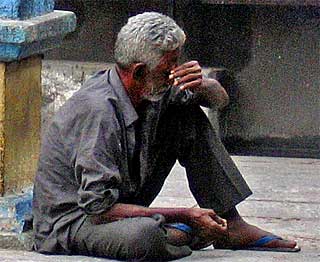 Urban-rural income disparities remain high and despite its relatively high human development, Malaysia has the widest income disparity in Southeast Asia with the top 10 percent earning 22 times what the bottom 10 percent earn.
Many plantation workers and urban settlers have been dispossessed of their homes with minimal compensation as landowners turn to property development.
Although the official benchmark for measuring poverty is a household income of around RM700, many believe the real poverty line should be closer to RM2,000. If that benchmark is used, 38 percent of Malaysian families could be classified as low-income and struggling.
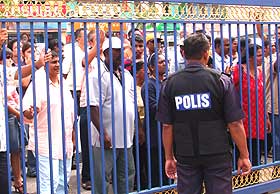 Activists were due to submit a memorandum to the Selangor chief minister before delivering their memorandums to Abdullah and Anwar today.
How they will get there, in the face of police action, is another matter, says Kohila. She vowed to complete the 16-day journey in Parliament - whether by walking, cycling or taking a bus.
Whether they succeed or not, their campaign message has already received publicity beyond anything the cyclists could have expected.
- IPS


Are you sure you want to delete this comment?
This action cannot be undone.