




Najib's fallacious 'majority' in Perak
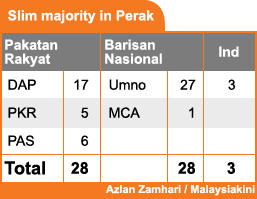
Deputy Prime Minister Najib Abdul Razak announced in a press conference yesterday that even though the Perak state assembly is tied between Pakatan Rakyat and Barisan Nasional at 28 seats each, he had the support of three ‘friendly independents’ for the national coalition to form a majority state government.
Deputy Prime Minister Najib Abdul Razak announced in a press conference yesterday that even though the Perak state assembly is tied between Pakatan Rakyat and Barisan Nasional at 28 seats each, he had the support of three ‘friendly independents’ for the national coalition to form a majority state government.
Najib’s claim of the majority of three is fallacious, because his so called ‘friendly independents’, former PKR assemblymen Jamaluddin Radzi and Osman Jailu, had already resigned on Feb 1.
When Speaker V Sivakumar received their letters of resignation on Feb 1, he announced on the same day that he had accepted the resignations and declared, "They have stepped down as state assemblypersons with immediate effect". Hence, these two men legally ceased to be assemblymen upon the speaker’s announcement.
 Subsequent announcement by the Election Commission (EC) that these two men remained assemblymen had no legal effect on their status, as the legal authority to accept resignation and hence determine assemblymen’s legal status within the assembly is vested with the speaker and not with the EC.
Under our laws, only a conclusive judgment in the court of law can restore the assemblymen status of these two ex-PKR members.
 As for the third so-called ‘independent’, ex-DAP assemblywoman Hee Yit Foong, she was reported to have resigned from the state assembly on Feb 4.
Sin Chew Daily
today reported that Sivakumar faxed a statement to the press at 5pm yesterday stating that he received Hee’s resignation letter on the same day at 8.10am and that he had already accepted her resignation, and he would soon contact the EC to arrange for a by-election within 60 days.
As for the third so-called ‘independent’, ex-DAP assemblywoman Hee Yit Foong, she was reported to have resigned from the state assembly on Feb 4.
Sin Chew Daily
today reported that Sivakumar faxed a statement to the press at 5pm yesterday stating that he received Hee’s resignation letter on the same day at 8.10am and that he had already accepted her resignation, and he would soon contact the EC to arrange for a by-election within 60 days.
With this latest resignation from Hee, the Perak assembly is tied at a 28 versus 28 stalemate.
This is a classic case of a political impasse that can be resolved by dissolving the assembly for a fresh election.
Sultan of Perak must make wise decision
As a constitutional monarchy practicing parliamentary democracy, it is the Sultan of Perak who dissolves the assembly under the advice of the mentri besar.
 Mentri Besar Mohd Nizar Jamaluddin has already had an audience with his Highness and is waiting for his consent for the dissolution.
In a country practicing democracy, consent for dissolution on legitimate ground is rarely withheld from the constitutional head, in keeping with the spirit of democracy which dictates that the people must be final arbiters as to who should form the government.
In the current Perak case, withholding consent to the incumbent, or worse, appointing a new mentri besar from the opposition at this time could plunge the state into dangerous and prolonged political turmoil when current political ambience is characterised by daily dramas of assemblymen ‘disappearing’ or ‘hopping’ or ‘double-hopping’ or even being ‘kidnaped’.
A wise decision from the Sultan at this critical juncture of history will go a long way to enhance the people’s faith in our system of constitutional monarchy, besides restoring stability to Perak, and improve the political ambience to the nation.
KIM QUEK, a retired accountant, is member of opposition party PKR.


Are you sure you want to delete this comment?
This action cannot be undone.