




Salehuddin tasked to shift PKR to full multiracial mode
After two rounds of endorsement last weekend, the first at an assembly of its leadership corps and later at a supreme council meeting, PKR secretary-general Salehuddin Hashim is poised to bring changes to the party to reflect the country’s multi-racial political culture.
After two rounds of endorsement last weekend, the first at an assembly of its leadership corps and later at a supreme council meeting, PKR secretary-general Salehuddin Hashim is poised to bring changes to the party to reflect the country’s multi-racial political culture.
Both meetings were convened to hear party supremo Anwar Ibrahim propound the opposition party’s philosophy and to answer attacks from its main adversary Umno, now in the final stages of a leadership change that is expected to ratchet up the pressure on PKR.
As a response, Anwar has fortified the position of PKR secretary-general, hitherto a vestigial role wholly unsuited to the instincts of its current incumbent.
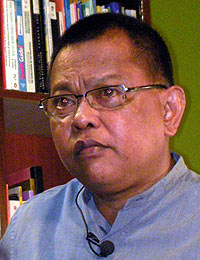 A professional administrator who disdains career politics (“I too much of a free spirit”), Salehuddin has been chafing at the bit because of the runs made round him by PKR minions.
Disliking directives he issued, they take their case to party supremo Anwar and at times succeed at circumvention. No doubt, fidelity to Anwar in his time of duress afforded them IOUs they could cash with some impunity.
As everyone knows, PKR is the lengthened shadow of Anwar so Salehuddin, an ally though not an acolyte of Anwar, has had to put up with this exasperation until it reached the point where he asked himself “whether I viewed my role as a vocation in which case I bite my tongue and carry on or” here his voice trailed off as he shoved his outstretched palms upward, in the manner suggesting someone who has lumped it.
Appointed PKR secretary-general in April last year, succeeding to a long line of placemen rather than professionals, Salehuddin brought a “disinterested interestedness” to the role.
“The disinterest lay in the fact I was not keen on career politics,” said Salehuddin, in an interview with Malaysiakini shortly after it was confirmed he had been ceded the responsibility to take the party from a swarm of individuals galvanised into action by the mistreatment dealt Anwar in the late 1990s to a national movement with a coherent and consistent message of change.
“My interest lay in what I saw three years ago, that PKR were going to do well in the multiracial constituencies in the upcoming general election,” he said of the time in 2006 when he played supportive roles in the party’s operations in the Federal Territory which has several mixed-race constituencies he felt were fertile grounds for the fledgling party.
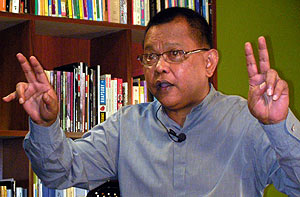 “When indeed PKR did well in those constituencies and that was followed by Anwar asking me to step up to secretary-general, I knew what I had to do – translate the mandate of multi-racialism into a culture within the party,” he added.
Membership of PKR now stands at the half-million mark, up from about 400,000 since the general election a year ago. Its predominantly Malay ranks have been watered down by the infusion of Indians and Dayak Malaysians in recent months, a trend that Salehuddin predicts will accelerate.
“The response we are getting from the Dayaks in Sarawak and from the non-Malays would increase our party’s multi-racial flavour. This is good all-round, for the future of the party and country,” said the man who virtually from his adolescent years in Ipoh was schooled by his father, a one-term PAS parliamentarian, in multi-racialism.
Like father, like son
Salehuddin’s father, Hashim Gera, was elected MP for Parit in the 1969 general election.
A product of the Sultan Idris Teachers Training College in Tanjong Malim, Hashim taught in schools, some Chinese-medium ones, in Tapah and later in Ipoh, before plunging, more by chance than by design, into the electoral fray in 1969.
Hashim, who is fondly known as Cikgu Hashim, was selected almost as an afterthought by PAS which had ready candidates for their strongholds of Bukit Gantang and Gunong Semanggol but not for Parit, which was why they rounded in on the unassuming but popular school teacher.
Cikgu Hashim unexpectedly won against the redoubtable Hussein Noordin, top editor at the Utusan Malaysia. It was a giant-killing feat but ballroom dancing enthusiast Hashim ran afoul of PAS because of a sensational picture of him doing the joget, frontpaged in the Utusan.
Also, he offended then PAS mogul Asri Muda when he spoke out of turn in responding to the Royal Address when Parliament reconvened in 1971 after being prorogued for two years because of the May 13 disturbances.
Cikgu Hashim paid the upstart’s forfeit in expulsion. But his multi-racialism never waned and was passed on to his eldest son, Salehuddin. Now the son is heir to the multi-racial man that Cikgu Hashim was.
“We have to make PKR a microcosm of the multi-racial polity that the party has embarked to bring about in Malaysia,” argued Salehuddin. “We have to deepen our talent pool, we have to attract members from the spectrum of the professions and occupations.”
He elaborated: “Our (party) divisions in specific localities must attract members from occupations and trades related to those areas. Thus we will have knowledgeable members who can contribute, not people for whom politics is a crutch and for that reason susceptible to the seductions of money and power.”
Salehuddin’s exertions are likely to cut the ground from under the feet of PKR’s territorial barons, preoccupied with their own fiefdoms, pursuing their own aggrandisements, and prosecuting their own feuds.
“We must allow talent to flourish and prevent little Napoleons from making the party their stomping ground,” said the man, unburdened by ambition for self and freshly mandated to take the party his early upbringing visions have intimated was viable for the creation of a new Malaysia.


Are you sure you want to delete this comment?
This action cannot be undone.