




Not even half Malaysian
Children are a blessing.
Say this to any Malaysian and they will generally agree with you. A child makes a family, and many countries (Malaysia included) exhort their population to produce more children. Children enrich their families by bringing joy and laughter, and enhance their nations by providing tomorrow's leaders and workforce.
One would think that a country like Malaysia, rich in resources and wanting the population to expand, would do its best to claim as many children as it can as Malaysians. Unfortunately, this is not the case.
Two years ago, Jamilah A (not her real name) became pregnant with her first child. She was shocked, dismayed and angry to discover that her baby would not become a Malaysian unless he was born on Malaysian soil. She took the decision to fly back to Kuala Lumpur whilst seven months pregnant. Now, pregnant again, she faces the same prospect.
Children are a blessing.
Say this to any Malaysian and they will generally agree with you. A child makes a family, and many countries (Malaysia included) exhort their population to produce more children. Children enrich their families by bringing joy and laughter, and enhance their nations by providing tomorrow's leaders and workforce.
One would think that a country like Malaysia, rich in resources and wanting the population to expand, would do its best to claim as many children as it can as Malaysians. Unfortunately, this is not the case.
Two years ago, Jamilah A (not her real name) became pregnant with her first child. She was shocked, dismayed and angry to discover that her baby would not become a Malaysian unless he was born on Malaysian soil. She took the decision to fly back to Kuala Lumpur whilst seven months pregnant. Now, pregnant again, she faces the same prospect.
It turns out there are only three ways in which to obtain Malaysian citizenship:
a) be born in Malaysia to at least one Malaysian parent
b) have a father who is Malaysian
c) apply for citizenship after years of waiting, and enduring more waiting after applying whilst Immigration officials make a decision
Marry Malaysian
Therefore, should a Malaysian woman marry a foreigner and set up home abroad, the fact that she has the right to vote in Malaysian elections, have familial and financial ties to Malaysia and carries a Malaysian passport, matters not a jot to the Malaysian authorities if she becomes pregnant. Her status as a Malaysian citizen means nothing if she gives birth overseas simply because she is a woman.
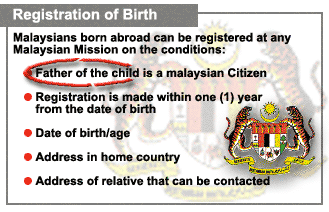 This is extremely unfair. Why are Malaysian women denied the right to pass on their citizenship to their child if they give birth overseas?
We all know that when it comes to pregnancy, it is the woman who carries most, if not all, of the burden. Most people, indeed most societies, do their best to help pregnant women shoulder the burden, yet the Malaysian government seem bent on creating ever more burdens on the expectant expatriate mother.
These women have to do what Jamilah endured if their child is to become a Malaysian - board a plane (they can't even shop arbtw keep mound for the best deals as they must fly with Malaysian Airlines - in international law, a country's official air carrier is acknowledged as being part of the country's territory) whilst heavily pregnant, then go through endless Sila Ambil Nombor (ticket count) sessions at JPN, Immigration and foreign embassies to register the child just days after giving birth (and if her stitches rupture whilst she is traipsing up and down these places, tough).
The expatriate father meanwhile, only has to stroll to the nearest Malaysian Embassy or High Commission to register his child.
Thus, the Malaysian mother, whose body is undergoing major changes, has to go back to Malaysia whilst heavily pregnant (a 13-hour flight from London is unpleasant enough at the best of times - think what it must be like for a pregnant woman), yet the Malaysian man, whose body has gone through no hormonal or physical changes over the course of his wife's pregnancy, need only go to the nearest Malaysian mission.
This law also has other consequences.
Money, money, money
Not all Malaysian women who live abroad can afford to up sticks and head home just because she is pregnant (apart from the high cost of travel, one also has to consider taking the time off work; in addition, some women go through very difficult pregnancies, and would probably be prohibited from travelling anyway), so what happens to the Malaysian woman who gives birth overseas in a country that does not automatically confer citizenship to a child upon birth?
This is precisely the situation one woman found herself in a few years ago in Australia. This woman had been held at a detention centre in Villawood with a deportation order hanging over her for immigration-related offences. She had a young child whose father was not an Australian citizen. In Australia, if both parents are non-Australians, citizenship is only conferred upon children who were born and had lived the first 10 years of their lives there.
This poor child did not qualify for Australian citizenship. Neither did she qualify for Malaysian citizenship. The child, through no fault of her own, in effect became stateless. That the Malaysian government allowed this to happen is reprehensible - the child of a Malaysian citizen is cast adrift simply because her Malaysian parent happened to be her mother, not her father.
Furthermore, this law is ensuring that Malaysian women abroad remain abroad. For example, a Malaysian woman marries a foreigner and sets up home abroad (it is of course, notoriously difficult for foreign male spouses to obtain residency and work permits in Malaysia, and also, should a Malaysian woman be unlucky enough to fall in love with, and marry a foreign worker in Malaysia, they would both have to move abroad as the man's work permit would be revoked; foreign female spouses however, are granted dependency permits which allow them to reside and work in Malaysia).
Being Malaysian is not possible
She finds it impossible to return home to Malaysia to give birth. Then her marriage breaks down. At this point, should she decide to head home, her child would only qualify for short-term social passes. She and her child would either have to keep going out and back into the country, or go to the Immigration department to renew this pass. It would take years before the child qualifies for Malaysian citizenship, and this is by no means a foregone conclusion.
It is of course, not the government's fault that this law exists - it is enshrined in the Federal Constitution, and when the Federal Constitution was written, we had a different society.
However, now it is the government's fault that the Malaysian woman does not enjoy equal rights with her male counterpart - consider this: though the foreign wife of a Malaysian citizen faces restrictions on the right to settlement and work in Malaysia, she has more rights than the Malaysian woman when it comes to getting Malaysian citizenship for her child.
Singapore too, had such a law on its statute books, but its government is now making moves to rescind this law so as to allow Singaporean women giving birth abroad to pass on their citizenship to their child. When is our government going to follow suit?
FARAH FAHMY is based in the UK. She is a frequent contributor to Rentakini. You may contact her at farah.fahmy@rocketmail.com.


Are you sure you want to delete this comment?
This action cannot be undone.