




Memoirs of a militant schoolboy: The second year

Apart from the normal mischief demonstrated by kids, hostel life was peaceful and good in general. By this time, when we were in second form, everyone understood the rights and wrongs, the haram and the wajib (the sinful and compulsory).
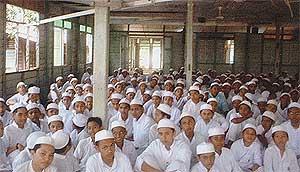
Soon, usrah (religious gatherings) was organised on every weekend. It was what we called 'usrah umum', and the holy brothers tried to make sure that everyone attended the occasion which commenced after Isyak and went right up until late at night.
Speakers were normally about five to six from the top echelon of the much respected holy brothers, among others:
- Abang D - the most senior and quite a mellow chap

Apart from the normal mischief demonstrated by kids, hostel life was peaceful and good in general. By this time, when we were in second form, everyone understood the rights and wrongs, the haram and the wajib (the sinful and compulsory).
Soon, usrah (religious gatherings) was organised on every weekend. It was what we called 'usrah umum', and the holy brothers tried to make sure that everyone attended the occasion which commenced after Isyak and went right up until late at night.
Speakers were normally about five to six from the top echelon of the much respected holy brothers, among others:
- Abang D - the most senior and quite a mellow chap
Usrah
 Subsequently, some selected juniors were organised to form specialised
usrah
groups. These groups were in tens, headed by two seniors. We normally met after Asar on the weekends. Groups were given names, from our idols whose thoughts and books were our guidance and their struggles were our wishful path Syed Qutb, Hassan Al-Banna, etc. We were told they were martyrs, murdered by anti-Islamic and infidel governments. We even praised the assassination of Anwar Sadat, one of the impostors.
Subsequently, some selected juniors were organised to form specialised
usrah
groups. These groups were in tens, headed by two seniors. We normally met after Asar on the weekends. Groups were given names, from our idols whose thoughts and books were our guidance and their struggles were our wishful path Syed Qutb, Hassan Al-Banna, etc. We were told they were martyrs, murdered by anti-Islamic and infidel governments. We even praised the assassination of Anwar Sadat, one of the impostors.
We were the apprentices, 'trained' to be the next group to uphold the rights and wrongs when the seniors left the school in due course.
In the East Coast, as mentioned earlier in my email to you, the recent splinter between an Islamic party and the ruling group had turned into a very nasty divorce. They became great enemies; it was a 'either with us or against us' game. Many things that were amicably agreed during their short marriage had been declared void and null.
One of the main factors might be from the sermon delivered by the man from Rusila at Benggol Peradung. What happened next? His followers took a section of that speech and turned it into a holy decree. A decree which declared the other group as possible impostors, infidels and even non-believers. More decrees were issued from the mimbar of Rusila Mosque, which was now seen as the guidepost by many.
Behind our hostel blocks, there was an old wooden mosque, just about 3 metres away from the school fence, on the other side of the dirt track. For decades, it had been the main mosque for the village. Besides being the place we went for Friday prayers, on many occasions we used its water for our bath as adequate water supply was really a problem in our school then.
Mosque A, mosque B
Nearby, a brand new modern mosque was under construction; a project which was initiated during the infamous marriage of the parties years before. The old mosque was to be down-graded into a surau and Friday prayers were to be conducted at the new mosque.
Like divorce, both parties had their own versions to tell. Some members of the local community ruled the new mosque illegitimate, as the old mosque on a 'tanah wakaf' was still functional, hence, no new mosque could exist in the same locality. They decided to stick to their old one, no matter what. And we concurred.
The opening of the new mosque by the Sultan didn't make any difference. Friday prayers were conducted at both mosques which were a few hundred metres apart. Though the majority of the boys went to the new mosque, a group of 'the hardcores' attended the prayers at the old.
By the second or third Friday, the state religious authority decided to extend their strong arm. One Friday afternoon, men in red helmets, batons and riot shields came by truckloads and surrounded the old mosque. The atmosphere was very tense. Thank God, nothing nasty happened, but we were told that would be the last ever Friday prayer to be conducted there.
Not easily defeated, the next Friday, the village hardcores organised yet another separate prayer. This was at a house (which was still under construction) belonging to one of the followers, a distance away though. We were picked up by a few cars and brought to the new place of congregation. It went on like this for a few Fridays. I must stress that it was only a small group of us, probably about 20 or so.
The path we chose
Soon, the school knew that 'an affirmative action' had been taken. From then on, we were watched by wardens and teachers. There was no escape. We went along, but not without plan.
At the new mosque, our holy brothers said that the imam did not recite the Surah Al-Fatihah correctly. A few brothers confronted the old imam after the prayer and heated arguments started. He was extremely annoyed; a bunch of schoolboys telling him off? He firmly stood his ground and our brothers were equally stubborn. The next Friday, a brother brought a small recorder and recorded the imam's recitation and another heated argument broke up.
Very soon, a decree was declared by the band of holy brothers. I cannot actually recall the right justification; was it the old mosque-new mosque issue, or the recitation issue, or both. It was declared that Friday prayers at the new mosque was null and void. Forced (by the school) to attend the new mosque, with our heavy hearts we obeyed. At the same time, a group prayer for Zohor was conducted as 'qada' (replacement prayer)at our school surau soon as we came back from the mosque. We felt we had to do it, we had no choice. It was the best alternative and we were told to believe that right path was not without struggle and tribulations. We felt holier
I AM MUSLIM is a column about Muslims in all stripes and sizes. You may contact Dina at dina@malaysiakini.com .


Are you sure you want to delete this comment?
This action cannot be undone.