




test
TESTING
Malaysia vs the world: How are we doing in fight against Covid-19?
Fifty days after Malaysia recorded its first Covid-19 case, the country came to a turning point on March 15, as it began to consistently record more than a hundred daily cases.
Three days later, Malaysia entered into a partial lockdown under the Movement Control Order (MCO).
Malaysia is not alone in facing a spike in Covid-19 infections, sparked by mass gatherings.
For some countries, the next phase is a paralysis of the healthcare system and mounting death. For other countries, they've succeeded in "flattening the curve" and averted, or postponed, disaster.
This article compares the trends of the Covid-19 pandemic in Malaysia and other countries and looks at what are the lessons to be learnt.
The chart below allows readers to compare Malaysia with other countries. Please note that the reported cases depend on a country's ability and capacity to test for Covid-19.
South Korea
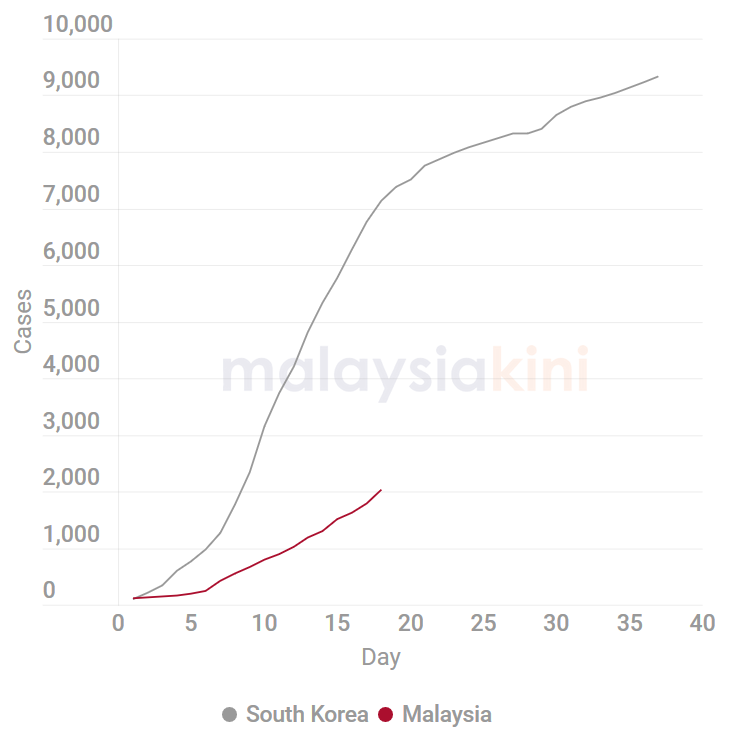
By late February, the Covid-19 situation appeared grim for South Korea. It had the most number of cases in the world, outside of China.
South Korea initially had low numbers of mostly imported cases which were quickly contained, but on Feb 21, the country
saw more than 100 new cases in a day, which was sustained for the next 20 days.
The spike was traced back to Patient 31, who attended mass
gatherings on Feb 9 and Feb 16 by the Shincheonji Church of Jesus in Daegu. This cluster would go on to see more than 5,000 infections.
Amid accusations that the Church was being uncooperative, authorities raided its headquarters and seized a name list of 42,000 followers. Contact-tracing was aided by mobile phone and credit card records.
The country rolled out mass testings, administering 15,000 to 20,000 kits a day. It pioneered "drive-through testing", taking just 10 minutes and those tested are notified by text message within a day. Soliders were mobilised for disinfecting works.
Through aggressive testing, contact-tracing and quarantine, South Korean succeeded in "flattening the Covid-19 curve" after the initial spike in cases. During this time, eight other countries overtook South Korea in case tally.
South Korea also repurposed buildings such as training centres to house Covid-19 patients with less severe symptoms while hospitals are reserved for more severe cases.
Those with mild symptoms are allowed to self-quarantine but are monitored by a state-sponsored mobile app to ensure they stayed put. South Korea also has one of the highest hospital bed to population ratio in the world.
The measures have been attributed to South Korea's low Covid-19 mortality rate of 1.5 percent.
South Korea managed this without going into a full lockdown and emergency measures were limited to the worst-hit areas, a strategy which has been hailed as a model for democratic countries.
However, the country is not out of the woods as new Covid-19 clusters continue to emerge, but at manageable levels. To date, it has recorded 9,332 cases and 139 deaths.
Malaysia
Similarly to South Korea, Malaysia's trigger was a religious gathering in Sri Petaling attended by more than 10,000 locals from Feb 27 to March 1.
The first local infection from the event came on health authorities radar on March 8, when a patient sought treatment at Bentong Hospital and was confirmed to be positive with Covid-19 on March 10.
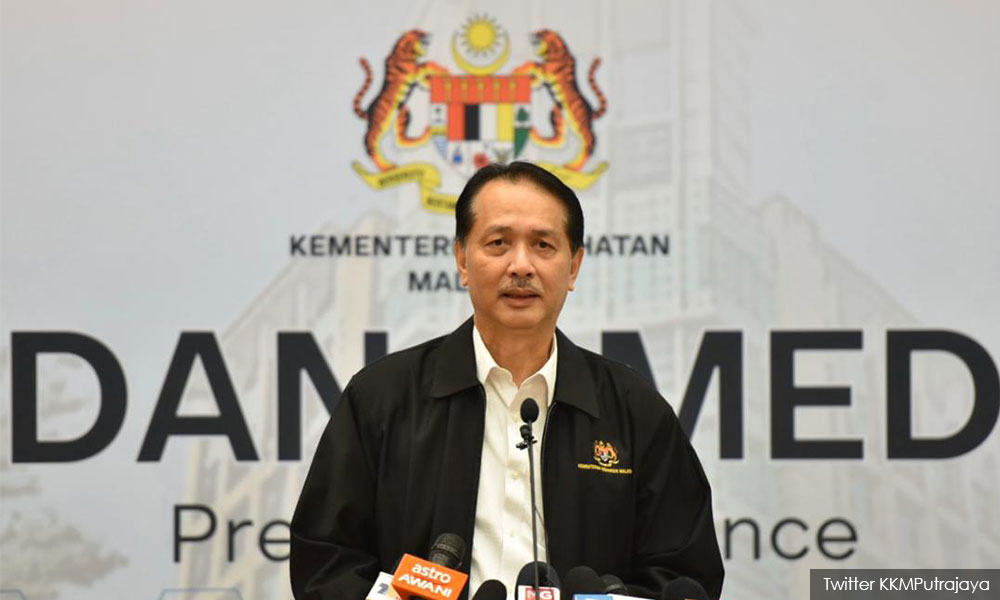
From the onset, Malaysia had adopted testing and contact-tracing but is now scaling up. Health Ministry director-general Noor Hisham Abdullah, during his Covid-19 briefings, repeatedly reference South Korea's testing capabilities.
South Korea, which has battled Covid-19 for longer, has to date conducted more than 357,000 tests (7.0 per 1,000 population). Malaysia has, as of yesterday, done 22,000 tests (0.67 per 1,000 population).
Noor Hisham said Malaysia could previously conduct 3,500 RPT-PCR tests for Covid-19 in a day, has scaled up to 6,000, and will be doing 16,000 by next week.
He added plans are afoot to increase it further utilising antigen-based rapid testing kits. Once implemented, this would be impressive numbers considering Malaysia's estimated 32.6 million population compared to South Korea's 51.3 million.
The enhanced testing capacity has allowed Malaysia to shift strategy, where even asymptomatic patients are tested, but for now, only for groups deemed "high risk" such as those in the Tabligh cluster.
Other measures announced also suggests Putrajaya is emulating South Korea. This includes converting medical institutes to house 1,892 beds. This is on top of around 3,400 beds across all public hospitals.
"This way, we can free the beds in hospital wards for more serious cases," Noor Hisham said. However, Malaysia has one major shortcoming - the ratio of hospital beds to population.
According to former health minister Dr Dzulkefly Ahmad, Malaysia only has a ratio of 1.98 hospital beds to 1,000 population in 2018, below the 2.5 beds average for a country aspiring developed status. This includes beds in both public and private hospitals.
In contrast, Organisation for Economic Cooperation and Development (OECD) data showed South Korea has 12.3 hospital beds to 1,000 population in 2017, more than six-fold above Malaysia.
This means if Covid-19 cases continue to mount, Malaysia will hit maximum capacity much sooner and will require more drastic measures.
Tougher measures compared to South Korea - including a 28-day
partial lockdown - could reduce the risks of Malaysia being put in such a situation.
The low hospital bed ratio was, in part, aggravated by years of underinvestment and mismanagement in public health, such as the granting of the Bera Hospital project to an unqualified contractor resulting in years of delay.
Similar issues have also hit Shah Alam Hospital, Sultan Aminah Hospital, Klang Hospital, Kota Kinabalu Hospital, Alor Gajah Hospital and Sri Aman Hospital.
At writing time, Malaysia has recorded 2,031 cases with 24 deaths. With sufficient beds for now, the mortality rate is similar to South Korea.
Singapore
Singapore has avoided a lockdown, taking incremental measures based on the Covid-19 situation in the country.
Singapore has dealt with several infection clusters but the country is fortunate not to have a cluster on the scale such as the Tabligh gathering in Malaysia or the Shincheonji Church of Jesus gatherings in South Korea.
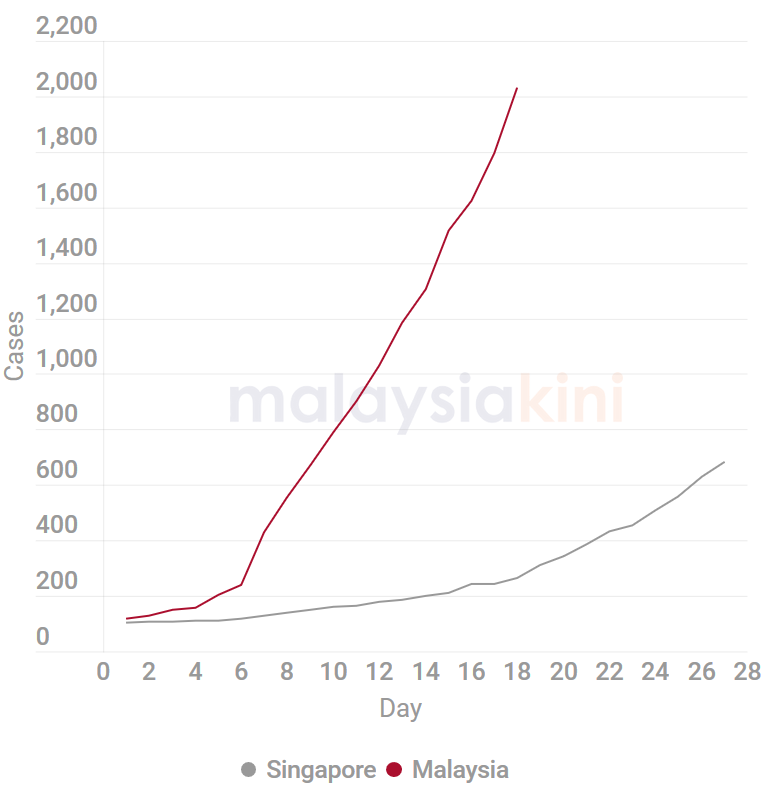
While it's aggressive testing, contact-tracing and quarantine efforts have helped slow the spread of Covid-19 in Singapore, the country has also harnessed innovative techniques.
This includes the introduction of a mobile app to assist the government with
contact-tracing. Science, Technology and Innovation Minister Khairy Jamaluddin said plans are afoot to emulate this.
Singapore's science agency is also producing a new rapid test kit, based on RPT-PCR, that can detect Covid-19 infections within 10 minutes.
A PRT-PCR test is more favourable as it targets the virus, which will return a positive result for an infected person sooner. The standard RPT-PCR test takes up to a day.
An antibody test looks for antibodies which
appears five to eight days after infection, meaning an infected person can test negative for up to a week.
Malaysian firms have been pushing to produce rapid testing kits but many of these are antibody-based, which Noor Hisham has spoken unfavourably about.
Singapore is also reserving beds in public hospitals for more severe Covid-19 cases and transferring patients who are recovering well but still shedding the virus to private hospitals under a public-private arrangement.
Even though there is no lockdown, Singapore ramped up social distancing
measures, cancelled mass gatherings, imposed entry approval and strict 14-day stay-at-home order
for overseas arrivals. Those who defy the order have had their work permits revoked.
As of 2016, Singapore has 2.5 beds for every 1,000 population. To date, it has recorded 631 cases and two deaths.
US and Europe
The US took the early measure in February by imposing a visa ban on travellers from China, where the virus began.
But its testing regime in the initial stages was plagued with
problems. The Centre for Disease Control produced 160,000 defective test kits, at a time when testing is crucial so as not to lose track of the chain of infection.
However, it was able to significantly improve capacity in a short time with 540,000 tests done, more than South Korea. But owing to the US' large population of 330 million, it is equivalent to 1.6 tests per 1,000 population compared to South Korea's 7.0 tests per 1,000 population.
The US Senate on March 18 approved a bill for the government to
foot the cost of testing as the US does not have universal healthcare and those without health insurance are reluctant to get tested or treated.
In Malaysia, public hospitals are footing around RM700 per person for free tests.
As of today, the US overtook China to become the country with the most Covid-19 cases in the world with 85,594 cases and 1,300 deaths.
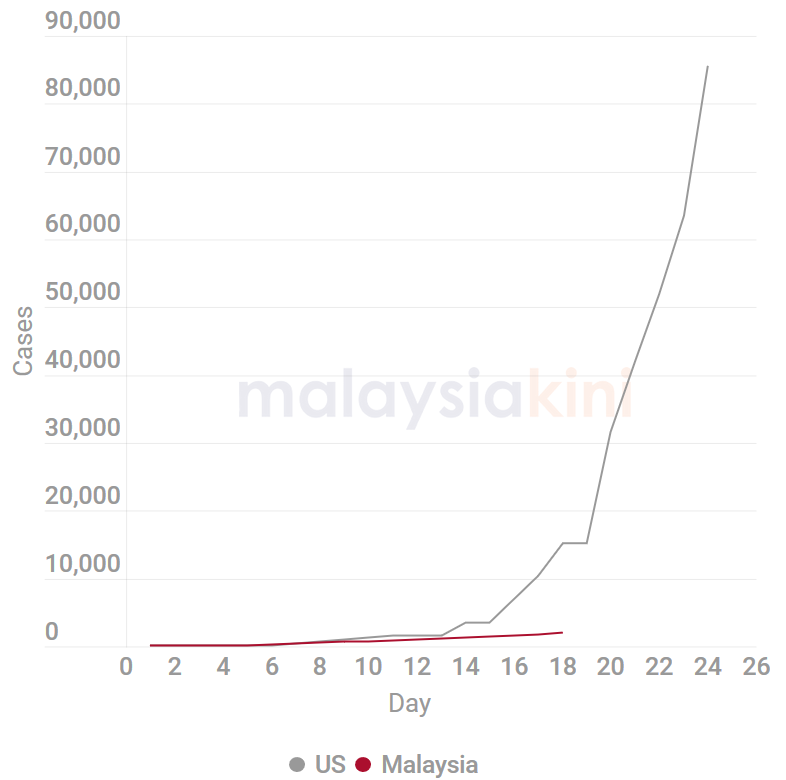
US states have also begun locking down cities. Lockdowns have devastating effects on the economy but the goal is to slow the spread (flatten the curve) so that hospitals do not become overwhelmed and patients can be treated properly, improving their chance of survival.
Amid the lockdowns, US President Donald Trump had said that "the cure cannot be worse than the problem". But state governors will have the final say.
Allowing the virus to spread at an exponential rate could see the outbreak ending faster and allow the resumption of economic activities but it may come at the cost of heavy casualties.
While other coronaviruses suggest that an infected person would later develop immunity, there is still no certainty for the relatively new Covid-19.
According to the OECD, the US has 2.8 hospital beds per 1,000 population in 2016. The US' current mortality rate is 1.5 percent.
Italy (80,589 cases; 8,215 deaths) and Spain (57,786 cases; 4,365 deaths), the two worst-hit countries in Europe, have 7.5 to 10 percent mortality rate.
Both countries have 3.2 and 3.0 hospital beds per 1,000 population respectively but due to the countries being significantly smaller than the US - less than one fifth - they have hit maximum capacity earlier. Spain has resorted to turning an ice rink into a morgue.
Furthermore, Italy and Spain have an older population with a median age of 45.5 and 42.7 respectively. In contrast, the median age of the US is 38.1 while Malaysia is 28.5. Older people face a higher mortality rate.
However, Germany (43,938 cases) which has among the top hospital capacity in Europe, with 8 beds per 1,000 population, has recorded 267 deaths, a mortality rate of 0.6 percent. This is despite having a median age of 47.1.
China
The first Covid-19 patient who visited a seafood market selling exotic animals had reported symptoms as early as the start of December 2019 but the local government in Wuhan, Hubei was slow to react and had reportedly tried to cover-up.
By the time the Chinese central government intervened in early January, the virus had spread widely, prompting a lockdown on several cities involving more than 50 million people. The outbreak happening near the Chinese Lunar New year aggravated the situation.
The measure differs from South Korea's and has been criticised as draconian but China has managed to bring the virus under control.
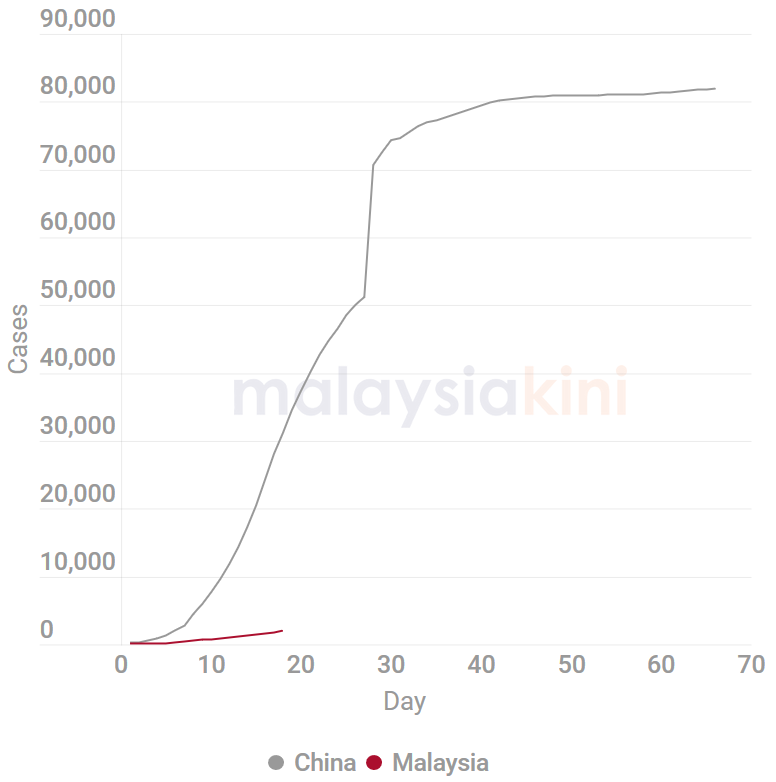
To date, China recorded 81,961 cases with 3,293 deaths, a mortality rate of around four percent.
China, which has experience in dealing with the previous Severe Acute Respiratory Syndrome (SARS) outbreak, appears to have anticipated a flood of cases and started building new hospitals using prefabricated modules as early as Jan 24. At that time, China recorded 830 cases.
Similarly to measures being undertaken by Malaysia, it postponed all elective surgery and started online medical consultation.
China also leveraged on specialised clinics, set up during the SARS outbreak of 2002, where people who believe they are infected can go to for a test instead of a regular hospital, thus minimising the risk of infecting other patients and medical staff.
Mobile applications were used to track the movement of citizens, drones used to enforce quarantine, contactless temperature scanner employed at every entrance and social distancing enforced.
Patients who are tested positive are not allowed to return home and are sent to isolation centres or hospitals.
Even though conducting contact-tracing for 80,000 patients and their close contacts appear monumental - it did it anyway, using a network of tracers built up during the SARS outbreak.
By the middle of February, China appeared to have "flattened the curve" after an initial explosive growth in cases due to the Wuhan government failing to act for almost a month.
It also asked recovered patients to donate blood, where plasma containing antibodies against Covid-19 is then extracted to treat existing patients. Malaysia is now exploring similar treatment methods.
China had for 10 consecutive days recorded less than 100 new cases but this has crept up slightly to the low 100s. It is now guarding against new outbreaks as well as imported cases but has eased lockdown restrictions.
China's example is indicative that for many countries, even after they bring Covid-19 under control, their way of life will never be the same for the near term as they must continue to be vigilant.
Likewise, even if Malaysia lifts its MCO on April 14 as planned, social distancing and other measures will need to continue so long as the virus is not completely eradicated from humans.
Keep up with the latest information on the outbreak in the country with Malaysiakini's free Covid-19 tracker.


