




Clinton starts Asia tour as N Korea tensions rise
US Secretary of State Hillary Clinton was to kick off an Asia tour in Japan Friday where both sides have condemned North Korea after investigators blamed it for sinking a South Korean warship.
The joint stance comes as Tokyo and Washington move to resolve a dispute over a controversial US base that has strained ties between the long-time allies since a centre-left Japanese government took power last year.
US Secretary of State Hillary Clinton was to kick off an Asia tour in Japan Friday where both sides have condemned North Korea after investigators blamed it for sinking a South Korean warship.
The joint stance comes as Tokyo and Washington move to resolve a dispute over a controversial US base that has strained ties between the long-time allies since a centre-left Japanese government took power last year.
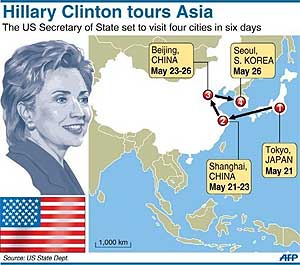
Clinton's trip, which will also take her to China and South Korea, starts off in Tokyo a day after a multi-national panel blamed North Korea for sinking a South Korean warship with a torpedo in March, claiming 46 lives.
 The United States and Japan, along with other world powers, have strongly condemned the reclusive, nuclear-armed regime and are expected to push for fresh sanctions against Pyongyang at the UN Security Council.
However, China, one of the five veto-wielding permanent members, has so far called for more evidence and urged calm, suggesting it will not jump to punish its communist neighbour, whose leader recently visited Beijing.
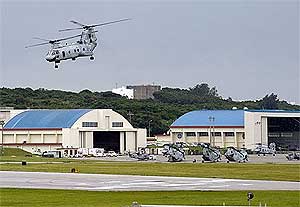
The rise in tensions in Northeast Asia comes at a time when Japan and the United States have squabbled over the fate of a US base on Japan's southern island of Okinawa, where most residents oppose a heavy US troop presence.
Japan's Prime Minister Yukio Hatoyama, after taking office in a landslide last year, proposed moving the base off the island to appease local sentiment, straining ties with the administration of President Barack Obama.
However, as the search for an alternative site in Japan has proved fruitless, Hatoyama has caved in to Washington's demand to honour a 2006 pact struck by previous conservative governments and relocate the base on Okinawa.
The United States, which under a post-war treaty is obliged to defend pacifist Japan, has insisted that its strategic Okinawa bases, close to Taiwan and the Koreas, are key to maintaining stability in the Asia-Pacific region.
Hatoyama is expected to announce next Friday that he will largely honour the base pact -- an issue that has sparked mass rallies and eroded his domestic support -- according to news reports published on the eve of Clinton's visit.
The premier has in recent days also conceded that deterrence provided by US forces in Japan was an important factor, and on Thursday pointed out to reporters that "now the Korean peninsula is growing tense".
Luke-warm on sanctions
South Korean President Lee Myung-Bak promised "resolute countermeasures" after the multinational investigation team said there was overwhelming evidence a North Korean submarine sank the 1,200-tonne corvette Cheonan on March 26.
 The United States, Japan, Britain, France and Australia were among nations that quickly condemned North Korea, which called the report "sheer fabrication" and threatened "all-out war" in response to any attempt to punish it.
Beijing is expected to stay luke-warm on sanctions, in part because it worries about heightened instability in impoverished North Korea and the threat of regime collapse and an influx of refugees, analysts say.
Japan's relations with North Korea have long been very tense. Pyongyang in the 1970s and 80s abducted Japanese citizens to train its own spies, and more recently fired missiles across the Japanese archipelago into the Pacific.
Hatoyama said in a statement Thursday that "the North Korean action is unforgivable and we strongly condemn it, with the international community."
His Foreign Minister Katsuya Okada said that "we would like China to take concerted action... The evidence is objective and I think we can trust it."


Are you sure you want to delete this comment?
This action cannot be undone.