




The sword, dagger, and keris
As a child, I was always fascinated by the mythical power of the Chinese sword.
There were times that I, without my parents' knowledge, sneaked into one of the cinemas in my hometown just to be entertained by the much awaited martial art movies produced in Hong Kong. The chances are, I would end up hypnotised by the atheistic yet dignified way in which the kungfu hero mastered his or her sword.
One of the greatest martial art movies of all times, and perhaps among the most classic in a century of Chinese films, is The Chivalrous Lady (Xia Nu), featuring the legendary actress Xu Feng. I was thoroughly mesmerised by the mystifying atmosphere, and the awesome, seasoned swordswomanship of the protagonist.
As a child, I was always fascinated by the mythical power of the Chinese sword.
There were times that I, without my parents' knowledge, sneaked into one of the cinemas in my hometown just to be entertained by the much awaited martial art movies produced in Hong Kong. The chances are, I would end up hypnotised by the atheistic yet dignified way in which the kungfu hero mastered his or her sword.
One of the greatest martial art movies of all times, and perhaps among the most classic in a century of Chinese films, is The Chivalrous Lady (Xia Nu), featuring the legendary actress Xu Feng. I was thoroughly mesmerised by the mystifying atmosphere, and the awesome, seasoned swordswomanship of the protagonist.
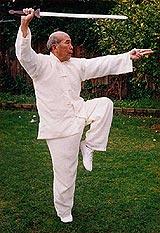 And I love martial art novels too. Like many Chinese around the world, I look up to Jin Yong precisely because he is arguably the greatest guru of Chinese martial art storywriting, having 14 solid works under his belt.
Among the books authored by Jin, the Legend of Yitian Sword and Tulong Knife is my all-time favourite. I must have read the book five or six times, and am always excited by the immense power that is unleashed when Yitian Sword and Tulong Knife meet one another.
My obsession with the Yitian sword did not just end there. The book was later made into a TV series and became an instant hit. Seizing the Yitian mania, the capitalist swung into quick action by saturating pasar pagi and pasar malam in my neighbourhood with toy Yitian Sword and Tulong Knife . I would have preferred having both. But the Tulong replica was so badly made that it was nowhere near the 'real thing' that I saw on TV, while the plastic Yitian sword thrilled me with its finely made appearance.
The bad news was that mom deemed it too dangerous, and she had had enough trouble of my making a sword replica out of a piece of plywood, giving her a bad name in the neighbourhood. I would go and challenge other kids for a competition, modelling on my imagination of the breathtaking Hua Shan Sword Competition, the ultimate test of one's sword skills in the world of martial art fictions. Mom could not have been more embarrassed.
True to my persistent nature when it comes to escapade, I skipped school lunches for a couple of weeks and saved up enough money to buy myself a Yitian sword. So proud of it was I that I even carried it with me to school, and I fully enjoyed the childish pleasure generated by the envious look of my peers.
Beyond cultural boundary
Though no harm had been done, a teacher notorious for his punitive nature later demanded that I turn in the sword. In pain, I parted with it to avoid meeting a severer fate. One day, the school bus that I was travelling on passed by the teacher's neighbourhood, and I watched with inconcealable horror and disgust that his son was showing off the sword which I still believed to be rightfully mine - to other kids. I could not help feeling utterly aggrieved and betrayed.
Years later, when a friend told me that a Malaysian customs officer confiscated his copy of Schindler's List video tape that he had bought from London, I recalled the fate that befell my Yitian Sword and comforted him by saying that his tape might have ended up in the good hands of the officer.
My admiration for swords is in fact beyond cultural boundary. Zorro, the legendary Mexican-American hero, continues to enchant me. Unlike Batman and Superman, who are equipped with magic powers that fools most of the kids, Zorro only has his righteous sword and skills to fight against the oppressive rule of the Spanish governor.
In September 1998, I ventured into the fascinating region of Xinjiang, China. The first place that I headed for was a Uighur market in Urumqi, the capital, because I had long been a fan of Uighur daggers. After some careful study and bargaining, I got myself a six-inch knife for around 20 Chinese yuan. A pretty good buy.
I then crossed over to a Han Chinese market to shop for some dates and dried fruits. A friendly lady vendor, noticing my foreign accent, asked if I came from abroad. She then kindly advised me to stay away from the Uighurs because 'they are all pick-pockets and armed with daggers'.
Tasting the dates, I said, "Well, Han Chinese carry daggers too."
She looked shell-shocked and probed further, "How is it possible? We are a civilised people."
"I have one in my bag. You wanna see it?"
She was not amused, and I swiftly disappeared into the crowd after paying up.
There is, however, a limit to my cultural affinities with swords. The image of the keris on the Umno flag, for one, never ceases to irritates me. Every year when the Umno general assembly is near, I would find myself making conscious effort to avoid using the roads in the area of PWTC because I do not want my eyes to be defiled by, literally, the flying keris in the sea of Umno flags. There is clearly no love lost between me and the keris.
Honestly, that a party resolved to produce towering Malays should reflect its political will in a sharp article is most bizarre, to say the least.
What was on his mind?
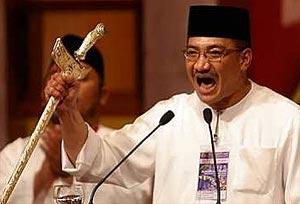 And I was even more puzzled when Hishammuddin Hussein, the head of Umno Youth, brandished a
keris
before the press. No, I am not suggesting a western-educated person like Hishammuddin should not engage himself in a salvage experiment such as this. I was (and still am) perplexed because, to me, swordsmanship in the old days was meant to execute justice and uphold integrity. In the case of Hishammuddin, I have seen neither but cheap and outlandish political stunt.
And I was even more puzzled when Hishammuddin Hussein, the head of Umno Youth, brandished a
keris
before the press. No, I am not suggesting a western-educated person like Hishammuddin should not engage himself in a salvage experiment such as this. I was (and still am) perplexed because, to me, swordsmanship in the old days was meant to execute justice and uphold integrity. In the case of Hishammuddin, I have seen neither but cheap and outlandish political stunt.
When Hang Tuah did it, he did it to show his feudalistic duty to defend the royal household even with his own blood.
When Zorro did it, he did it to cut short the misery of the downtrodden and the oppressed.
But what was on Hishammuddin's mind when he was flashing the keris for all to see? Was it a gesture of his determination to root out corruption? Or was it symbolic of his concern over the delinquency of the Malay youth?
Or was it just a warning to those who question the bumiputra policy? If he does think the Malays are in need of his bravery, who, really, is the enemy that he envisions? The 'evil' West or the 'greedy' Chinese?
Or was he merely seeking to demonstrate his resolution to head off any challenge to his party position in other words: pantang dicabar ?
All this, really, leaves me tormented by the vacuousness in this wasteland of racist rhetoric otherwise known as Malaysia. Yes, truly Asia.


Report this comment
Are you sure you want to delete this comment?
This action cannot be undone.