




Merdeka reflections
I realised with a start that it is Merdeka season in Malaysia once again.
 For some strange reasons, we are spared the orgy of outpouring of patriotism this year. The motor vehicles that fly the national flag are few and far between. So far, there has not been any report of silly people baking the world's biggest cake, sleeping with the greatest number of scorpions for the longest period of time, or sewing the biggest national flag in the world.
The lack of attempt to break the world's petty records does not make Malaysians less patriotic; it merely makes them less ludicrous, less insecure, and less immature politically.
A 42-year-old Malay citizen called in on a RTM1 Selamat Pagi programme, to complain that the younger generation of Malaysians show no interest in the history of our struggle for independence. Like most unimaginative Malaysians, he proposed that the schools be used to instil in the youths memories of the great achievement of our independence. What he did not realise is that schools are not the solution, but a post-independence problem in the first place.
In any case, Malaysian history as taught in schools is the national narrative dictated to by the brand of Malay ethnic nationalism that gave birth to Umno and kept them in power for half a century. It is not my history.
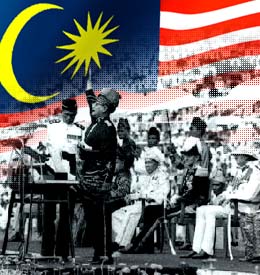 It is not the sort of history that I learned in Form 3, when I was taught about the evolution of parliamentary democracy and the separation of powers in England. We had to learn it in English too, in those formative years in the 60s, when the National Education Policy had yet to taint the proper purpose of education.
I would like to think that my education English has not made me an unpatriotic Anglophile. I pray to God to bless the soul of my late mother for insisting that I went to an English mission school in my secondary years. Today, that excellent school is still one of the best in the land, though bogged down and shackled by the National Education Policy. Its glory is very much diminished.
The national narrative as proclaimed proudly by successive Umno supremoes and written into school history texts is also not my history. I did live through those early years before and after independence. As I remember it, as an Anak Sarawak , Independence Day fell on September 16, in 1963. Such a day is well remembered by Sarawakians and Sabahans of my generation, but why should Umno and their millions of minions care?
In the self-consciousness of Umno, as guardians and executors of Malay destiny in their Malay homeland, only they can make history. Their ideology of Malay dominance is first manifest in their dominance of the powers to write and interpret Malaysian history. Their natural psychological impulse is what the historian Eric Hobsbawm calls "official nationalism".
Umno's Malay agenda
Therefore, for half a century, Umno has sought, and gotten dominance of all major institutions of state. The rulers of course have always been a significant symbol of Malay political powers, although the former PM did curtail somewhat the prestige of the palaces with his constitutional crisis in the 80s. The courts, the Parliament, the ministries, the secret services as well as the armed forces and the police are dominated by the Malays. Eventually, the banking and corporate sectors are also in the hands of the officially defined bumiputras.
The Malay Agenda of Umno in Malaysia has been implemented and achieved at great costs to the country. Millions of Malaysians those with the money and the talents - have migrated overseas to escape what is perceived as outright racial discrimination. Obvious protectionism for one race in the guise of "affirmative actions" has done great harm in impeding foreign and local investment. The entire nation has to bear the unseen costs of lost opportunities, capital flight, brain drain, enormously expensive failures of public and private enterprises, and endemic corruption.
Whether the agenda of the NEP has been achieved is subject to availability of reliable statistics, standards for measurement and framework of interpretation. In the end, it is to the advantage of Umno that the objectives are never fully realised, because they can then continue their ideology of domination in the name of social justice forever. It will keep Umno politicians in power for a very long time.
 But history real history or "effective history" has a way of thwarting human design envisioned by political parties and their ideologues. One cannot make and manipulate history as one manipulates lifeless atoms or machine parts. Human beings, even Malaysian human beings, are much less predictable than lifeless objects, simply because men and women are motivated by internal and external forces in ways that cannot be controlled entirely by anyone.
For instance, the solution to a set of problems proposed by political leaders creates in its turn a whole host of unforeseen insoluble problems. To give one simple example, the reliance of Malay businessmen on government assistance in terms of contracts and financing has meant that we have yet to see the emergence of a very competitive self-reliant bumiputra business community, especially in the all important small-medium industrial sector. The crutch will cripple Malay businessman in this world of rapid globalised market.
In this sense, you could say that the NEP and the addiction to racial quota have done a great disservice to the best of Malay businessmen and business women, big or small.
The judicial crisis
I make this observation not as a Chinese, or an Iban, or a Sarawakian, or a right-handed white-haired retired male. Wearing my "veil of ignorance" in an imagined "original position" after the fashion of John Rawls, I wish the Malays well, just as I wish all Malaysians well. The NEP has outlived its usefulness and should be reviewed radically for the sake of the Malays and for all Malaysians. The Malays do need a new set of political leadership with new ideas, to think and fight their way out of their racial and religious box.
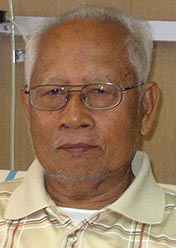 This article is actually motivated by news reports that the former Lord President of Malaysia Tun Salleh Abas (
right
) has broken his 18-year silence, and spoken out for righting the wrongs of his dismissal, during a constitutional crisis that saw the grievous erosion of the independence of the judiciary.
That incident, described as "shameful" by Yeo Yang Poh, president of the Malaysian Bar Council, mortally wounded the Doctrine of Separation of Powers that ought to be the bedrock of any democratic way of life.
I remember those days well, in August 1988, shortly before the first anniversary of Operation Lalang. I was sitting at the very much reduced opposition front bench, with many of my political colleagues then still detained in Kamunting under the ISA for various ridiculous charges that were never tried in court.
The constitutional; amendment that took away judicial powers was tabled, and my colleague Gooi Hock Seng from Penang had to lead the opposition in the debate, since Lim Kit Siang and Karpal Singh were not available. I did vote against the bill, but with thunderous applause, it was passed by the ruling party. The BN MPs were very proud of defeating the opposition, while I felt very ashamed of my country.
The tribunal that was appointed to determine the fate of Salleh Abas was also holding their meetings in Parliament House. It was not possible to enter and leave the building without sometimes rubbing shoulders with these gentlemen. Until today, I am convinced that Tun Salleh was not trialled by his peers, in the real sense of the word "peers".
Another tribunal was also set up to purge Salleh's brother judges who came to his aid. It was truly ugly business. The judges whom I had come to respect through my involvement with public life were removed and humiliated one by one. Five judges were suspended. The late Wan Suleiman Pawan Teh and George Seah (a fellow Sarawakian) were dismissed.
Greatness stunted
In the end, Malaysia as a whole has become a victim of this debacle. Our judiciary, which before 1988 was the pride of the nation among Commonwealth countries, never managed to recapture its past reputation. Until today, it is still not fully trusted as before.
The consequences are dire, though your common men and women on the street may not perceive the complex issues as clearly as I like. For two decades since, our democracy has sunk to the level of a virtual dictatorship, that of the Executive, or more precisely, that of the prime minister's office.
In terms of national disasters, this one event must rank a close second to the May 13 Tragedy.
I could go on analysing how the removal of very respected judges of the land had its source in the internal power struggle within Umno. I could also reiterate how the personal will of the former PM alone had led to this shameful state of affair. I could also relate how deeply hurt I was at the time, feeling the fury at the obvious injustices inflicted upon the soul of the nation, and how helpless I felt in the face of brute power as violent as all the arsenals of the US in Iraq.
But I am running out of space. Let this then be my contribution to my nation's independence this year my testimony of how Umno has also created some infamous events in our history, and how they have stunted the potential of Malaysians for greatness.


Report this comment
Are you sure you want to delete this comment?
This action cannot be undone.