




Malaise, Chinese and Indians (Part 1)
When the lawyers walked in Putrajaya, I'd wondered if police would baton charge them, like it did the public who last protested at KLCC over the fuel price hike. On balance, I thought not. If the black coats had been manhandled, they'd have been more than happy to sue, I reckon.
Umno veteran Shahrir Abdul Samad hopes the march will not spread to other things. I have a diametrical view and wish the show of disapprobation would spread further. That's why the Walk for Justice was a gloaming (that faint light seen before sunrise).
To have had cautious Chinese even participate in last Wednesday's walk is already a positive development. The Malaysian-Chinese ethos is best characterised by their catechism "Don't get involved" it's what parents teach children and wives preach to husbands who show even a sliver of political activism.
When the lawyers walked in Putrajaya, I'd wondered if police would baton charge them, like it did the public who last protested at KLCC over the fuel price hike. On balance, I thought not. If the black coats had been manhandled, they'd have been more than happy to sue, I reckon.
Umno veteran Shahrir Abdul Samad hopes the march will not spread to other things. I have a diametrical view and wish the show of disapprobation would spread further. That's why the Walk for Justice was a gloaming (that faint light seen before sunrise).
To have had cautious Chinese even participate in last Wednesday's walk is already a positive development. The Malaysian-Chinese ethos is best characterised by their catechism "Don't get involved" it's what parents teach children and wives preach to husbands who show even a sliver of political activism.
But the real axis of Chinese existence resides in the mantra: "It's the economy, stupid", a tagline from Bill Clinton's presidential election campaign. However frayed at the edges and broken at the seams the system is, as long as there is a thread left hanging, on which to make a half decent living, the Chinese will be prepared to stomach the malaise.
This malaise is the systemic rot in Malaysian institutions, both statutory and quasi-government (e.g. the mass media that is controlled and owned by ruling parties). The Chinese have mainly thus far been indifferent to their rotting surroundings, well at least in public but we don't know what's whispered at home.
It is this public apathy that has allowed Barisan Nasional to stake the middle ground, for instance when Umno minister with legal schooling, without portfolio Nazri Abdul Aziz equated the march and marching lawyers with the opposition. It is BN political opponents and the usual suspects, i.e. the NGO types, who normally dissent against the status quo.
'Naysayers and detractors' have been accused by PM Abdullah Ahmad Badawi of painting a dark and bleak picture of Malaysia. Government critics, says Abdullah, are discordant voices. Actually, these are lonely, overburdened soloists when there should be a strident chorus.
The tai-ko syndrome
Referring to the Lingam tape, Shahrir also says the Bar Council should not be 'overly sensitive' to matters yet unverified, reports national news agency Bernama .
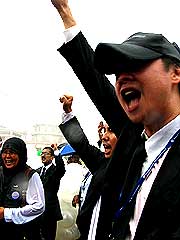 Why were the lawyers antsy on the implications of the video to which mainstream media has been self-consciously coy about attaching names, incidentally? On a personal level, some of those lawyers may need to submit in the courtroom before some judges they lack faith in.
But the national pall over the judiciary includes a deficit in upholding the Federal Constitution which has been amended more times than there are independent years in Malaysia; defending 'the rule of law', some promulgated to lawfully benefit particular privileged people; asserting civil jurisdiction uncivilly jostled by syariah, etc, etc.
Nonetheless, the average man on Petaling Street may not care about lofty ethics, rarefied separation of powers, yadda-yadda if they do not see these as bread-and-butter issues. Such parochial insularity is why there are Chinatowns the world over we Chinese prefer to keep ourselves to ourselves.
A Chinatown product is MCA. It is a runner and fixer, operating on petty levels through eternal 'internal discussions' with da Boss. Its service centres assist Ordinary Joe or Ong Ah Ngiau and Koh Ah Kow to meander through red tape, say, in applying for trading licences or filling bureaucratic forms in triplicate. The nature of this communal party speaks volumes about the Chinese credo.
A goldfish outlook to one's rice bowl will not help keep malaise at bay. National policies assuredly impact on Chinese lives, be it through education diktats and missed educational opportunities, escalating cost of private healthcare, down sliding professionalism in public healthcare or simply the rot permeating too many institutions of governance.
What apolitical Chinese should ponder on is this: if you don't go to politics, wouldn't politics come to you?
Chinese fears and the cabal
Politics comes knocking on our door in many guises; in Little Napoleons attempting to impose a race quota in private sector employment, for one. Earlier, there was Maybank at the same on its appointment of legal firms.
To a Chinese child growing up, the bogeyman is the ' mata ' or cop, who if he is a naughty boy will spirit him away into the night. It's perhaps no coincidence that the police force is overwhelmingly Malay. However, the average, law-abiding adult Chinese will have no cause to blip on the police radar. Which is not to say, though, that he is able to evade police altogether. Driving, he can't skirt roadblocks.
 This is fasting month and despite being starved of food and parched of drink, our hardworking cops are assiduously on the job. So like it or not, Ah Ngiau in his shiny Honda or Ah Kow in his spotless Toyota will have to wind down his automatic window to be addressed in greasy tones by the mata.
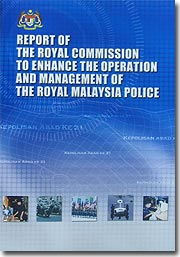
The Royal Commission to Enhance the Operation and Management of the Royal Malaysia Police has made 125 recommendations. If the crucial recommendations objected to by police (and the force's political patrons) were to be implemented, it might go some way towards wiping away some of the sliminess.
Among the recommendations are those on safeguarding the human rights of detainees in police custody. This is largely an Indian community concern and more on it in Part 2 of my article.
One other recommendation is to amend Section 27 of the Police Act 1967 which confers on police the power to regulate assemblies, meetings and processions.
Malaysians are curbed of freedom of assembly, be it to demonstrate against impending toll hikes, petrol price spike and runaway inflation or to gather for a Bersih ceramah without fearing violent dispersal. DAP secretary-general Lim Guan Eng revealed there are 7,000 personnel in the Special Branch. What are their policing duties, pray tell.
If it's the economy that is dearest to the Chinese heart, then the least this economically-driven minority should expect is the right of peaceful congregation at its chambers of commerce.
But when 'the' (I detach myself from association by refraining from saying 'our') MCA forebears bartered race dignity for their bowl of gruel, they left a legacy that has echoed through time. Their descendants inheriting the mythical social contract are serenaded with song of these chambers of commerce to be burnt down and music of keris slicing the air.
Have police ever given any assurance they would protect buildings from arsonists or the public from politicians who run amok?
What Chinese kow-tow to
The lawyers had walked and submitted a memorandum to express their loss of confidence in the direction that the judiciary is heading. This action has been construed by certain notables (renowned for their other enlightened utterances) in government as being "disrespectful" of judges.
Taking the discussion tangentially, who or what do the Chinese respect? Besides money, the Chinese respect authority and titles. It is abject conditioning to a habit of fear that makes them so mindful of the pecking order.
 Lee Lam Thye's elevated 'Tan Sri' title puts him at par with the Chinese billionaire tycoons and socially at the top of the food chain. Perhaps in appointing Lee to the three-man Malay-Chinese-Indian panel to tackle the Lingam tape, the government believed that Lee commanded respect and credibility in Quadrant Two.
As someone proud to be Chinese and a denizen of this quadrant, I'm willing to say I have no respect for Lee given his chequered history in politics. He may be seen either as a role model for Chinese pragmatism or as a walking example to dissuade idealism in the young. You choose.
Lee has lent his name to several government campaigns as well as the National Service which has overseen the wasteful, unforgivable deaths of 14 teenagers and it is a programme that should not have seen the light of day. Lee is hardly a Justice Bao to be tasked with reviewing tape or judiciary.
It is unadulterated feudalism to deem that title, authority and integrity must necessarily be mutually inclusive. While we want a Royal Commission on the video clip and the baggage it carries, there was the Royal Commission on police to which there has been no discernible follow-up action as far as public opinion goes for improving the trustworthiness of police.
Do we even realise how in over-legislated Malaysia and with our overpowering police we're all easily 'criminals' in the making? Jeff Lee Kwong Yong, 19, spent half a year in Kajang prison because he could not produce his MyKad to show the police and could not remember his IC number. Yes, the law does allow his punishment as such.
We can rue that there's no 'political will' to revamp our decayed institutions. Well, it's simple; simply because establishment leaders and their beneficiaries have a vested interest in maintaining the racket and theirs is the will to power in perpetuity.
The will to change is to be found in Atan, Ah Kow and Arumugam (' dan lain-lain ' in NEP parlance). Crisis or no in the judiciary, where is the Independent Police Complaints and Misconduct Commission, IPCMC? It was to have been set up by May 2006, according to the Royal Commission's timeline.
This is the present status of the IPCMC: The Attorney-General's chambers has prepared the second draft of the bill. We do not know how far the AG's version deviates from the first draft prepared and published by the Police Royal Commission. Perhaps the PM, as minister-in-charge or Umno man ministering to police, has some answers.
Part 2 of this article on Indians will appear next week.


Report this comment
Are you sure you want to delete this comment?
This action cannot be undone.