




Federal Court shuts door to Chin Peng's homecoming
Former communist chief Chin Peng today failed in his final attempt to seek a court order to allow him to return to the country from his exile since 1961.
Former communist chief Ong Boon Hua @ Chin Peng today lost in his final bid to return home from his exile since 1961.
The Federal Court ended his attempts to come back to the country by rejecting unanimously his leave application to appeal against a Court of Appeal ruling on that matter.
 The three-member panel led be Justice S Augustine Paul (
left
) refused to hear the octogenarian's application for a formulation of a question on whether he would be required to produce his birth certificate or letter of citizenship or other documentations as a proof for him to return to Malaysia.
The three-member panel led be Justice S Augustine Paul (
left
) refused to hear the octogenarian's application for a formulation of a question on whether he would be required to produce his birth certificate or letter of citizenship or other documentations as a proof for him to return to Malaysia.
The apex court also did not want to look into the details of the international treaty signed on Dec 12, 1989, between Malaysia, Thailand and the Communist Party of Malaya (CPM) led by Chin Peng to end hostility.
Besides Augustine, the other two judges who sat on the bench today were justice Hashim Yusof and justice Mohd Ghazali Mohd Yusof.
"The motion is dismissed with costs for the respondents," ruled Augustine.
Chin Peng, 85, who is from Setiawan, Perak, along with members of the CPM named the home minister, inspector-general of police, Malaysian Armed Forces chief and the government as respondents in the application.
He is now residing in southern Thailand with less than 200 former CPM members.
Chin Peng's application
Chin Peng filed an originating summons at the High Court on March 4, 2005, where he and the other appellants sought:
- a declaration that Chin Peng and others had the right to enter, stay and reside in Malaysia;
- an order that they be allowed to enter Malaysia;
- an order that the Malaysian government issue documents allowing them to enter Malaysia;
- an order for the Malaysian government to comply with the Dec 12, 1989, treaty.
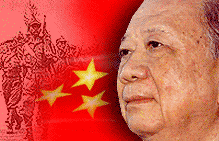 In his affidavit-in-support, Chin Peng claimed he was born on October 1924 in Sitiawan and he is a Malaysian citizen and he had never had his citizenship revoked and he had never been banished out of the country.
He claimed that his birth certificate was lost when he tried to escape from the authorities during the Emergency period.
Central to Chin Peng and the other's application to return was the 1989 treaty signed where it was stated:
- Members of the CPM and members of its disbanded armed units, who are of Malaysian origin and who wish to settle down in Malaysia, shall be allowed to do so in accordance with the laws of Malaysia. [ section 3.1 ]
- Members of the CPM and members of its disbanded armed units, who are not of Malaysian origin, may be allowed to settle down in Malaysia in accordance with Malaysian laws, if they so desire. [ section 3.2 ]
Chin Peng, who fought a bloody 12-year guerrilla campaign against the government, left Malaysia in 1961 and has been in exile in Thailand since then.
The former secretary-general of the outlawed CPM took legal action after the government rejected his 2003 request to return.
The Kuala Lumpur High Court had allowed a striking out application by the respondents when it ruled that Chin Peng failed to provide the necessary documentation to prove his citizenship within 14 days.
Last June, the Court of Appeal unanimously threw out his appeal by upholding the High Court ruling that he must produce identification papers to prove his citizenship.
The government in 2003 denied his request to return on grounds he was still linked to a banned organisation with a "history of perpetrating terrorism" in the country.
End of the road for Chin Peng
Chin Peng was represented by a team of lawyers led by Raja Aziz Addruse. Others in the team were Chan Kok Keong, Darshan Singh Khaira and Leong Cheok Keng.
 Chan (
left
) said it was unfortunate that the High Court, Court of Appeal and the Federal Court decided that Chin Peng has to produce documentation to prove his citizenship as "we felt the main question is on the section 3.1 and 3.2 of the treaty signed".
Chan (
left
) said it was unfortunate that the High Court, Court of Appeal and the Federal Court decided that Chin Peng has to produce documentation to prove his citizenship as "we felt the main question is on the section 3.1 and 3.2 of the treaty signed".
"I think they do not want to entertain our request to look into the treaty as it may affect Malaysia's international standing and reputation," Chan said.
Leong said there has been seven judges who had heard the case (i.e. one from High Court, three from Court of Appeal, and three more today from the Federal Court) but none of them wanted to entertain matters raised in the treaty.
"We may have exhausted his legal options and this could be the last as he would really like to return home," he said.
Leong described Chin Peng's health as deteriorating as a result of his old age and he suffers from gout.
Chan last met him earlier this year and besides suffering from gout, he is otherwise in good health and spirits.
Senior federal counsel Azizah Nawawi represented the respondents.
"The court insisted he show his citizenship but we argued that under the peace agreement, there was no need to prove citizenship but that he was born in Malaya," Darshan Singh - one of Chin Peng's lawyers, told AFP .
"The court did not accept this. It is disappointing but we are not going to give up," he added.
"We will now look at filing a case in the international court and go for an extrajudicial remedy for Chin Peng."


Are you sure you want to delete this comment?
This action cannot be undone.