




Goodies for Chinese schools in the works?
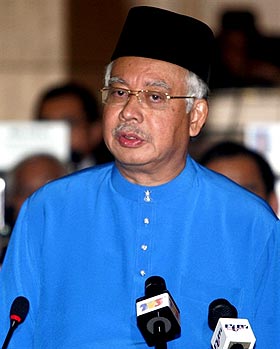
The recent meeting between Prime Minister Najib Abdul Razak and several Chinese association leaders over Chinese education has been widely seen as another Malaysia Makkal Sakti Party (MMSP) type strategy to win back the Chinese votes, bypassing the divided MCA.
The recent meeting between Prime Minister Najib Abdul Razak and several Chinese association leaders over Chinese education has been widely seen as another Malaysia Makkal Sakti Party (MMSP) type strategy to win back the Chinese votes, bypassing the divided MCA.
Several Chinese dailies and news portals quoted reliable sources and reported that Najib's political secretary Oh Ei Sun had arranged for the prime minister to privately meet with leaders from major Chinese associations to understand the problems of Chinese community.
 Among the suggestions raised by the Chinese leaders during the meeting was the government to recognise the Unified Examination Certificate (UEC), a standard examination taken by the students of Chinese independent high schools under the umbrella of Dong Zong, a national Chinese educationist's group.
The other proposals on Chinese independent high schools included allowing new schools to be open and subsidising RM1,200 for every student, annually.
Besides this, there were also speculation that the Najib might announce these goodies in the near future.
Although both Dong Zong chairperson Dr Yap Sin Tian and the Federation of Chinese Associations of Malaysia (FeCAM, popularly known as Hua Zong) deputy secretary Dr Chin Yew Sin denied such a meeting took place, a reliable source confirmed there was such a meetng.
He revealed that the "informal" meeting was held about a month ago and involved those were from Dong Zong, Jiao Zong, Hua Zong and other groups. Among the leaders, several were "Tan Sri's".
The source also said their target was to revive the Chung Hwa Independent High School in Kuantan, Pahang and the subsequently to build another new school in Petaling Jaya, Selangor.
People in these two places have fought for many years for Chinese independent high schools to be built, however their efforts have failed.
It is also understood that the meeting discussed the technical problems in recognising the UEC. One of the proposals was for UEC to adopt the Malay language question papers from the official examination.
But, the source said he was not sure when those proposals will come to fruition. He also added the meeting didn't have any fixed schedules.
Bypassing MCA to win Chinese votes
Many political observers opined the move was akin to Najib's earlier strategy in roping the MMSP, a splinter group of Hindraf, and bypassing MIC to win back Indian support, who were mostly with the opposition in the last general election.
Najib launched the new Indian based party one day before the recent Bagan Pinang by election and the strategy was seen as successful as BN candidate Isa Abdul Samad won with a bigger majority with the Indian votes swinging back to BN.
Since, several Umno leaders and grassroots have held the view that the party is capable of approaching non-Malays directly with the "1 Malaysia" slogan and without relying on other non-Malay component parties which are facing serious internal problems.
MCA fell into serious infighting after its president Ong Tee Keat broke up with his deputy Chua Soi Lek two months ago.
The dispute took another dramatic twist when the newly-appointed deputy president Leow Tiong Lai, widely seen as a Ong's loyalist, also broke ranks with his boss. This forced the latter to reconcile with Chua.
 "The meeting between Najib and Chinese organisations is a reminder to MCA (that they can be bypassed by Umno and become irrelevant)," said Tang Ah Chai, the Kuala Lumpur-Selangor Chinese Assembly Hall chief executive officer.
He also welcomed these kind of meetings as it would encourage the civil societies to approach government officers directly, instead of going through those "middle men" under the BN traditional structure.
"This will break the traditional operating methods, where Chinese and Indians solve their problem through MCA and MIC respectively," he explained.
Tang said this kind of meeting should actually become a normal practice, but in the context of our country, it always seemed as "kindness" from the governing parties.
However, he was skeptical about the goodies as they always fall short of the implementation stage after the election.
The best example is the promise by BN government to build several new Chinese schools before the March 8 general election.
He hoped that the government will take its promises seriously and implement official policies, and not merely pay ‘lip service'.
"Verbal promises are always forgotten after a change in leadership," he stressed.


Report this comment
Are you sure you want to delete this comment?
This action cannot be undone.