




MACC chief opts out early, No 2 to take over
The embattled Malaysian Anti-Corruption Commission chief Ahmad Said Hamdan has opted for early retirement and he is to be replaced by his deputy, Abu Kassim Mohamed.
The embattled Malaysian Anti-Corruption Commission (MACC) chief Ahmad Said Hamdan has opted for early retirement and he is to be replaced by his deputy, Abu Kassim Mohamed.
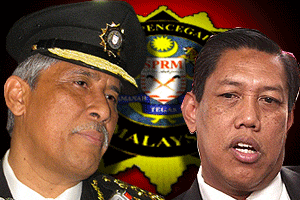 Chief secretary to the government Mohd Sidek Hassan, in making the announcement, said that Ahmad Said (
right in photo
) has requested that his tenure be shortened to the end of this month.
Chief secretary to the government Mohd Sidek Hassan, in making the announcement, said that Ahmad Said (
right in photo
) has requested that his tenure be shortened to the end of this month.
"Ahmad Said had given us a notice to end his tenure at the end of the year... his contract was supposed to end on May 25, 2010," he said.
"To fill the vacancy, the Yang di Pertuan Agong has consented, based on Section 5(1) of the MACC Act 2009, to appoint Abu Kassim ( left in photo ) to head the commission effective Jan 1," Mohd Sidek said in a statement.
It is learnt that Ahmad Said, 57, would begin his leave starting Dec 14.
Ahmad Said has been under tremendous pressure from the opposition to quit after Malaysia plummeted in the Transparency International ranking by nine places from last year's 47 th to 56 th in its global corruption perception index.
This was the worst ranking in 15 years and it put a severe dent on the commission's reputation since a bill was introduced this year to transform the Anti-Corruption Agency into what is now the MACC.
It had also been dogged by the controversial death of political aide Teoh Beng Hock while he was being questioned by the MACC officers at its Shah Alam office on July 16.
Following the plunge in the rankings, opposition leaders like DAP advisor Lim Kit Siang, who is also the Ipoh Timur MP, have called for Ahmad Said's head.
Mohd Sidek did not disclose the reasons for Ahmad Said's departure, only saying that the chief commissioner had asked his tenure to be cut short.
"The government would like to thank Ahmad Said for his contributions to the government," he said.
"Since leading MACC, the commission has performed its task admirably and in line with its vision to free the society of corrupt practices and to fight graft. It is through his effort that MACC's performance had also been raised," he said.
Change lauded
Transparency International Malaysia (TI-M) president Paul Low, when contacted, welcomed the move by the government to replace Ahmad Said with Abu Kassim.
Low said the change was good as Abu Kassim had extensive experience, having been with the commission for a long time.
"Abu Kassim is also well-respected. We welcome this change," he said.
Asked to comment on Abu Kassim's immediate task, the TI-M president said he should deal with the negative public perception that MACC is not politically neutral.
"He should address the issue of independence of the commission and the competency of its staff. This is so that the MACC would build a better image or improve its credibility," he said.
MACC advisory panel committee member Ramon Navaratnam also lauded the move.
"Abu Kassim is known to be efficiency-oriented as he had experience working in the private sector. He brings with him a very open and serious commitment to fight corruption."
Ramon said the appointment would boost MACC staff morale, which has plunged to its lowest depth since the death of Teoh.
He hailed Abu Kassim as a "dedicated anti-corruption fighter" with "missionary zeal".
He said that MACC's priority should be in stepping up the pace of its graft probes, especially in investigating the "big fishes".
25 years in the anti-graft body
Abu Kassim has a Bachelor of Social Science degree from Universiti Sains Malaysia, Penang and Master of Science in Criminal Justice from the Michigan State University, United States.
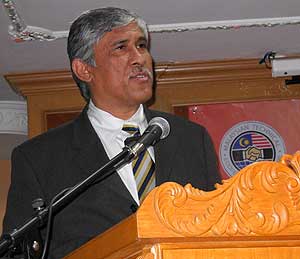 Abu Kassim, who will be celebrating his 49th birthday tomorrow, joined the Anti-Corruption Agency (ACA) on Sept 1, 1984 as an investigation officer.
He had served as director of planning and policy coordinator at the ACA headquarters, ACA director for Perak and Penang, director of the Malaysian Anti-Corruption Academy and was seconded to Amanah Raya Berhad as its head of integrity.
Abu Kassim was appointed deputy director-general (operations) of the ACA in 2001, and with the enforcement of the new Act on Jan 1, 2009, he was appointed deputy chief commissioner of MACC.


Are you sure you want to delete this comment?
This action cannot be undone.