




Sarawak dams: Boon or bane?
Plans are afoot to build a dozen dams in Sarawak which would inundate vast tracts of pristine rainforest and affect the lives of many ethnic tribes.
Tribal leader Kelak Ubin worries over plans to build a dozen dams in the pristine, interconnected river ecology of Sarawak, home to many ethnic tribes located north-west of Borneo Island.
Considered the third largest island in the world, Borneo occupies an area the size of Singapore and lies at the centre of Maritime South-east Asia. It is divided among three countries, namely, Indonesia, Brunei and Malaysia. At its north lies the Malaysian states of Sarawak and Sabah.
 The proposed Sarawak complex of hydroelectric dams is expected to lead to a forced resettlement of the affected tribal communities to unfriendly places as well as to inundation of the state's vast tracts of rainforest, said to be the earth's oldest tropical rainforest.
"Our life ... our tradition is all connected to the land. Our way of life is inherited from our ancestors," Ubin told IPS.
"We don't know any other way of life. Our very existence is under threat. They (government officials and private entrepreneurs) have promised to resettle us and pay us some money, but I fear our traditional way of life will die with the forest."
The proposed massive dams are intended to generate cheap electricity and feed China's rapidly expanding economy on top of Malaysia's energy- consuming manufacturing industries that are intended to be relocated to the state. The complex is expected to have a combined power-generating capacity of 7,000 megawatts (MW) by 2020, or at least 600 percent more than the current capacity of the island.
Why it makes economic sense
A state official, speaking to IPS on condition of anonymity, explained why exploitation of Sarawak's rivers makes economic sense and moving industries to the island is a better option.
“Sarawak's interconnected river system is unique and unlike any in the world. The system is the state's greatest wealth and, if tapped intelligently, will feed industries that need cheap power like aluminum smelters,” he said.
On Jan 11, the government announced plans between China and Malaysia to pursue joint venture energy projects amounting to US$11 billion in Sarawak.
Prime Minister Najib Abdul Razak unveiled the plans involving the government-owned development and investment firm 1Malaysia Development Berhad (1MDB) and China's leading power grid operator, the State Grid Corporation of China (SGCC).
“In a short period of time 1MDB and SGCC, which is China's leading power and distribution company, will be collaborating to identify and plan a number of multi-billion-dollar projects,” Najib said in his speech during the announcement. He did not identify, however, the projects that would be undertaken under the joint venture.
But government officials, who also declined to be named, said dams and power plant constructions were among the huge joint projects of the two firms.
“Sarawak is slated for huge growth and will be transformed within 20 years,” a senior official involved in financial development and planning told IPS. “The focus is on the energy sector.”
English daily, The Star, has reported that 1MDB and SGCC will establish hydropower plants similar to the controversial Bakun Dam located on Balui River in Sarawak and a massive aluminum smelter in the same state.
The Bakun facility is the forerunner of this huge and ambitious plan to tap Sarawak's power for power-intensive industries, state officials also admitted to IPS.
Indigenous people uprooted
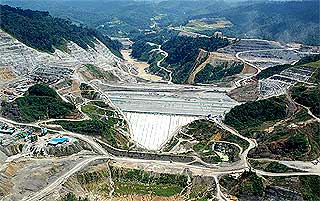 Anti-dam groups said the US$2 billion Bakun Dam, scheduled to come online later this year, would engulf a huge tract of the Borneo jungle in water. Approved by the government in 1986, the project is nearing completion after more than two decades of controversy, opposition and financial constraints triggered by the 1997 Asian crisis.
During the intermittent construction of the hydroelectric dam, thousands of indigenous people were uprooted and moved out of the construction and immediate catchment area. Large tracts of rainforests, where natives of the several tribes lived, were cleared to make way for the dam.
When completed, Bakun's reservoir will cover 695 sq km and power eight turbines. But for the displaced indigenous people of Sarawak, Bakun is nothing but endless misery. Used to a life of farming, fishing and limited hunting, the tribal people have great difficulty adapting to a cash economy.
“The government must clarify the development plans for Sarawak and give all details, especially their impact on the indigenous people,” said Meenakshi Raman, a senior official of Friends of the Earth Malaysia, a member of an international grassroots environmental network from which it derives its name.
“Our primary fear is that these projects involve hugely dirty industries like aluminum smelters and dams and coal power plants, which all degrade the environment in Sarawak and threaten the economy and livelihood of the indigenous people,” she said.
The dam has an estimated generation capacity of 2,400 MW, considered ambitious for Sarawak's small, agriculture-based economy, which has no use for such huge generated power.
The original Bakun plan was to ship the generated power through undersea cables across the South China Sea to Peninsular Malaysia. But those opposed to the project said it did not make sense because Peninsular Malaysia was already experiencing a power glut, with numerous independent power producers queuing up to sell power.
Peninsular or West Malaysia, accounts for the majority of the South-east Asian country's estimated 28 million population and economy.
Alarm bells sounded
Environment activists also argued that the option to lay cables would be expensive, was fraught with technical uncertainties, and could raise sovereignty issues if they passed through Indonesian waters.
This ambitious and, in the words of some experts, 'foolhardy plan' to use undersea cables across 1,000km of open sea appears to have been abandoned for an equally ambitious plan to bring power-hungry industries to Sarawak.
Senior government officials, who also declined to be named, said the undersea cable plan is 'all but abandoned.'
But even before the turbines of the Bakun hydroelectric facility begin to turn later this year, environmentalists and activists continue to sounding the alarm bells on plans to build 12 more mega dams in Sarawak, which the government sees as a major injection into the sluggish economy and an investment that will deliver political capital as well.
Foreign investment in Malaysia plummeted in 2009 as a result of the global financial crisis. The 1MDB, which was created in 2008, is aimed at forming global partnerships to drive Malaysia's economic growth. - IPS


Are you sure you want to delete this comment?
This action cannot be undone.