




Tsunami roars across Pacific after massive Chile quake
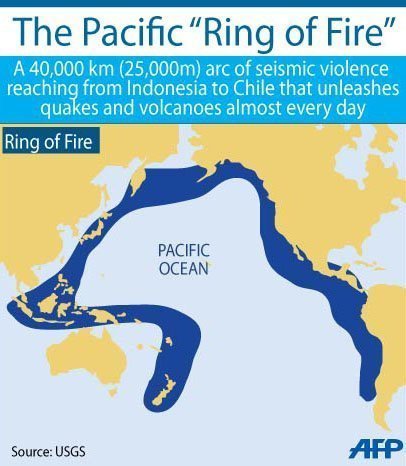
Waves hit Chile, Hawaii, French Polynesia and the South Pacific as the tsunami moved at jetspeed around the "Ring of Fire" after the 8.8-magnitude quake on Saturday which left at least 300 people dead.
Five people were killed and 11 missing on the remote Robinson Crusoe archipelago far off the coast of Chile, the first reported casualties from the tsunami as it power west across the Pacific.
A tsunami roared across the vast Pacific Ocean after a massive killer quake in Chile yesterday, with dozens of nations on alert for destructive waves and thousands of people fleeing their homes.
Waves hit Chile, Hawaii, French Polynesia and the South Pacific as the tsunami moved at jetspeed around the "Ring of Fire" after the 8.8-magnitude quake on Saturday which left at least 300 people dead.
Five people were killed and 11 missing on the remote Robinson Crusoe archipelago far off the coast of Chile, the first reported casualties from the tsunami as it power west across the Pacific.
Warning sirens wailed as about 50 countries and territories along an arc stretching from New Zealand to Japan were put on alert, five years after the Indian Ocean tsunami disaster that killed more than 220,000 people.
Despite initial fears, no major damage has been reported and an alert was cancelled in the US state of Hawaii.
But elsewhere in the Pacific experts warned bigger waves could follow the initial surge of water andpeople in vulnerable coastal communities were still being evacuated.
 The Pacific Tsunami Warning Center, set up by Pacific governments after a tsunami unleashed by a 9.5-magnitude earthquake in Chile in 1960, had warned of possible "widespread damage" from waves as high as three metres.
"We could be looking at an all-day event," US National Weather Service meteorologist Eric Lau told AFP , as officials warned that the US and Canadian west coasts could also be hit.
"It will stop once it hits the land masses on the other side of the Pacific, in Asia. The wave is spread out across the entire body of water in the Pacific."
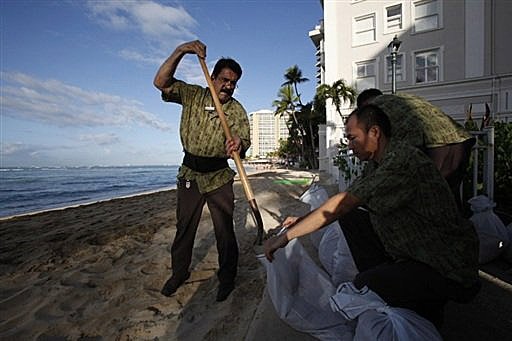
Thousands of people in the US state of Hawaii moved to higher ground, rushing to grocery stores to stock up on food and water and queuing at petrol stations, and authorities warned people not to put themselves in harm's way.
 "If you live anywhere in the evacuation zone, you have to evacuate," Oahu Emergency Management Department John Cummings said as tsunami sirens wailed for the first time in 16 years.
"We're going to treat this as a destructive-type tsunami."
US President Barack Obama, who was born in Hawaii, warned that the US western seaboard may see dangerous waves and currents throughout the day.
"In the hours ahead, we'll continue to take every step possible to prepare our shores and protect our citizens," he said.
One tsunami measuring nearly 2.5 metres slammed into Talcahuano, one of about 11 coastal towns in Chile hit by the wave, according to the Pacific centre. There was no immediate word of casualties.
Chilean President Michelle Bachelet announced a partial evacuation of Easter Island, but the island of about 4,000 people, known for its hundreds of monolithic stone statues, received a relatively small onrush of water.
The pan-Pacific tsunami warning applied also to Central America, and authorities as far afield as Russia's Sakhalin island were monitoring the potential for tidal trouble.
Japan said it was bracing for waves of up to three metres expected to hit early afternoon Sunday.
Waves of 750km per hour
One expert said the mass of water would be hurtling towards Hawaii at 200 metres a second or 720 kilometres an hour.
"Mid-ocean, the wave is travelling at around the speed of a jet plane," Roger Bilham, a professor of geological sciences at the University of Colorado, told AFP .
"The amplitude of the wave is small when it's mid-ocean, but it may rise to five to 10 metres when it reaches Japan or the Philippines."
Tsunamis generally come in waves and the first may not be the largest.
 The Pacific Warning Center, which manages a network of early-warning electronic buoys strung across the Pacific Ocean, said local authorities can assume the threat has passed when no major waves have been seen for two hours.
The region is in the middle of the "Ring of Fire", a belt of seismic fury responsible for most of the world's tremors and volcanoes.
In the island paradise of French Polynesia, waves hit the Marquesas Islands and the Gambier archipelago, but there were no casualties or major damage reported.
Schools across the region were closed, the port in Papeete was evacuated and thousands in Tahiti's hillside areas were taken to safer areas. However many residents along the coast refused to leave for fear of looting.
Waves of up to 1.5 metres rammed New Zealand's eastern Chatham Islands, with officials warning that the country's entire east coast was at risk from impending waves of up to three metres.
"It is expected that the greatest wave heights will occur between six and 12 hours after the initial arrivals," the Ministry of Civil Defence and Emergency Management said.
However, fisherman were still heading out to sea and in Napier on the east coast of the North Island, unperturbed stallholders were setting up their Sunday market.
No tsunami threat to Malaysia
In the South Pacific island nations of Tonga and the Cook Islands, residents were making their way to higher points inland.
Many islanders are still living in makeshift shelters following a terrifying tsunami in Samoa, American Samoa and Tonga that trashed entire villages in September, leaving more than 180 people dead.
Despite the early warning system, the September waves came so suddenly that there was little time to flee to higher ground.
The Joint Australian Tsunami Warning Centre warned of the "possibility of dangerous waves, strong ocean currents and foreshore flooding" along the coast between Sydney and Brisbane.
Authorities in Indonesia and Taiwan said they were monitoring, while Philippine officials started planning for possible evacuations.
Seismic waves could reach the east coast of Japan around noon (11am Malaysian time), the country's meteorological agency said.
Alert withdrawn
Malaysia's Meteorological Department said that there is no tsunami threat to the country.
However, people living along the coastal areas of Lahad Datu, Semporna, Tawau and Sandakan in Sabah were advised to stay away from the beaches as there are likely to occur rough sea conditions and a rise in the sea level from 12pm until 6pm today.
In Semporna, one of the coastal districts in the east coast of Sabah, the authorities are on standby to face any eventualities.
Semporna district officer AM Ibnu AK Baba said he had contacted the
district's police chief to coordinate their action plans.
"We have informed tour operators here and those operating in islands off here to be on the alert. They have also been told not to panic because evacuation plans are already put in place," he told reporters.
"Fishermen are also told not to go to the sea for the time being," he said further.
Lahad Datu district officer Zulkifli Nasir, meanwhile, advised residents to remain calm and follow instructions from the authorities.
Tawau Municipal Council President Ismail Mayakob said all agencies were on standby to face any eventualities.
The Meteorological Department has since withdrawn its alert on the possible rise in sea level in Sabah's east coast following the earthquake in Chile.
The department said it had not detected any rise in the sea level in the
state. "It is now ascertained that the Sabah waters are free from the threat," the department said in a statement.
- Agencies


Are you sure you want to delete this comment?
This action cannot be undone.