




DPM's 'I'm Malay' has a history
comment Deputy Prime Minister Muhyiddin Yassin’s ‘I’m Malay but that does not mean I’m not Malaysian’ must be seen against a longer historical perspective than in the present controversy.
Viewed against the parameters set by the current debate, the formulations of ‘I’m Malay first’ or ‘I’m Malaysian first’ appear as opposed: if you insist that you are the one first, you could not quite be the other.
The current debate appears to pit a race-based identity, if that’s what one owns up to first, as somehow opposed to a nationalist identity.
This wasn’t always so...
comment Deputy Prime Minister Muhyiddin Yassin’s ‘I’m Malay but that does not mean I’m not Malaysian’ must be seen against a longer historical perspective than in the present controversy.
Viewed against the parameters set by the current debate, the formulations of ‘I’m Malay first’ or ‘I’m Malaysian first’ appear as opposed: if you insist that you are the one first, you could not quite be the other.
The current debate appears to pit a race-based identity, if that’s what one owns up to first, as somehow opposed to a nationalist identity.
This wasn’t always so.
A controversy just over two decades ago, over the soul of Umno waged in the wake of a contest for top posts in the party, would illuminate the point.
In the April 1987 Umno elections, Dr Mahathir Mohamad narrowly beat Tengku Razaleigh Hamzah for the president’s post and Ghafar Baba similarly held off Musa Hitam for the deputy president’s job.
Aftermath of the battle
The immediate aftermath of the battle saw a long struggle for the soul of the party, with Umno being de-registered as a result of a court case and Umno Baru, led by the winners in the party election, being formed.
The losers, led by Razaleigh, went on to form Semangat 46, though not all the losers joined the splinter party. Musa stayed clear of the new alignments.
No doubt, the April 1987 party election was a watershed. Some would say all of subsequent Malaysian history was a sequel to that seismic event.
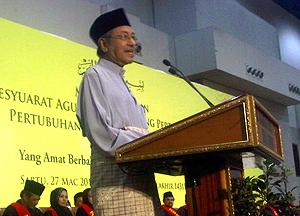 Essentially, Mahathir became more authoritarian as prime minister and as Umno president.
Lord President Salleh Abas was removed, the civil service began to lose its independence, the ISA became a much abused instrument of political intimidation, newspapers suffered more anxieties over renewal of their annual licences, you had to receive a certain number of nominations before you could contest for top posts in Umno Baru, and there were bonus votes awarded to the top grossing nominee for the president’s and deputy president’s posts.
These developments and changes were seen as oligarchic and, therefore, undemocratic.
Two retired PMs
The two then retired prime ministers – Tunku Abdul Rahman and Hussein Onn – were most unhappy.
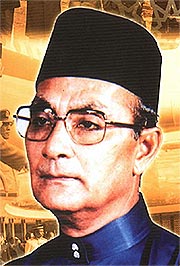 Tunku took his discontent to the extent of campaigning for Semangat 46 in the October 1990 general election.
Hussein was more restrained and discreet in his public remonstrations over what was going on in both party and country.
In private, he was said to be extremely rueful over his choice of Mahathir as his successor.
From about three years after his retirement in 1981, Hussein, as Petronas adviser and as head of a fund-raising drive in aid of an eye hospital named after him, would use the occasion of his receipt of public donations to air his views on national affairs.
These turned out to be increasingly critical of the status quo.
They hewed to a line that was in favour of a more equitable society.
On one occasion, he lamented that though there (then) were five public universities, not one had a non-Malay as vice chancellor.
Hussein’s style ‘very Malay’
This was a courageous thing for an illustrious Malay public figure to say at that point in time.
Hussein’s publicly aired dissent from the growing ethno-centrism of Mahathir’s policies and practices marked him out as keeper of the Malaysian flame or identity in the national discourse.
 Thus when Musa Hitam began to maintain one corner in the public jousting with Mahathir over the future of Umno, seen as blown adrift by the divisive elections of April 1987, he repeatedly described the mediation efforts of Hussein as “polite, very Malay”.
Coming from one known to be careful about deploying Malay verbal locutions, Musa took pains to underline the “very Malay” approach of the retired PM as most welcome and as most likely to pave the way to a resolution of Umno’s problems.
Nobody took Musa’s description of Hussein’s style as “very Malay” and, therefore, most emollient as having an exclusivist connotation.
In fact, at that point in time it was seen that in being “very Malay” Hussein, in manner and public utterance, was being very Malaysian.
True, Hussein enjoyed the stature of a national statesman and so his “very Malay” bearing could not be taken as anything other than inclusive.
Traitor to the Malays
Muhyiddin does not enjoy a similar stature and so his insistence on his ‘Malay first’ identity and his claim that this doesn’t make him less of a Malaysian does not connect with the prevailing political reality of a racially polarised country.
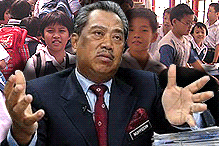 Further, he has not helped his stature one bit by calling Anwar Ibrahim a traitor to the Malays.
By contrast, Anwar has attempted to define his Malay/Muslim identity in an inclusive way by saying, when accused by Umno of abandoning it by supporting Hindraf’s demonstration of November 2007, that his concept entailed a more humanist approach to national problems.
“I’ve not abandoned my Malay and Muslims moorings,” said Anwar, when responding to the Umno slur against his supposed apostasy.
“Under a PKR administration, a Malay problem, a Chinese problem, an Indian problem, a Dayak problem and a Kadazan problem would be viewed as a Malaysian problem,” said Anwar in December 2007 when pressed to air his concept of his Malay/Muslim identity.
Still, the way remains open for Muhyiddin to give a more capacious thrust to his ‘Malay first’ identity.
He ought to be allowed to do so for a broadening of the contours of this crucial debate in advance of the 13th general election.


Are you sure you want to delete this comment?
This action cannot be undone.