




Muhyiddin gilds the lily and shreds it
COMMENT Like a canoeist facing rapids, Deputy Prime Minister Muhyiddin Yassin paddled on one side of the issue of the government’s interfaith panel (“let’s give them a chance to work”) and then on the other (the panel is “small fry” ) to placate the concerns of critics who charged that it detracted from Islam’s constitutional stature as the official religion.
In the process, he sounded even less convincing than he did recently when in avowing he was ‘Malay first’ ...
COMMENT Like a canoeist facing rapids, Deputy Prime Minister Muhyiddin Yassin paddled on one side of the issue of the government’s interfaith panel (“let’s give them a chance to work”) and then on the other (the panel is “small fry” ) to placate the concerns of critics who charged that it detracted from Islam’s constitutional stature as the official religion.
In the process, he sounded even less convincing than he did recently when in avowing he was ‘Malay first’ he said he was also Malaysian simultaneously.
 In this connection, there is a
not-so-well-known history
to the connotations to the term ‘Melayu’ that offered justification for Muhyiddin’s stance.
One need not be tendentious to hold that there is less justification for his straddle on the issue of the interfaith panel: His plea that the panel must be given a chance to work simultaneous with his description of it as “small fry” is tantamount to gilding the lily and then shredding it.
To the more rabid critics of the interfaith panel, the constitutional designation of Islam as the ‘official religion’ has a supremacist flavour.
Hence they feel that if the government allows its Islamic bodies to talk to other religions, they must condescend to do so and not appear to sit in equality with the other religions.
These nuances are significant in the discourse of supremacists.
Muhyiddin’s straddling the issue with simultaneous placation of interfaith dialogue proponents and Islamic supremacists must be compared with Opposition Leader Anwar Ibrahim’s handling of the same issue that occurred almost at the same time.
In a speech to the Sixth Assembly of the World Movement for Democracy in Jakarta on Sunday, Anwar met the issue head on.
Compromises from all sides
It is best that those excerpts from the speech be quoted in full to convey the salience of the points he made:
“If we agree that a constitutional democracy must concern itself with the protection of minorities as well, government must ensure that their rights and liberties be not infringed even if it may entail the loss of popularity with the majority.
“Naturally this would entail making adjustments to overlapping claims to entitlement of rights or competing goals. Among the most significant of these competing claims is religion where history has shown that attempts by one community to impose its will on another will only lead to disharmony and eventual violence and bloodshed.
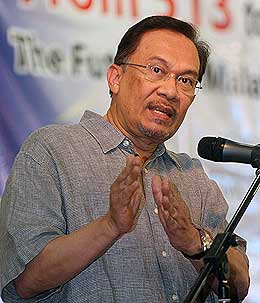 “No doubt religious harmony can only be realised by making compromises from both sides. Leaders of democratic regimes must therefore not just attempt to play to the gallery or engage in grandstanding whenever the situation suits them. They must not blow hot and blow cold.
“They cannot on the one hand pride themselves as leading the way for cultural and ethnic harmony while on the other hand furtively stoke the fires of religious animosity through state-controlled media and other organs of propaganda.
“Religious strife of whatever denomination or faith would seriously undermine the very foundation of constitutional democracy. There is therefore much sense in the saying that the empowerment of one cultural group at the expense of another in any society would only lead to a clash of interests.
“This clash if left unchecked would threaten the essential overlapping consensus, recognised as a central feature of the kind of democracy that we are talking about.”
Malaysians ought to be glad that on the great questions of the day, they now have a choice between exponents of the straddle and those who see these questions in the light of a long history from which they distill understanding for the wisdom to face them nobly.
TERENCE NETTO has been a journalist for close on four decades. He likes the occupation because it puts him in contact with the eminent without being under the necessity to admire them.


Report this comment
Are you sure you want to delete this comment?
This action cannot be undone.