




Sultans and mosques: Decree or puppetry?
Renowned constitutional law expert Abdul Aziz Bari sheds some light on the motivation behind the sudden resurgence in the role of Malay rulers' as the head of Islam, long left unpractised, yet suddenly re-appearing under questionable circumstances.
Renowned constitutional law expert Abdul Aziz Bari sheds some light on the motivation behind the sudden resurgence in the role of Malay rulers' as the head of Islam, long left unpractised, yet suddenly re-appearing under questionable circumstances.
He stressed that while constitutionally, rulers are the head of the religion, this special position and the vested powers must be exercised in accordance with Islamic tenets and independent from the government of the day.
"This is how the [royalty's role] left unregulated by the constitution needs to be understood. Not at the rulers' own whims and fancies," he explained.
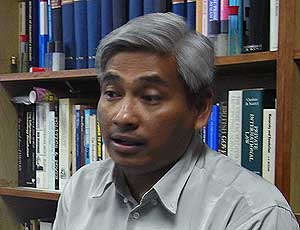 Speaking to
Malaysiakini
in an exclusive interview, the International Islamic University Malaysia law professor contended that contrary to their role as head of the religion, the rulers' personal character and knowledge about Islam leave a lot to be desired.
Speaking to
Malaysiakini
in an exclusive interview, the International Islamic University Malaysia law professor contended that contrary to their role as head of the religion, the rulers' personal character and knowledge about Islam leave a lot to be desired.
"This is too evident and has become a matter of public knowledge," Abdul Aziz ( right ) said.
What is more puzzling he asked, is "why are the rulers suddenly become so assertive?"
Questions over sultans' nuetrality
"Where was the Sultan of Selangor when Khir Toyo issued a directive to prevent tazkirah (lectures) in the mosques during Ramadan? What did the sultan do when Toyo demolished a mosque in Bangi and locked one in Batu Tiga some years ago?" he asked.
Abdul Aziz also pointed out the incident wherein the Agong suddenly said objected to the proposal to appoint a Penang deputy chief minister as the chairperson of the zakat fund there.
"As the head of Islam in Malacca, Sabah and Sarawak, why is it that the Agong did not do the same over there? Does this indicate that the other three states are better than Penang?" he asked.
He said that other similar incidents involving the rulers and religion had also taken place in Pahang and Perak.
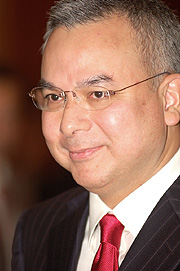 "These are some the things that Perak Regent Raja Nazrin (
right
) - who two weeks ago reminded the people that the rulers have complete control over religion - ought to bear in mind."
"These are some the things that Perak Regent Raja Nazrin (
right
) - who two weeks ago reminded the people that the rulers have complete control over religion - ought to bear in mind."
Abdul Aziz then opined that the 'selective' defense of the faith by the royalty seems to occur mainly in states ran by the Pakatan Rakyat opposition coalition.
"These royal pronouncements seem to have been moved by circles close to Umno, in particular, the cases in Selangor and Penang," suggested Abdul Aziz.
Be it in Perak, Selangor, Penang or Perlis, the constitutional law expert opined that they occur also in Umno's favour, while the rulers seem to be "throwing their lot with Umno."
"Where is Raja Nazrin and his father's assertion that rulers stay above party politics?" he asked.
Nothing made this more obvious than in Pahang, he added, the ruler was reported to have exhorted the public to continue supporting the BN to ensure that development continues in the state.
"What they are doing is against the spirit of constitutional monarchy and constitutionalism. Without doubt, the rulers are pressing their own self-destruct button."
"Just like in 1992 when the Sultan of Johor's fatal indiscretion eventually saw the rulers' immunity taken away by parliament," said Abdul Aziz.
Not seditious
While Umno may deny his assertions and question any attempt to look at the matter, Abdul Aziz said, the principle remains that "under the constitution, public functionaries and public powers are subject to close public scrutiny."
"Their exercise must be transparent," said Abdul Aziz.
As of now, the rulers and their pronouncements as heads of the faith have been far from transparent, he added.
As such, he believe that this issue must be looked at and understood by the public at large.
"There is nothing seditious about this. The matter affects the Muslims who are in the majority in the country.
"They have the right to know. It is our duty to explain these issues to them as pertaining to the rules and roles depicted in the constitution."
"After all, we are a constitutional monarchy," he concluded.


Are you sure you want to delete this comment?
This action cannot be undone.