




RPK emerges from hiding in London
On a warm and sunny Saturday afternoon, Malaysians, political observers and members of the media streamed into BPP Law School in London to listen to iconic political blogger Raja Petra Kamarrudin, popularly known by his initials, RPK.
Raja Petra walked into the theatre to a good 10 seconds or so of applause from a crowd that filled up the backseats of the lecture theatre.
On a warm and sunny Saturday afternoon, Malaysians, political observers and members of the media streamed into BPP Law School in London to listen to iconic political blogger Raja Petra Kamarrudin, popularly known by his initials, RPK.
Raja Petra walked into the theatre to a good 10 seconds or so of applause from a 300-strong crowd that filled up the backseats of the lecture theatre.
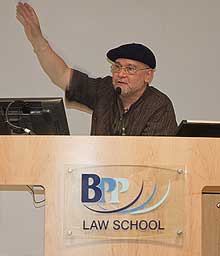 In his trademark beret, and his wry sense of humour, he spoke about the politics of fear in Malaysia, illustrating his experiences of having been twice detained under the Internal Security Act and the importance of the separation of powers in restoring integrity to Malaysian politics.
“Different people are broken in different ways,” Raja Petra commented.
While the draconian security law of the past aimed to stop bombings or killings, the ISA of today is “a preventive law” to stop Malaysians from thinking, resulting in “a nation of robots”.
He pointed out the irony that Malaysia is still technically under the state of emergency today - 40 years after the ISA was enacted to combat the communist insurgency.
Raja Petra is currently in self-imposed exiled in London, unconvinced that he will be afforded due process in defending himself against the charges of sedition and criminal defamation for alleging Prime Minister Najib Razak and his wife, Rosmah Mansor, of being linked to the sensational murder of Altantuya Shaariibuu, a young Mongolian.
Prior to Saturday’s talk, the Malay Mail reported that Scotland Yard was working with the Malaysian government to arrest him. A quick phone call to the New Scotland Yard undermined that claim.
 Scotland Yard has reportedly said that there is no extradition request from the Malaysian government, nor is there any arrest warrant against Raja Petra.
In addition, there is no extradition treaty between the Malaysian and British governments, and as such it would be extremely difficult for Kuala Lumpur to request for Raja Petra to be sent home to face charges.
Marina Lee Abdullah, Raja Petra’s wife of over four decades, described the speculation of Raja Petra’s possible arrest as “fear tactics employed by the bogeyman”. Nevertheless, the infamous blogger was flanked by two burly security guards.
In 2002, the Human Rights Commission (Suhakam) after interviewing detainees including Raja Petra in Kamunting, came to the conclusion that ISA has outlived its usefulness and is manipulated for political reasons.
Raja Petra talked about the approximately 10,000 faceless, nameless, undocumented ISA detainees over the last 40 years. He has heard the numbers of detainees pegged at a wide range from 6,000 to 20,000. There were people too overcome by fear to even speak out that a family member had been detained.
A documentary by the Australian Broadcasting Corporation was screened at the event, showing the strain of Raja Petra’s detention had taken on Marina and the famous couple’s daughter, Sarah.
Two stages of detention
According to Raja Petra, the period of being detained under the ISA can be roughly divided into two stages. The first 30 days is called the ‘confession period’, while the next 30 days is what the Special Branch terms ‘the turning over’.
Faced with a long list of crimes in the first 30 days, he either had to confess to everything or face the prospect of indefinite detention. Raja Petra’s confession was 200 pages long, and as a joke he commented, “We confessed to everything including the Kennedy assassination.” After the first 30 days, he signed 30 copies of his confession.
The next 30 days, Special Branch officers set to work on the detainee to change his stand, with incentives such an apartment or a cushy job dangled as a carrot.
Physical torture, Raja Petra said was reserved for the hardcore.
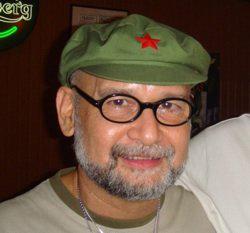 For normal people, mental torture was enough. Detained in a 10 feet by 10 feet concrete box, without a bed or slippers, he was blindfolded and handcuffed every time he left the cell, causing him to lose track of time and place.
Keeping a wry sense of humour, he interjected, “You are not allowed to mark the number of days in your cell, it’s not like in those old cowboy movies. They break you down mentally until you do whatever they want you to do.”
He concluded his speech by saying, “It’s not the freedom of speech that we lack in Malaysia, it is the freedom after speech that you don’t have.”
During the question-and-answer session, a member of the audience wanted to know how integrity could be restored to the system.
Raja Petra criticised the opposition for addressing the symptoms of the problems but not the disease. To cure the disease, Raja Petra said the separation of powers was crucial to provide the necessary checks and balances to prevent abuses. After Dr Mahathir Mohamad’s rule, he observed, the prime minister’s role had taken on too much power.
RPK: No honest politicians
Quite cynically, Raja Petra underscored, “There is no such thing as an honest politician. All politicians can be corrupted, it may not be money, but it can be cronyism, nepotism. The only way to keep them honest is to remove the arrogance by removing the power.”
His underlying argument was that different people could be broken or corrupted in different ways.
In response to Raja Petra’s assertion, Marie Tan from Penang, who currently works at a charity organisation, begged to differ, “I think that there are well-meaning politicians out there.”
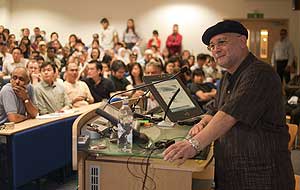 In a surreal interjection during question-and-answer time, a member of the audience and a law student, who claimed to be a good 15 years older than Raja Petra, stood up and saluted him with a long dramatic speech.
Following the conclusion of the two-hour talk, Gerakan Mansuhkan ISA (UK) announced that the organisation will picket against the ISA outside Tralfagar Square on the last Saturday of every month to put pressure on the Malaysian government to repeal the law.
Controversy is no stranger to the events held at the BPP Law School, which are organised by the Solicitors International Human Rights Group.
In April, environmental journalist Hilary Chiew screened ‘Penusah Tanah - The Forgotten Struggle’ at the same venue. It is a documentary highlighting the plight of the Penan tribe severely affected by logging companies in Sarawak as their native customary land rights were undermined by state legislation.
She was later criticised in Borneo Post and Eastern Times for attempting to discredit the timber and palm oil companies, and for painting an unflattering view of Malaysia.
It should be interesting to see how the Malaysian media responds to Raja Petra’s talk.


Are you sure you want to delete this comment?
This action cannot be undone.