




Faster growth, reducing deficit
Prime Minister Najib Razak will unveil the government’s vision for Malaysia for the next five years with the tabling of the 10th Malaysia Plan in parliament at 11.40am.
Malaysia rolled out a fresh five-year development plan on Thursday to rein in its ballooning fiscal deficit, trim subsidies and seek new sources of growth for its trade-dependent economy.
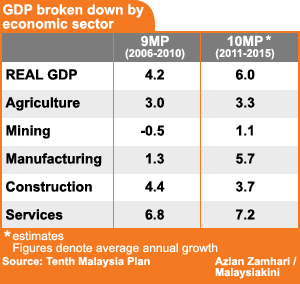
 Prime Minister Najib Abdul Razak forecast average economic growth of 6 percent over five years while pledging to cut the fiscal deficit to 2.8 percent of gross domestic product (GDP) in 2015, but gave few details on how he would achieve the deficit target.
Malaysia's budget deficit widened to 7 percent of GDP in 2009 after the government pumped in RM67 billion of stimulus to help its economy weather the global slowdown.
"The government will continue with fiscal reforms to bring greater value for money to government spending and widen its revenue base, particularly through a more broad-based tax system," the government said in the 10th Malaysia Plan.
 Najib, who is also finance minister, wants to win back foreign investors and open up the Southeast Asian economy to more competition.
The success of economic reforms is seen as crucial for the government to win the next general election due by 2013.
"The 10th Malaysia Plan is part of wider reforms that Najib has promised to deliver economic growth and prudent spending, which the electorate will evaluate him on," said political analyst Ong Kian Ming from UCSI University in Kuala Lumpur.
Malaysia's economic growth has averaged 4.2 percent annually since 2006, below the 6 percent targeted by the government under the previous five-year plan. The economy
shrank 1.7 percent last year.
Slashing subsidies, cutting debt
Analysts say Malaysia's main challenge is the government's willingness to push through needed economic reforms, with concerns that the authorities may be reluctant to implement
politically unpopular decisions such as cutting subsidies.
 Many foreign investors have bypassed Malaysia's economy in recent years in favour of its fast-growing neighbours such as Indonesia and Vietnam.
Malaysia's 5-year plan aims to bring the deficit down to 5.3 percent this year, and reduce government debt as a proportion of GDP to 49.9 percent in 2015 compared to 52.9
percent this year.
The government will cut its subsidy bill to RM15.7 billion in 2015 from RM18.3 billion this year, according to the plan.
It said Malaysia's tax base would be widened, but gave no details on how this would be done.
The government had earlier delayed the implementation of a goods and services tax to cut its deficit, after the plan met with strong public opposition.
Total government development spending for the five-year period is expected to hit RM230 billion versus RM200 billion in the last plan, with RM91 billion to be spent in both 2011 and 2012.
12.8 percent private investment growth
The plan aims to transform Southeast Asia's third-most trade reliant economy by boosting domestic demand and private investment. Domestic demand accounted for 5.4 pct of GDP in the first quarter of 2010.
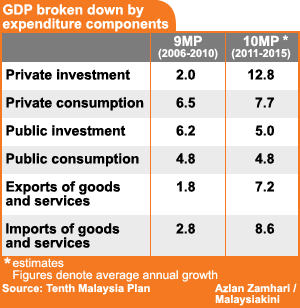 It said Malaysia would need an average of RM115 billion worth of private investments annually to achieve its target of growing investments by 12.8 percent annually.
Investments grew only 2 percent on average during the 9th Plan, which covered 2006-2010, and are expected to be 10 percent of GDP this year. It was 30 percent prior to the
1997/98 Asian financial crisis.
The plan also said Malaysia's service sectors would continue to be liberalised, although these commitments are largely due to agreements made with Asean and the World Trade
Organisation.
- Reuters
10MP Special Reports
Doubts remain over Najib's reform agenda
PM's 10MP speech - salient points
Faster growth, reducing deficit
Big ticket items lined up for privatisation
Experts: Privatisation drive must be transparent
A leap forward or just talk as usual?
Ibrahim Ali gives thumbs up to 10MP
Clearing the human capital hurdle
Public transport revolution planned for Greater KL
Sg Besi airport to make way for 'Greater KL' plan


Report this comment
Are you sure you want to delete this comment?
This action cannot be undone.