




Doubts remain over Najib's reform agenda
Prime Minister Najib Razak announced today a five-year plan to cut subsidies and accelerate investment but outlined few measures to boost competitiveness, reinforcing doubts about his reform agenda.
Prime Minister Najib Razak announced today a five-year plan to cut subsidies and accelerate investment but outlined few measures to boost competitiveness, reinforcing doubts about his reform agenda.
In the blueprint, Najib said the government would reduce its fiscal deficit and gradually phase out subsidies while aiming for average 6 percent annual economic growth.
 "This plan is critical to make sure our ambition to become a fully developed country by the year 2020 succeeds," the prime minister said when presenting the plan in parliament.
"The target to reach 6 percent growth needs a massive leap in investments, especially more robust private sector investment."
He gave few clues on how the government would attract more investment apart from a plan for it to partner private firms in RM63 billion of "high-impact" projects including building highways, a new financial district in the capital and coal electricity generation plants.
Malaysia needs an average RM115 billion in private investment annually to achieve its target of growing investment by 12.8 percent a year, the plan said. Investments grew only 2 percent on average between 2006-2010.
The government will cut its subsidy bill to RM15.7 billion in 2015 from RM18.3 billion this year, according to the plan.
Silence on NEP
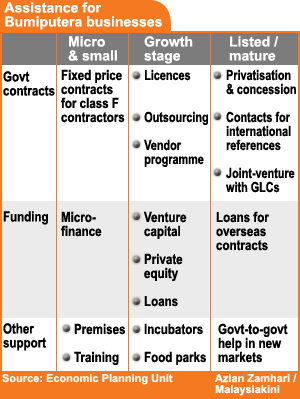
But the plan avoided thorny issues such as dismantling a four-decade old race-based policy in favour of the politically dominant Malays, a change that analysts say is crucial for Malaysia to compete with other economies.
 Financial markets want to see more aggressive reforms after a recent string of government policy reversals cast doubt on Najib's commitment to open up the economy to more competition.
The stock market was little changed after the announcement, up about 0.2 percent by the midday break.
A decade ago Malaysia accounted for half of total capital inflows into Southeast Asia's emerging economies that included Thailand, Malaysia and Indonesia. Increasing competition means it now accounts for about a third.
Net portfolio and direct investment outflows hit US$61 billion in 2008 and 2009, according to official data, although money came back into the bond market this year fuelled by two Malaysian interest rate hikes and the use of the ringgit as a proxy for a possible Chinese yuan revaluation.
Najib’s choice: Votes or reform
Critics have charged Najib with sacrificing Malaysia's economic interests for political expediency, and say he needs to act decisively to win over voters.
"He will try to carry out (reforms) as soon as possible, since he has to show the electorate that he can push through unpopular but necessary policies. Time is not on his side," said Ooi Kee Beng, a political analyst at the Institute of Southeast Asian Studies of Singapore.
 "His coalition is also in a bad way, and the only chance he has of winning back Chinese votes is to be steadfast in his reform agenda."
Najib's 14-month old government had previously U-turned on its decision to raise fuel and electricity prices, and delayed the implementation of a goods and services tax after a public
outcry.
Analysts said Najib's reforms so far including liberalising 27 service sub-sectors have avoided core issues like dismantling the pro-Malay New Economic Policy. The prime minister has promised to make the policy more needs-based but has not detailed how he will do so.
A recent survey by independent polling outfit Merdeka Centre showed 43 percent of the 1,028 respondents were not confident Najib would meet his economic targets within two years.
More than half the respondents polled from May 6 to 16 also felt that Najib's reforms merely repackaged old ideas and would be fouled by weak implementation.
Quick reactions
Khoo Kay Peng
, political analystSurprisingly the new 10th Malaysia Plan did not put emphasis on the state and federal government relationship; one of the main keys is state participation. This has not been reflected.
When it comes to areas of socio-economic development, one of the main problems comes from overcentralisation. Najib must acknowledge that making announcements does not mean anything. At the end of the day, he has to look at the mechanics, the implemantation.
That is the part the federal government did not give us in detail, the implementation mechanism. This has been the main problem for Malaysia.
He would have difficulty carrying out subsidy cuts. If you want to cut subsidies you must have a large middle income group who can afford to have subsidies cut. We're still trapped in the low-income level. We are caught in a situation where you can't cut subsidies without really improving earning per capita.
Ooi Kee Beng , political analyst, Institute of Southeast Asian Studies of Singapore
The fact that general elections have to be called by early 2013 means that he will either try to implement immediately the more painful measures like subsidy cuts and the introduction of the GST, or wait until after the general elections.
My guess is he will try to carry them out as soon as possible, since he has to show the electorate that he can push through unpopular but necessary policies. Time is not on his side.
His political will depend on the pressure put on him by economic figures, by right-wing activism in the Malay community, and by the opposition. His coalition is also in a bad way, and the only chance he has of winning back Chinese votes is to be steadfast in his reform agenda."
Lee Heng Guie , economist, CIMB Investment Bank
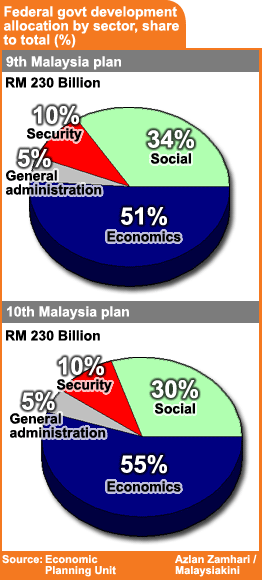
The 6 percent annual growth target under the plan is challenging. The allocation under the 10th Malaysia plan is RM230 billion, what matters most now is to ensure the money is widely spent on value-for-money projects. As for the fiscal deficit, it is still a narrowing deficit. We think the government should work towards a near balanced budget.
Wan Suhaimie Wan Saidie
, economist, Kenanga InvestmentI think the 6 percent average GDP growth on the back of 12.8 percent increase in private investment is too ambitious.
That means they have to come out with solid policies to attract foreign and local investors. The government says the key component to this is FDI, which has not been encouraging in the past few years. In the 9MP we only averaged 2 percent private investment.
As for the targets to cut the budget deficit, that is also going to be a challenging task because at the rate the cost of subsidies is going, they need to cut more subsidies and they need to implement GST as soon as possible.
- Reuters
10MP Special Reports
Doubts remain over Najib's reform agenda
PM's 10MP speech - salient points
Faster growth, reducing deficit
Big ticket items lined up for privatisation
Experts: Privatisation drive must be transparent
A leap forward or just talk as usual?
Ibrahim Ali gives thumbs up to 10MP
Clearing the human capital hurdle


Report this comment
Are you sure you want to delete this comment?
This action cannot be undone.