




Speaker vs speaker: Sivakumar loses appeal
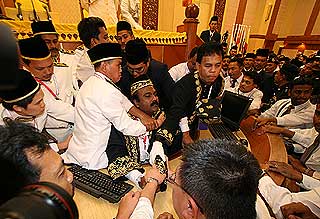
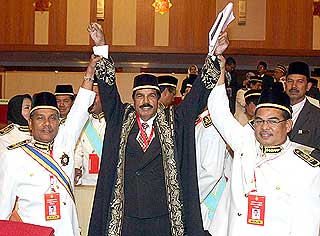
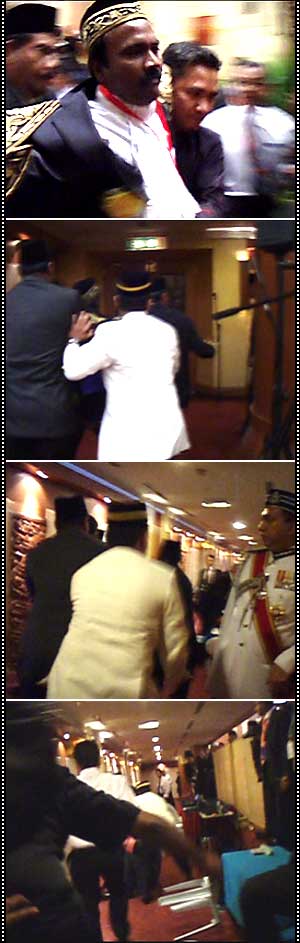
Could the controversial dragging of ousted Perak speaker V Sivakumar from his seat and detention for two hours when the state assembly sat on May 7 last year be deemed part of the proceedings, and hence non-justiciable?
Could the controversial dragging of ousted Perak speaker V Sivakumar from his seat and detention for two hours when the state assembly sat on May 7 last year be deemed part of the House proceedings, and hence non-justiciable?
The Court of Appeal today apparently thought so as it dismissed Sivakumar's appeal over a suit he brought against BN speaker R Ganesan for alleged assault and battery.
A lower court had ruled that it could not interfere with what had been decided by the Perak assemblypersons at their sitting.
And given that Sivakumar's alleged assault and detention was taken to be part of the assembly proceedings, the Court of Appeal threw out his appeal.
 The irony in today's unanimous decision by the three-member panel led by Justice Abdul Malik Ishak was that the trio had already decided the matter during a recess, before continuing to hear submissions from both parties.
The case had continued from yesterday evening and into this morning up to 11.30am before Abdul Malik called a recess to attend to a written judgment in another case.
The hearing resumed at about 1.20pm to hear submissions from Firoz Hussein Ahmad Jamaluddin representing Ganesan and a reply from lawyer Chan Kok Keong for Sivakumar who is Tronoh assemblyperson.
Immediately after submissions, Abdul Malik announced the panel's unanimous decision, adding that they had deliberated on the matter yesterday and today during the recess.
"This is our unanimous decision. After hearing submissions over the appeal and deliberating the matter at length yesterday and today, we unanimously dismiss the appeal with costs."
Sivakumar to pay costs too
Abdul Malik proceeded to ask Firoz for costs and the lawyer replied RM20,000 to which Chan objected saying that the case was a public interest matter and as such, costs should not be imposed.
However, Abdul Malik handed down costs at RM20,000.
No grounds were stated for the appellate court's decision. The other panel members were Justice KN Segara and newly-elevated Justice Abdul Wahab Patail.
On Sept 8 last year, the Ipoh High Court summarily struck out Sivakumar's suit to seek damages and costs for the assault, battery and wrongful detention he suffered following Ganesan's orders, after the latter was declared the Perak speaker.
High Court judge Azahar Mohamed had ruled that the court could not interfere with what had been decided by the Perak
 assemblypersons at their sitting on May 7.
This was in accordance with Article 72 (1) of the federal constitution which states that "the validity of any proceeding in any state legislative assembly cannot be questioned in any court".
Azahar had said that any matter arising with regard to the dismissal or appointment of the speaker at the assembly sitting should be examined, discussed and resolved in the assembly and not in court.
There were also controversial actions accepted by the appellate court today when the panel accepted Firoz’s application to admit the Hansard of the controversial sitting as evidence.
The Hansard had not been admitted at the High Court. Normally, on appeal, the court will not allow additional evidence as this is normally done at the trial court. However, Firoz submitted that the Hansard had apparently been made available to him only now and not earlier.
Chan: ‘Ganesan not immune’
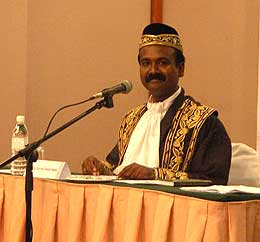
Chan, in his submission, questioned whether Ganesan - who was not an elected assemblyperson - was truly immune from legal proceedings as speaker of the assembly.
 "Ganesan is immune only if it is proven that the House proceedings had begun. It is admitted that he was `elected' before the opening of the House by His Royal Highness the Raja Muda of Perak."
"On this score alone, his election is questionable and the matter should have therefore gone through a full trial. It need not be struck out at the initial stage," argued Chan.
On May 7, the proclamation to summon the assembly was made at 10.30am and the BN assemblyperson proceeded immediately to sit to elect a new speaker. The royal address was only made at 2.30pm.
This in contravention of normal protocol where the assembly’s sitting begins only after the royal address. This was the basis for Chan's contention that Ganesan was not legally elected as speaker.
"If he fails to prove that he had been properly elected, he must be liable in law to face the civil suit and possibly battery and assault charges under the Penal Code.
And even if immunity protected him as speaker, Ganesan must prove that what he did (ie, the battery and assault) constituted proceedings of the House.
"Does taking part in the proceedings include beating up your opponent," asked Chan.
Firoz: ‘Ganesan legally elected’
Firoz then submitted that the Hansard showed that Ganesan was lawfully elected and appointed as the speaker. He added the Perak assembly secretary had also verified this.
Counsel also cited the provision under Article 72 of the federal constitution which stipulated that matters of House could not be heard in court.
 "The defendant's (Ganesan) action in the assembly as the lawful speaker in exercising his functions and duties cannot be interfered with by the court," he said.
Firoz said the commotion on May 7 came about when Sivakumar refused to remove himself from the speaker's chair. Following this, Ganesan instructed the sergeant-at-arms (Bentara Dewan) to remove him.
"Ganesan also cited the standing orders and this showed his action was within the legal requirements of the assembly," he said.
Chan, met after the decision, said he would consider filing an appeal over today's judgment at the Federal Court.
He noted that he faced an uphill battle to reinstate Sivakumar's suit particularly after it had been struck out and the decision upheld by the appellate court today..
"Furthermore, leave (permission) to appeal is not automatic. Hence, we have to secure leave before the case can be heard," he said.


Report this comment
Are you sure you want to delete this comment?
This action cannot be undone.