




Gender deficits in the 10MP
COMMENT On a whim today, I surfed the ministerial website on women and was pleasantly surprised to see a 2009 national policy on women and a 2009 action plan. And finally after years of not knowing, there is a document on the site developed in partnership with United Nations Development Programme of Malaysia’s Gender Gap Index.
COMMENT On a whim today, I surfed the ministerial website on women and was pleasantly surprised to see a 2009 national policy on women and a 2009 action plan. And finally after years of not knowing, there is a document on the site developed in partnership with United Nations Development Programme of Malaysia’s Gender Gap Index.
For a very long time since Shahrizat Abdul Jalil was made minister of women, family and community development, we do not even have a decent annual status report or gender profile done in-house. There has been the occasional country briefing paper by non-government bodies and development banks, or documents to be presented by a government delegation to an international meeting on gender.
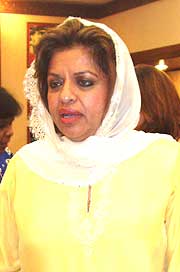 Shahrizat (
right
) has been minister since 2001, except for a very short hiatus in 2008 when she lost her parliamentary seat to Pakatan Rakyat. BN had been extraordinary in allowing her to keep her job at the ministry, first as a special adviser to the cabinet, then as a senator in 2009.
Shahrizat (
right
) has been minister since 2001, except for a very short hiatus in 2008 when she lost her parliamentary seat to Pakatan Rakyat. BN had been extraordinary in allowing her to keep her job at the ministry, first as a special adviser to the cabinet, then as a senator in 2009.
The Gender Gap Index is very informative. It is one of the primary documents policy makers would have to view in order to plan effectively. I must say however, that I am quite disappointed with the newly-minted policy on women and its corresponding action plan.
The policy is a document of several paragraphs seemingly cobbled together in haste. It reflects more of a statement of intent. If I may say so, these documents do not appear to be very different in context from the original 1989 policy and the 1997 action plan.
This raises a question whether there is any synergy between the writers of the Gender Gap Index and the government? The Gender Gap Index is dated 2007 and its thrust on gender mainstreaming is there. I do not however see any mention of gender mainstreaming ( pengarustamaan gender ) in the 2009 policy documents, available only in Bahasa Malaysia.
Gender mainstreaming is a key word and provides the shift in policy direction on gender justice and equality from the women-in-development approach of the 70s. And while UN’s development assistance in ensuring that governments will meet its international obligations on gender is gratifying, the UN is not the body responsible for mainstreaming gender in the country.
And if the UN assists in the development of reports, tools and manuals, it still requires the government’s commitment and action to move the agenda forward. Indonesia, the most populous Muslim country, institutionalised gender mainstreaming in the public sector in 2000 via a presidential decree.
Copy-pasting previous plans
The 10th Malaysia Plan’s ( 10MP ) section on social development begins with a strategy of “work from home policies” to encourage a more “family-friendly workplace”. Let’s hope that it is a translation problem and not a dodgy analysis of reinforcing women’s traditional role of homemaker and primary care-giver without a corresponding plan to address strategic needs.
If we are talking about flexible working hours, then that has to be considered for both women and men, in addition to parental leave. This option addresses both the practical and strategic needs in a successful gender mainstreaming strategy.
 Further, the plan for flexi-hours should not place the burden of child-care on families. This has to be weighed with the option of day-care at “family-friendly” workplaces. Employers in the public and private sectors should absorb some of the costs of running day-care centres.
The 10MP reiterates, maybe even copy-pasted, the promises under previous plans. There was some flurry about the creation of another special committee. What has happened to the Cabinet Committee on Gender Equality in the 9th Malaysia Plan?
Has nothing changed for a decade which calls for the same outcomes? Why are we still doing “gender sensitisation programmes in the public sector”? It might be more appropriate to have guidelines on gender mainstreaming in the public sector. It is quite inevitable that these “gender sensitisation programmes” are more ceramahs .
A programmatic strategy on gender mainstreaming is necessary to ensure that there will be continuity and sustainability in government planning on gender. We do not want the 2007 Gender Gap Index report to be a one-off document. Three years have passed since then.
And while it is impressive that we have set up so many offices at federal and state levels to do the ministry’s work, we need to know the organisation mandate and procedures to implement gender mainstreaming as well.
There are other concerns. Are frameworks in place to measure change? Have gender indicators been developed to measure outcomes and impacts? Do we have national sex-disaggregated data? Have we done a gender audit? When was the last gender budget analysis done to show how government expenditure and revenue benefited women as compared to men?
Pakatan action sustainable?
All state plans will mirror the 2009 policy and action plan. Current programmes of the ministry’s state offices continue the same ‘activity’ type of programmes of ceramahs , skills training, study tours etc.
I am sure the Pakatan state governments are not the only ones having problems in reading these activity-driven action plans in assessing the successes and failures of the policy on gender.
This is not the only dilemma. As with all other government bodies, the branches of the women’s ministry adhere to federal policies and budget lines. It is unclear if UN funds channeled to the Economic Planning Unit or EPU can be extended to the Pakatan state governments’ plans on gender and gender mainstreaming.
I think it is still possible for Pakatan to introduce a state directive on gender mainstreaming from the office of the menteri besar.
Gender mainstreaming is a planning tool. There is no discernible problem involving unique federal and state jurisdictions. The directive would enable an opposition state to translate the national policy through a gender mainstreaming lens.
Pakatan may have shown a serious commitment to gender justice by advocating for quotas in political participation and decision-making after just three years in office. It may still be a little early to tell as it works from GE to GE. Nevertheless it would be a loss if its gender agenda fails due to a lack of sustained support.
SALBIAH AHMAD is a lawyer by training and works on human rights with a specialisation on Islam and gender.


