




A PKR contest that bodes ill
COMMENT Reports that there could be as many as five hats in the ring for the deputy president’s post in PKR at the party’s triennial elections later this year serves only to underscore the anticipated divisiveness of the contest.
COMMENT Reports that there could be as many as five hats in the ring for the deputy president’s post in PKR at the party’s triennial elections later this year serves only to underscore the anticipated divisiveness of the contest.
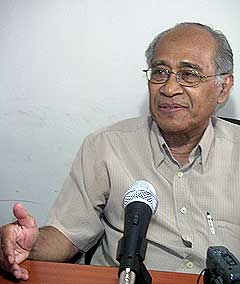 Incumbent deputy president senator Dr Syed Husin Ali (
right
) appears not budging from an earlier expressed inclination to retire. At 74 and with word of illness to a member of his family, no one can begrudge him his desire to withdraw to the shadows.
Incumbent deputy president senator Dr Syed Husin Ali (
right
) appears not budging from an earlier expressed inclination to retire. At 74 and with word of illness to a member of his family, no one can begrudge him his desire to withdraw to the shadows.
But another term in office, attainable if party supremo Anwar Ibrahim lets on that the incumbent ought not to be contested, is all that is needed to avert a divisive fight for the post.
This would defer the question of who is to be No 2 to Anwar in PKR to a later time when new challenges will test aspirants in ways that would enable the party’s electorate to make a more informed choice.
At this stage, a multi-cornered fight for the post of deputy president would deepen factionalism in the party, encourage the mediocre to overreach, diminish the image of PKR in the public eye, detract from the party’s stature as primus inter pares (first among equals) in the opposition Pakatan Rakyat coalition, and add not a whit to the all-consuming campaign for democratic restoration in Malaysia that is personified by the travails of Anwar.
It would not be a slight to the putative candidates for the No 2 position to say that they are rather short of the intellection, moral fiber, and elocution for the job.
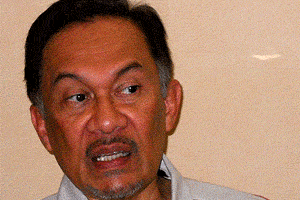 Anwar is the main adhesive in a Pakatan coalition that would be fissiparous if not for his ability to forge consensus.
Additionally, being No 2 to Anwar in PKR would require of a leader that he possess something of Anwar’s ability to interpret public opinion, purge it of its baser undercurrents, and translate it into policy for which broad-based support must be won to transmute it into reality.
Topping this already tall order is the need for someone with intellectual traction on a world-historical issue: whether Islam is compatible with democracy in Muslim-majority nations. In important portions of the world, Anwar is viewed as the leader most capable of delivering Islam’s positive response to that question.
Given the intellectual stakes involved, the question of who is to be No 2 in PKR is no ordinary one. Though this analogy is not exactly accurate, it does help to get the perspective right: PKR needs a Mohamed Hatta to a Sukarno.
Lack of credible successor
Elsewhere, the historical parallels are cautionary at best. The experience of two parties in the democratic world with similar beginnings to PKR suggests that the question of who is to help the founding leader is crucial for the party’s longevity.
The Swatantra party in India was a Congress splinter that tired of Nehruvian socialism but its viability as a free-market exponent in the 1960s was hampered for lack of a credible successor to its founding leader, C Rajagopalachari.
Swatantra’s failure was inimical to the growth of Indian democracy. A long-term effect of its failure was the spurt this gave to Hindu revanchism in the form of the Bharatiya Janata Party.
In Britain, the Social Democratic Party, a breakaway from left-inebriated Labour, could not catch on among voters in the 1980s because David Owen was a feckless back-up to SDP founding eminence Roy Jenkins.
Failure issued in the decline in intellectual vigor of politicians of the social-market stripe that Labour once produced with regularity. The result: a strand of political ideology called ‘New Labour’ that was neither here nor there.
Breakaway parties from mother lode ones need to be careful about a choice of who is to be in the ancillary position to the trailblazing founder.
It’s a question of sustenance and that may require putting the issue of who should be No 2 on a backburner when it appears that there is nobody yet on the horizon.
TERENCE NETTO has been a journalist for close on four decades. He likes the occupation because it puts him in contact with the eminent without being under the necessity to admire them.


Are you sure you want to delete this comment?
This action cannot be undone.