




Cops grill Soi Lek over Perkasa's report
MCA president Dr Chua Soi Lek today had his statement recorded by the police over his alleged inflammatory speech which had angered Malay pressure group, Perkasa.
MCA president Dr Chua Soi Lek today had his statement recorded by the police over his alleged inflammatory speech which had angered Malay pressure group, Perkasa.
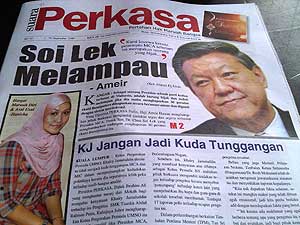 Perkasa had previously lodged a police report against Chua for allegedly questioning the special rights of the bumiputras in his speech at the MCA organised Chinese Economic Congress last month.
Speaking to the press after he met the police for about 50-minutes this morning, Chua said he had given a copy of his speech to the police.
He maintained that his speech was in no way racially motivated and was purely focused on the liberalisation of Malaysia's economy.
 "Whatever I said was for the good of the country, especially the economy... There was no ulterior motive," he said.
Chua earned condemnation from Umno leaders and Perkasa for his speech at the Aug 14 congress organised by MCA, which passed a 12-point declaration that among others, called for the gradual removal of the 30 percent bumiputera equity and the implementation of an open tender policy.
It led to a war of words between Chua and Umno deputy president and deputy Prime Minister Muhyiddin Yassin, who warned the MCA president against causing “uneasiness and anger just because you want to defend the rights of others”.
'It's just a suggestion'
In a bid to diffuse the uproar over his speech and the congress’ declaration, Chua a week later told the media that he was merely stating his views and not making any demands.
Repeating his softened stance, Chua said today that MCA was thankful for Prime Minister Najib Abdul Razak’s move to liberalise 22 sectors and believed the time has come to open up more sectors in Malaysia’s economy.
He stressed that his proposed “price preference system” is a reasonable alternative to the 30 percent bumiputera quota as it will encourage competitiveness across the board while still providing the right of higher value for bumiputeras as opposed to non-bumiputeras.
“If you want to develop land and factories, it is easier to work out (the 30 percent) equity.
“But if you want to develop your economy based on innovation and creativity, it would be quite difficult to get 30 percent innovation and creativity from and individual,” he said.


Are you sure you want to delete this comment?
This action cannot be undone.