




Will ETP work with uneven playing field?
Questions over the creation of a level-playing field in business cropped up at the Performance Management and Delivery Unit (Pemandu)'s Economic Transformation Programme (ETP) launch despite what appeared to be a high-level of optimism.
Questions over the creation of a level-playing field in business cropped up at the Performance Management and Delivery Unit (Pemandu)'s Economic Transformation Programme (ETP) launch despite what appeared to be a high-level of optimism.
When asked what the government should do to encourage private investment, captains of industry did not mince their words.
 Addressing this at the Chief Executive Officers (CEO) Forum following the launch, AirAsia chief Tony Fernandes bluntly said: "Government should get out of business, it will make us all much happier.
"The government should not see their role as a protector of GLCs (government-linked companies) but an enabler to both these companies and private companies," he said to applause from the full-house audience of 4,000 people.
Fernandes, who confessed that "most of his grey hair (sprouted) from competing with a GLC, added that when the government as a regulator sits on the board of GLCs, "there will never be a level-playing field no matter what they say".
"I am not a GLC slayer, there are good GLCs like CIMB which has been set free and Celcom which has competed without much government help.
"(But) Public Bank does not have to call up CIMB to open a branch at Jalan Ampang," he said. While Fernandes did not name Malaysia Airlines, he was clearly referring to the national carrier.
Similarly, Federation of Malaysian Manufacturers (FMM) president Yong Po Kuan said that it does not matter if private investment comes from GLC or otherwise, but "both must be free to compete (and) the government should not involve itself in business per se ".
Fernandes and Yong were on a panel with CIMB chief Nazir Abdul Razak, HSBC deputy chairperson Mukhtar Hussein, Celcom CEO Shazalli Ramly and Credit Suisse head of research Malaysia Steven Hagger.
The panel discussion was held following the launch by Pemandu CEO Idris Jala of an ambitious RM1.4 trillion development plan to be implemented over the next nine years with investments mainly from the private sector.
Nazir: Bumi quotas hold back investors
For Nazir, the one thing that needs to be addressed is consistency in government regulations.
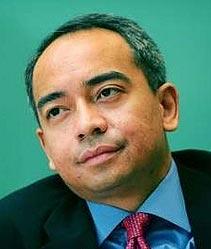 "It is necessary to have absolute certainty in rules and regulations. We don't want surprises and changes.
"(For example) the invitation for more entry point projects (as part of the ETP)... There must be a clear process. The last thing I want is for someone else to come in and (take over my) project. That's my worry," he said to nods from the audience.
An area which Nazir previously highlighted to be relatively vague and is causing investors to hold back is affirmative action policies involving bumiputera equity quotas.
Grilled on this by the media later, Idris - the man behind the ETP - said bumiputera companies that are capable are "encouraged" to compete on their own two feet.
 However, he could not provide details over how the government will decide if a bumiputera is considered 'able' enough to compete or not.
Nor could he say what guidelines there would be in terms of the "managed liberalisation" of such quotas.
"In the case of small and big stores, it is crucial for the government to play the part of the regulator to protect small stores.
"In regulating bumiputera/non-bumiputera competition, the government plays the part of keeping it fair and transparent, which is easier said than done," he admitted.
'If it fails, it is your fault'
Earlier in his opening speech , Idris addressed a popular concern that there is not enough political will to push the programme through.
"The government will not publish such a thick document... it is risky to expose yourself if you have no plans to do it.
 "Don't get vortexed on philosophical and wasteful academic debates. Remember, (the ETP) is private sector driven, so if it fails, it is your fault," he told the audience, comprising a large number of industry players.
The ETP is a product of 12 national key economic area labs largely from the private sector.
The programme provides detailed groundwork in changing the economy so the gross national income per capita will reach at least US$15,000 by 2020.
During the eight-week lab, the members recognised 131 entry-point projects which is expected to draw in RM1.4 trillion in investment by 2020, of which 92 percent will be from the private sector.


Report this comment
Are you sure you want to delete this comment?
This action cannot be undone.