




Saifuddin: Ignore student power at your peril
Deputy Higher Education Minister Saifuddin Abdullah today became one of the first in the BN government to warn against ignoring the lessons offered by Egypt and Tunisia.
Deputy Higher Education Minister Saifuddin Abdullah today became one of the first in the BN government to warn against ignoring the lessons offered by Egypt and Tunisia.
 If the authorities suppress the voices of the young - abreast as they are with political developments and ideas around the world and brimming with their own ideals - Saifuddin (
right
) said the indomitable energy of the young will only spill into the streets and onto the government's doorsteps.
The first scenario had occurred many times when students demonstrated over their right to free and fair campus elections.
The second went even beyond the literal form when more than a hundred Universiti Malaya students broke down the door to its deputy vice-chancellor’s office to protest the barring of candidates from contesting this coming week.
In an e-mail interview with Malaysiakini , Saifuddin admitted he recognises students want their voices to be heard.
“This is a fundamental and universal right. The authorities must entertain students’ rights. If authorities deny these rights, then the authorities should not blame the students if they act in ways that may be seen as radical, and so on,” said Saifuddin.
With many opposition leaders having raised the spectre of Egypt - whose president of 30 years Hosni Mubarak was toppled on Feb 11 by a popular revolt led by youth leaders - as the BN’s bogeyman, Prime Minister Najib Abdul Razak had issued a stern warning against such a revolt in Malaysia.
The revolution in Egypt came hot on the heels of another popular revolt in Tunisa that had led to the ouster of Zainal Abidin Ben Ali - previously dubbed the country's 'president-for-life'.
Lone voice in gov't
Saifuddin is best known as the sole voice within the BN government to call for amendments to university regulations so as to allow student participation in politics.
 The only other notable BN politician supporting the call has been Umno Youth chief Khairy Jamaluddin Abu Bakar (
left
).
“Students today follow political developments taking place around the world," Saifuddin told Malaysiakini in his e-mail.
"With the advent of ICT, they have access to all information. Because the social media is also interactive, they can even communicate with young political activists around the world.
“So, there is a lot of knowledge- and experience-sharing among them,” he said.
“I know that they are informed of various ideas of political improvements discussed in ths country: either the 'reform' ideas of Pakatan Rakyat or the 'transformation' ideas of BN, other discourses like on 'new politics', etc.
“I am sure they also follow closely what is currently taking place in the Middle East with a lot of interest,” he added.
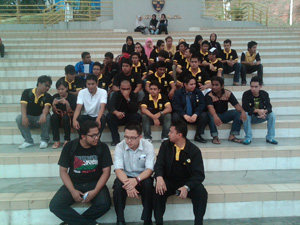 On the e-voting put in place by universities, Saifuddin said despite the demonstration by UM students last year over the matter, the university’s administration’s explanation was “satisfactory”.
Less than commendable, however, are the campus election turnout rates.
Noting that a few saw turnouts of less than 60 percent, Saifuddin said the universities have been asked to undertake programmes to motivate and encourage students to vote for their representatives.
“We don’t believe in compulsory voting,” he said.
Saifuddin also said he believed the student affairs departments in the universities have overall been doing “a good job” in spite of the occasional hiccups.
“I don't think we need observers for the elections,” he added.
He suggested, however, that it may be time for discussions to begin on how to allow students to run the campus elections themselves.
“This will provide for better opportunities for political education,” said Saifuddin.
He also said, however, that students should be allowed to form their own political groups. These should not be labelled pro-government or anti-government.


Report this comment
Are you sure you want to delete this comment?
This action cannot be undone.