




New rare earth plant revives radiation fears
The industrial town of Gebeng, near Kuantan, will soon have one of the biggest rare earth refineries in the world, according to US daily the New York Times .
The industrial town of Gebeng, near Kuantan, will soon have one of the biggest rare earth refineries in the world, according to US daily the New York Times (NYT).
Experts quoted in the report have raised concerns about hazardous radioactive wastes the operations will produce.
 The RM700 million refinery is being constructed by Australia’s Lynas Corp, which will ship rare earth ore mined from Western Australia’s Mount Weld.
This is Malaysia’s second foray into rare earth refining, following the much-disputed operations in Bukit Merah, Perak, in the 1980s.
The NYT quoted Malaysian Atomic Energy Licensing Board director Raja Abdul Aziz Raja Adnan as saying that approval was granted for the Lynas project after a thorough review by various government agencies.
Raja Abdul Aziz said the imported ore and waste products would have low-enough radiation levels to be manageable and safe.
 “We have learned we shouldn’t give anybody a free hand,” he said, referring to Bukit Merah.
However, Dr Jayabalan A Thambyappa, a physician and toxicologist who has treated patients in Bukit Merah, is not convinced.
“The word ‘low’ here is just a matter of perception - it’s a carcinogen,” he told NYT .
Yet the Malaysian government is eager for the Lynas plant to be constructed and has offered a 12-year tax holiday.
“If rare earth prices stay at the current lofty levels, the refinery will generate RM5 billion a year in exports starting late next year, equal to nearly one percent of the entire Malaysian economy,” NYT reported.
The refinery will have two dozen inter-connected buildings over a 20ha area. It will include the latest technology in pollution control and radiation detection.
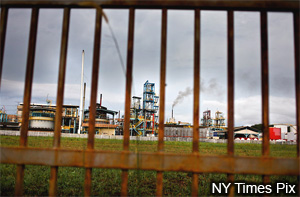 There will be a storage pool lined with dense plastic over impermeable clay to hold radioactive by-products until transported elsewhere.
How the waste will be permanently disposed of remains unanswered.
Lynas was quoted as saying that it intends to turn the waste into concrete-like objects known as tetrapods, to be used for artificial reefs and sea walls to contain erosion.
The report noted that most countries were extremely wary about the environmental impact of refining rare earth, leaving China, as the world’s biggest producer, with a virtual monopoly.
‘Secret clean-up under way’
In the 1980s, Japan’s Mitsubishi Corp had set up Bukit Merah Asian Rare Earth company.
It relocated its refining work to its plant in Bukit Merah, near Ipoh, where semi-processed slag rich in rare earth ore left by tin mines is abundant.
However, the refinery was blamed for the unusually high number of birth defects among those in the vicinity.
The Bukit Merah plant ceased operations in 1992 after sustained protests from locals and environmentalists.
NYT reported that Misubishi, conscious of its image, is currently engaged in a secret clean-up job, which is reportedly costing RM300 million.
It also claimed that radioactive wastes from Bukit Merah are being stored in the core of a hill in a nearby forest reserve, and that it is entombed under more than six metres of clay and granite.


Report this comment
Are you sure you want to delete this comment?
This action cannot be undone.