




News portals excluded from govt's media council
News portals will not be included in the media consultative council, mooted to be jointly-headed by Information, Communications and Culture Minister Rais Yatim and Home Minister Hishammuddin Hussein.
News portals will not be included in the media consultative council, mooted to be jointly-headed by Information, Communications and Culture Minister Rais Yatim and Home Minister Hishammuddin Hussein.
This is according to the proposal sent to selected members along with an invitation for the first meeting on the matter, scheduled at 4.30pm in Kuala Lumpur today.
 Instead of widely-read portals like
Malaysiakini
, the
Malaysian Insider
,
Free Malaysia Today
and
Merdeka Review
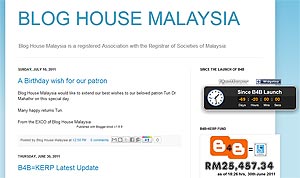
, the proposal included bloggers' association Blog House as representative of “new media”.
Instead of widely-read portals like
Malaysiakini
, the
Malaysian Insider
,
Free Malaysia Today
and
Merdeka Review
, the proposal included bloggers' association Blog House as representative of “new media”.
The Blog House committee members are made of, among others, veteran journalist Ahiruddin Atan and former premier-turned blogger Dr Mahathir Mohamad as a patron.
Other mooted senior government members of the council include Information, Communications and Culture Ministry secretary-general Kamaruddin Siaraf and Home Ministry secretary-general Mahmood Adam, who will serve as joint-deputy chairpersons.
Also on the list are the Prime Minister’s press advisor and press secretary, the National Security Council secretary, and 20 other top officials from the two ministries, including those from the Information Department's Special Functions Department (Jasa).
‘Joint-communications strategy’
Non-governmental bodies listed as proposed members are the Malaysian Press Institute, National Union of Journalists Malaysia and the Association of Magazine Publishers.
The six-page proposal notes that the purpose of the council is to create a “forum” for “harmonious” cooperation between the government and the media to ensure “national interests are protected and upheld”.
 Among others, it aims to “formulate communications plans to overcome recurring issues” and to “instill patriotism”.
“The council’s function includes... detecting, handling and overcoming all negative elements with the aim of defending the sanctity of the state and constitution,” it states.
It also makes repeated mention that the objective is to “guarantee media freedom in accordance to the law”.
The proposal, however, does not mention legislative powers or methods to be introduced to ensure media members adhere to any consensus made during the suggested bi-annual meets.
The state currently has control over print media through the Printing Presses and Publications Act 1984 and electronic media through the Communications and Multimedia Act 1998.


Are you sure you want to delete this comment?
This action cannot be undone.