




'Social media moves people to choose sides'
The social media is often seen as a platform for dissent, with Facebook protest groups mushrooming every time people are displeased with the authorities.
The social media is often seen as a platform for dissent, with Facebook protest groups mushrooming every time people are displeased with the authorities.
Despite its polarised nature, the social media is very diverse, observed research analyst Tricia Yeoh.
 Through her observation of micro-blogging site Twitter, Yeoh said, she noted fierce debate from both sides of the divide from the day Bersih 2.0 launched its online campaign for the July 9 rally for free and fair elections.
"Funnily enough, the word 'Bersih' was not trending (most popular topic) on Twitter on that day but the words 'Yellow' and 'Kotor' were.
"This is to say that both pro-Bersih and anti-Bersih online citizens were actually participating in this live dialogue," Yeoh ( left ) said.
She was speaking at a discussion session organised by the Centre for Independent Journalism (CIJ) in Kuala Lumpur last night.
The other panellists were a former editor with The Star, Gobind Rudra, academician Pauline Leong and CIJ media monitor Ding Jo-Ann.
The social media, Yeoh explained, has highlighted the polarity between online citizens as people were more likely to speak their mind against one another.
This, she said, forced people to confront the Bersih phenomenon and ultimately take sides.
"It was so widespread you were forced, in a way, to talk about it, to think about it and bring yourself into the conversation. You sense that both sides would say, ‘you are either with us or against us'.
"The social media brought the debate public, everyone was moved to deal with the issue somewhat... even if you have no clue who the opposition leader is, you would know there is something going on with Bersih," she said.
Social media countered mainstream media
Gobind said that besides encouraging debate, the social media was effective in debunking misreporting by the mainstream media.
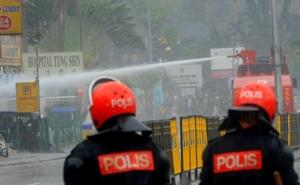 "The video clips on the Tung Shin Hospital and the photo of the man allegedly holding a knife were debunked on the social media almost instantly on Sunday morning (the day after the Bersih rally)," he said.
Police had, after the protest, denied firing tear gas and water cannons into the Tung Shin Hospital compound but video clips posted online revealed otherwise.
The front pages of Berita Minggu the Sunday (July 10) edition of Malay daily Berita Harian and New Sunday Times that featured a man brandishing a knife during the rally were also refuted online , showing him holding the national flag.
Leong said the countering of the Bersih rally was so "crude" that people could easily debunk the claims of the government and the police.
 "The methods used by the government were very crude. Because it was so crude, any person with minimum intelligence could see this," she said.
Gobind ( right ) cautioned that though the mainstream media did not live up to its expectations, the social and online media could not be expected to take up the role of a full-fledged media.
"We cannot expect the online media to perform this load yet, because it is a very young media and very short on staff. It is so fragmented and defused there is no way it can focus on a particular aspect of an issue," he said.
The discussion session followed a report presented by CIJ on the mainstream media's coverage of the Bersih 2.0 movement in the run up to the landmark rally.
Related stories :
EC chief: More woes with biometrics than indelible ink
DAP reveals 'clone wives' of army voter
'Parties complain roll is dirty but try to register the dead'
Postal votes to be extended to all M'sians overseas
Amendment to postal votes to be tabled in October
EC deputy chief told to stop flip flopping
'By-election losses spur Pakatan's reform demand'
NGO wants MACC to probe phantom voter 'syndicate'
KJ: Polls panel won't look only into Bersih demands


Are you sure you want to delete this comment?
This action cannot be undone.