




Academicians moot freedom march to Putrajaya
A cosy forum on academic freedom at Universiti Malaya last night turned into an action meeting of academicians incensed by what had happened to their colleague, law professor Abdul Aziz Bari.
A cosy forum on academic freedom at Universiti Malaya last night turned into an action meeting of academicians incensed by what had happened to their colleague, law professor Abdul Aziz Bari.
 Lamenting on what they viewed as "political appointments" in the academia and the silencing of dissent, the 30-odd academicians from private and public universities made several suggestions, including marching in the streets to show their discontent.
"If you can get 1,000 academicians to walk to Putrajaya, I think the government will have to listen to you," said Universiti Kebangsaan Malaysia senior research fellow Denison Jayasooria, inspired by the lawyers' march of 2007.
Denison said this in response to concerns expressed by Isham Pawan Ahmad of Universiti Islam Antarabangsa, who said that only 60 out of the university's 2,000 academic staff had endorsed the press statement in support of Abdul Aziz.
"If we had gone to the rector with the 60 names, it would have been embarrassing," Isham said at the three-hour event that ended at midnight.
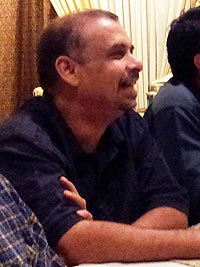 In keeping with the embarrassment theme, Isham (
left
), who is assistant professor of comparative religion, went on to moot shaming the high profile National Professors Council.
"We could perhaps get some of the professors in the council to endorse greater academic freedom so that we can embarrass the council (for not taking a stand on the issue)," he said.
UM senior research fellow Muhammad Ikmal Mohd Said suggested an assembly, like the one held by academicians in the UM campus in 1985 in response to the sacking and demoting of two colleagues.
"Every academic association needs to mobilise, for instance, an assembly to again show the force of academicians on this issue. A demonstration of sorts," Ikmal said, met with concerns that only a handful could show up.
Creating a 'tipping point'
Sharing his experience in mobilising students for the protest the Friday after Aziz's suspension, student leader Mohd Zaki Sukery made his argument to the academicians that big enough numbers to create a "tipping point" effect was needed, not necessarily huge numbers.
 "We had 2,000 people there, which is nothing compared with the student body of UIA. We even mobilised people from other campuses, and the event was a tipping point," said the Gabungan Mahasiswa Islam Se-Malaysia leader.
Mohd Zaki ( right ) said that greater numbers could also be achieved if students and academic staff linked arms, particularly to hold an assembly to push for academic freedom.
Agreeing with this, Universiti Sains Malaysia's Wan Manan Wan Muda said students and academic staff have for too long been under a "divide and rule" administration.
"We're not even allowed to address student association meetings. Students and academic staff are the patty and buns of the academia hamburger. The others are just pickles and salad, not essential," Wan Manan said, to laughter.
Centre for Independent Journalists representative Masjaliza Hamzah suggested that students lobby their lecturers to endorse the move, while lecturers hold special lectures on issues such as academic freedom to educate students on what they were missing out on.
International pressure
Wan Manan, who compared academicians to second class citizens for being gagged against voicing their opinions, also drew from his experience in the movement in 1985.
In 1985, USM lecturers Hashim Hussein Yaacob and Rohana Ariffin were sacked and demoted respectively for a press statement made, sparking rallies.
In response to this, Wan Manan said, international academicians who came to Malaysia for conferences in 1985 were alerted so they could speak out on the matter, and the same could be done today.
"Western academicians are very open about this and will speak out on issues. In 1985, we slipped documents under the hotel doors of visiting academicians. Now, it's much easier.
"The (then) USM vice-chancellor said he was hounded by academicians wherever he went. He stepped in a university in Canada and they were saying, 'It's all your fault'," Wan Manan said.
Hashim and Rohana won their cases against USM in 1987.
 UM lecturer Rosli Mahat said international pressure groups could also be co-opted for their cause.
"We have strong relations with Education International, and managed to get it to issue a statement (on Aziz's suspension)," said the Malaysian Academic Movement (Move) chief.
Rosli said the Network for Academic and Economic Rights (Near) also put out an alert on the matter to its members.
"Near also submits reports to the United Nations Educational, Scientific and Cultural Organisation (Unesco) and if we can organise for this (academic freedom in Malaysia) to be part of the Unesco general assembly, it can rattle the powers that be," he said.


Report this comment
Are you sure you want to delete this comment?
This action cannot be undone.