




Suhakam tries to apply brakes on Assembly Bill
The Human Rights Commission of Malaysia (Suhakam), has called on the government to halt the enactment of the Peaceful Assembly Bill 2011, slated for second reading at Parliament today.
The Human Rights Commission of Malaysia (Suhakam), has called on the government to halt the enactment of the Peaceful Assembly Bill 2011, slated for second reading at Parliament today.
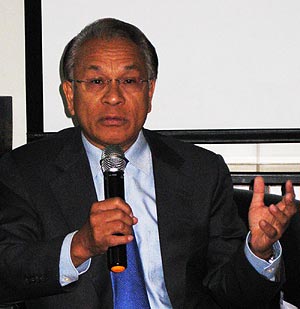 "The commission, therefore, calls upon the government to consider recommendations made by various parties and open up avenue for discussion and public discourse on freedom of assembly before enacting the Peacful Assembly Bill 2011 into law to ensure that the provisions provided are in line with human rights principles," said Suhakam chairperson Hasmy Agam (
left
) in a statement released today.
"The commission, therefore, calls upon the government to consider recommendations made by various parties and open up avenue for discussion and public discourse on freedom of assembly before enacting the Peacful Assembly Bill 2011 into law to ensure that the provisions provided are in line with human rights principles," said Suhakam chairperson Hasmy Agam (
left
) in a statement released today.
Although Suhakam, the statutory body set up to advise the government on human rights issues, welcomed the Bill, it pointed out that its views provided to the government at a meeting with the Attorney General last month on the freedom of assembly and related matters, are absent in the Bill.
Suhakam emphasised that amendments to some of the provisions of the Bill must be made to ensure that the right of the people's right to express themselves through peaceful public assemblies is protected and expressed in a manner that meaningfully reflects the essence of that right.
"Some of the provisions under the Bill impose too many restrictions and give too much discretionary powers to the police, thus undermining the right of the public to organise or participate in peaceful assemblies."
Listing down vital requirements
The commission proposed, among others, that:
1.A clearer distinction be made between the definition of an "assembly" which includes procession and that of "street protest";
2.The extension of the right to assemble peacefully without arms to non-citizens as they too, have the right to express themselves and
 to be heard;
3.A review of the prohibition against any assembly within 50 meters of any prohibited place as such prohibition is impractical and unrealistic in most cities and towns;
4.To allow the appeal on restrictions and conditions imposed by the police to be made to the court instead of to the Minister;
5. To reconsider the provisions on the participation of children in the light of our treaty obligations under the Convention of the Rights of the Child (CRC);
6.To review Clause 13 to put in place a co-operative model which would allow the police and the organiser of public assemblies to discuss and arrive at a consensus on matters relating to the assembly for the purpose of facilitating the assembly in line with the objectives of the Bill;
7.To incorporate the provisions of the UN Basic Principles on the Use of Force and Firearms by Law Enforcement Officials under Part V of the Bill which deals with enforcement;
The need for supervisory eye
8. To ensure full, and not just reasonable, access of the media in public assemblies under Clause 24;
9. To review the notification period of 30 days or to provide for exceptions in cases where it is not feasible or not practicable to meet the requirement of 30 days; and,
10. To include a provision to allow external parties such as Suhakam, the Bar Council and other relevant statutory bodies to monitor public assemblies.
Suhakam supported the objectives of the Bill in principle but stressed that in the implementation of the the Bill, a proper balance must be
 struck between organising and participating in public assemblies, and the protection of the rights and freedom of other persons indirectly affected by the assemblies.
The commission said that the announcement to repeal of Sections 27, 27A, 27B and 27C of the Police Act 1967 is much welcomed as it recognised the spirit of and the respect for human rights.
"However, the Bill replacing it imposes too many restrictions and conditions for the public instead of facilitating freedom of assembly.
"Whilst acknowledging that peace and stability are paramount and that public order needs to be maintained at all times, the commission is of the view that peaceful public assemblies provide an avenue for the public to express themselves on issues that are of concern," Hasmy added.


Are you sure you want to delete this comment?
This action cannot be undone.