




'Political corruption a major factor in deforestation'
Decades of political corruption are seen as the main contributor to the depleting natural forest cover, says Transparency International-Malaysia (TI-M), with the felling of timber being the foremost revenue for political funding.
Decades of political corruption are seen as the main contributor to the depleting natural forest cover, says Transparency International-Malaysia (TI-M), with the felling of timber being the foremost revenue for political funding.
"Unfortunately, corruption has become a root cause of deforestation and forest degradation in developing countries, including Malaysia," TI-M's secretary-general Josie M Fernandez said.
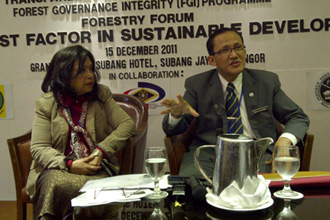
 In her keynote address at a TI-M forum under the Forest Governance Integrity Programme (FGI), Josie (
right
) said countries rich in forests are well-known to "suffer" from a high level of corruption.
Citing a World Bank report, she said an estimated "US$10 to US$23 billion worth of timber is illegally felled or produced from suspicious origins" and the forestry sector "thrives and depends on corruption".
In turn, Josie said, the widespread corruption influenced land policies, which were under the direct purview of the states, and were in effect controlled by politicians.
Although Josie stressed that the situation was not unique to Malaysia, she reminded "the ruling elite" that natural resources were not to be treated "as personal fiefdom" to be sold, regardless of the laws in force.
Data on protected areas, forest reserves lacking
Perceptions of the elite as corrupt, she said, would prevail "as long as there is no accountability and transparency in how concessions and timber licences are awarded".
 Speaking to reporters later, Josie said there could be a situation where timber concessions and logging licences awarded exceeded the acreage of the primary forest in the country.
The lack of current and accurate information on the statistics of the "protected areas and forest reserves" was among the factors for the prevailing fraudulent practices.
"Corruption in forestry thrives because, even though publicly condemned, it has been tolerated," she said.
According to the Malaysian Anti-Corruption Commission's 2010 annual report that was released in April, Peninsular Malaysia alone lost RM8.95 million in royalties from illegal logging.
Stressing that the nation's forests were at stake, Josie urged the government to restructure revenue-concentrated forestry policies and to move towards "sustainable extraction and conservation".
The survival of the country's tropical rainforest rely much on the sustainable forest management, she added.
 The Swiss NGO campaigning against corruption in Sarawak, Bruno Manser Fund, and online news portal
Sarawak Report
have been insisting that uncontrolled timber extraction would destroy 90 percent of Sarawak's forests by 2020.
However, Chief Minister Taib Mahmud (right) has denied this charge, saying 70 percent of Sarawak's rainforest is still intact, while 14 percent of its "secondary forests" have been replanted or are in the process of being converted into plantations.
Universiti Kebangsaan Malaysia's Institute for Environment and Development (Lestari) head Shaharuddin Mohamad Ismail, explained that state governments often neglected the importance of the country's tropical rainforests because they are the highest revenue earners.
Shaharuddin told the some 80 stakeholders present that the timber industry contributes significantly to the economy as in 2010 it chalked up RM20.52 billion in revenue.
“State income from forest revenue for the Peninsula alone, was RM385 million for 2010, providing 300,000 jobs, as for Sarawak it was RM600 million while Sabah earned RM297 million,” he said.
“If the state has 1,000 hectares of land they are not going to keep it if they need the money,” he reasoned, adding that this could be curbed if state governments were given an allocation out of federal government revenue.
Meanwhile, Sabah Forestry Department deputy director Rahim Sulaiman gave an anecdotal speech when criticising the federal government’s National Key Result Areas (NKRA) and National Key Economic Area (NKEA).
“All this NKRAs and NKEAs suck as far as forestry is concerned... the federal government cannot have high impact projects when we have no money,” he said to laughter from the participants.
“We are getting no money for services provided by the Forestry Department... in fact we are getting only one third of the allocation we used to get under the Ninth Malaysia Plan,” he said, adding that the cost of reforestation can run into tens of millions of ringgit.


Report this comment
Are you sure you want to delete this comment?
This action cannot be undone.