




Religious status: Case sent back to High Court
The Federal Court will not answer five constitutional questions raised on the religious status of a 61-year-old storekeeper and his children because the facts are disputed.
The Federal Court will not answer five constitutional questions raised on the religious status of a 61-year-old storekeeper and his children because the facts are disputed.
These questions should be determined by the High Court in Shah Alam, the five-member panel headed by Court of Appeal President Md Raus Sharif decided today.
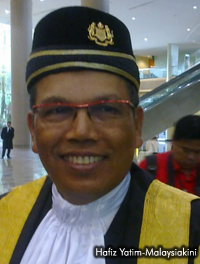 In announcing the unanimous decision in Putrajaya, Justice Md Raus (
right
) said the facts of the case were in dispute and the matter therefore had to be reverted back to the High Court.
"We will let the High Court decide on the facts first, based on its merits," he said in dismissing the application.
The other four judges are Chief Judge of Malaya Zulkefli Ahmad Makinuddin, and Federal Court judges Hashim Yusof, Suriyadi Halim Omar and Hasan Lah.
The storekeeper, Zaina Abdin B Hamid @ S Maniam or Balachandran, his two sons Surindran a/l Zaina Abdin, Mohanasubash a/l Zaina Abdin and daughter Chandrika a/p Zaina Abdin, are Hindus and said they never were Muslims.
Despite having a Muslim name, Zaina Abdin affirmed in an affidavit that he had never practised Islam since birth, is a practising Hindu and is married to a Hindu woman, with whom he has three children.
His marriage was registered by the National Registration Department in 1986.
Zaina's mother is stated to be a Muslim, while his father is said to be a convert to Islam.
But both, according to Zaina's affidavit, practise the Hindu religion.
Zaina and his children are represented by K Shanmuga and Fahri Azzat.
This case has also attracted the attention of the Malaysian Human Rights Commission (Suhakam), with deputy commissioner Dr Khaw Lake Tee present in court, along with other non-governmental organisations, including the Bar Council, which held a watching brief.
Prayers sought
In their originating summons filed in 2002, the four had named the Malaysian government, the Selangor government, the State Islamic Council and also the Malaysian Consultative Council for Buddhism, Christianity, Hindu, Sikhism and Taoism as respondents.
They are seeking to change their names to Balachandran a/l S Maniam, Surindran a/l Balachandran, Mohanasubash a/l Balachandran and Chandrika a/p Balachandran.
 The family is also seeking that all records and deeds state them as being of the Hindu religion and not Muslims, and that they do not want to be considered as Malays or professing the Islamic religion. The children are now aged between 19 and 24 years.
Shanmuga ( right ) said he respected the court’s decision and would go back to the High Court on the matter.
“For us, the facts are clear but now are being disputed by the other side,” he said.
Selangor state legal adviser Zauyah Be Loth Khan represented the Selangor government while the head of the civil division in the Attorney-General’s Chambers, Azizah Nawawi, represented the Malaysian government.
Zauyah had raised the status of Zaina’s religion following a claim made by his mother that she had returned to practising Islam.
Questions posed
The case was transferred to the Federal Court for determination under Section 84 of the Courts of Judicature Act 1964 by High Court judge Nurchaya Arshad.
The questions involve:
- Are the following paragraphs containing the word “Muslim” in Section 2 of the Administration of the Religion of Islam Enactment 2003, inconsistent with Article 11 (Freedom of Religion), which is to be read together with Article 3 (Position of Islam), Article 5 (Liberty of the Person) and Article 154 (Special Privileges of the Malays) in the Federal Constitution?
- Do the parents of a child under the age of 18 have the right to determine the religion of that child for all public and private purposes, pursuant to Article 11 and 12(4) of the Federal Constitution?
- ls the application of lslamic law on a person who professes himself to be a Hindu but is considered a Muslim under Islamic law inconsistent with Article 11 (and read together with Articles 3,5, 8 (Equality before the law) and Article 153 of the Constitution?
- Does the condition that a person must first get a declaration from the State Religious Council or the Syariah Court that he or she is no longer “a Muslim” before he or she is recognised by the relevant authorities as a person who does not profess Islam render his or her rights under Article 11 [read together with Articles 5, 8 and 153] of the constitution illusory and therefore unconstitutional?
-
 Is Regulation 14(2) of the National Registration Regulations 1990 inconsistent with Article 11 [read together with Articles 3, 5, 8 and 153] of the Federal Constitution and is therefore unconstitutional?
However, Fahri ( right ) conceded that questions two and five were not relevant but questions one, three and four were, especially the first question, which is vital for the court’s determination.
After hearing submissions from the parties, Justice Md Raus, who is the second highest judicial officer in the country, said the court could not be making a finding of fact on the questions posed as the facts of the case were in dispute.


Report this comment
Are you sure you want to delete this comment?
This action cannot be undone.