




Government debt now 65.2% of our GDP
MP SPEAKS Based on the government's Economic Report 2011-2012 published last year, our federal government debt will hit RM455.7 billion as at the end of 2011.
MP SPEAKS Based on the government's Economic Report 2011-2012 published last year, our federal government debt will hit RM455.7 billion as at the end of 2011.
This would be a 11.9 percent increase from RM407.1 billion incurred in 2010. Our debt levels have been increasing rapidly in recent years, compared with RM242 billion in 2006 and RM146 billion in 2002.
 As it stands, the federal government debt has hit 53.8 percent of our gross domestic product (GDP), compared with 53.1 percent in 2010 and 44.6 percent in 2006.
However, what is of greater concern is the government "off-balance sheet" financing which isn't reported as federal government debt.
In recent years, the government has increasingly issued debt papers via its statutory bodies and corporatised entities. These loans are obtained with guarantees provided by the government, but are not reflected as federal government borrowings.
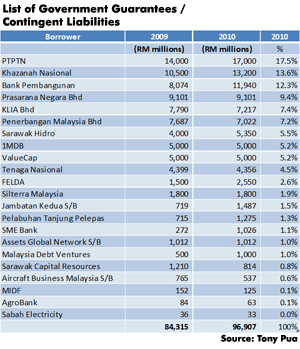
In 2010, the "off-balance sheet" financing activities hit a record high of RM96.9 billion, a 14.9 percent increase from RM84.3 billion in 2009.
These are loans that have been taken with a government guarantee, which the government is obligated to pay should the borrowers fail to settle the debts.
As an example, if the Federal Territories Foundation is unable to repay the proposed RM300 million loan from EPF to provide financing for the low-cost housing purchasers, then the government will have to step in to make the RM300 million payment to EPF.
Inability to repay loans
Hence for all intents and purposes, even though these loans are not taken by the government, they are essentially government debts, or otherwise known as contingent liabilities.
Adding RM96.9 billion to the current debt of RM455.7 billion, the effective debt that Malaysian taxpayers are liable for is RM552.6 billion.
This expanded figure would then constitute 65.2 percent of our GDP, well above the 55 percent federal government loan limit as defined in the Loan (Local) Act 1959 and Government Funding Act 1983.
The list of statutory bodies and corporate entities that have been given government guarantees are as per the table above. Based on the list, there are some serious concerns over the performance or non-performance of these loans, which will require bailouts by the federal government.
 For example, the Higher Education Loan Fund (PTPTN) and Syarikat Prasarana Negara Bhd owe RM17.0 billion (17.5 percent) and RM9.1 billion (9.4 percent) respectively and they have both been heavily criticised by the auditor-general for their weak financial management and their inability to repay their loans.
The list also includes Syarikat Penerbangan Malaysia Bhd (RM7 billion), which was set up to bail out Malaysian Airlines System (MAS); 1Malaysia Development Bhd (RM5 billion), which in turn lent nearly all its money to a questionable foreign company, PetroSaudi International Ltd; and Silterra Bhd (RM1 billion), which has made more than RM2 billion in losses to date.
Hidden debts
What is interesting is also the fact that loans of Syed Mokhtar Al-Bukhary-owned Port of Tanjung Pelepas (PTP) also received financial guarantees from the government.
PTP's "guaranteed" loans have in fact increased from RM715 million in 2009 to RM1.275 billion in 2010.
Expert testimonies in 2009 in the parliament of the United Kingdom heavily criticised government guarantees to statutory bodies, government-linked companies or "private-finance initiatives" as an attempt to hide real debt levels in order to achieve better credit ratings.
Professor Dieter Helm of Oxford University said that such initiatives had succeeded as "an exercise to get investment off the public balance sheet so that the debt numbers look better than they otherwise would have done".
The Greek financial crisis has similarly unravelled as a result of hidden contingent liabilities not reflected as official government debt or reported in its balance sheet.
For a start, the BN government must reflect all its guarantees and contingent liabilities in the annual Economic Report and budget to be debated in Parliament and it must impose measures to slow down the rate of growth of Malaysia's debt levels.
Malaysia should not wait for a major financial crisis of Greek proportions before attempting to reform our public sector finance. At the pace which our debts are increasing, we are accelerating headlong into a financial disaster.
TONY PUA is the DAP national publicity secretary and MP for Petaling Jaya Utara.


Report this comment
Are you sure you want to delete this comment?
This action cannot be undone.