




Tabloid's Penan incest story 'offensive and baseless'
On Sunday May 13, the front page of the tabloid Metro Ahad read: ‘Ibuku, isteriku, bapaku, suamiku’ (My mother, my wife, my father, my husband). On page 4, the report was titled ‘ Abang kahwin adik sendiri’ (Brother marries his own sister). This must have been the most offensive caption ever on Mother’s Day!
On Sunday May 13, the front page of the tabloid Metro Ahad read: ‘Ibuku, isteriku, bapaku, suamiku’ (My mother, my wife, my father, my husband). On page 4, the report was titled ‘ Abang kahwin adik sendiri’ (Brother marries his own sister). This must have been the most offensive caption ever on Mother’s Day!
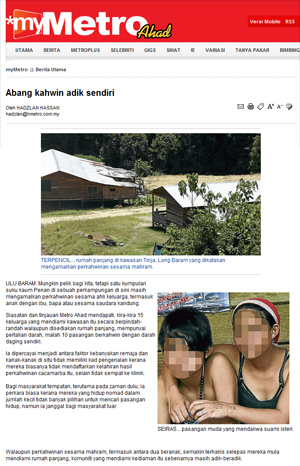 The
Metro
article was a pathetic effort at sensationalising a non-existent issue to humiliate the Penan.
The Metro reporter Hadzlan Hassan highlighted his ignorance of Penan ‘adet ’ or customs and the customs of Sarawak’s indigenous communities, by writing a story on purported incestuous marriages.
He made the indefensible claim that these crimes were committed by the Penan of Ulu Baram - a vast area, nearly the size of Perak.
In this damaging article, Hadzlan Hassan gave a vague estimate that 10 married couples in Ulu Baram are practising incestuous marriages.
He wrote in Malay that “for this local community, especially in bygone days, incestuous marriage is the norm because they live a nomadic life in small numbers and do not have much choice in finding a life partner…”.
As far as the Penan ‘ adet ’ is concerned, marriage between siblings,or between a child with a parent - as claimed by Metro - is entirely prohibited.
Even marriages between first cousins or nephews/nieces marrying their uncles/aunties are banned, not only for the Penan but also for other indigenous communities in Sarawak.
I am an anthropologist who has worked with the Penan in Sarawak for many years. I have never come across any Penan community that allows incestuous marriage.
In fact, none of the indigenous communities in Sarawak practise this - not the Penan, not the Kayan, not the Iban, not the Kenyah, not the Bidayuh!
I do not know of any literature regarding communities in Borneo practising incestuous marriages.
Rodney Needham, one of the first anthropologist who worked with the Penan in the 1950s, also stated clearly in his thesis that the Penan had no recollection of allowing incestuous marriages in the past.
On the contrary, the Penan consider such relations as a strict taboo.
Baseless inferences
Metro Ahad ’s story has stirred up a serious controversy, especially when the author cannot provide evidence for his claims.
Hadzlan Hassan should have done a modicum of research on this subject.
Instead, he simply built his article on baseless inferences, following a reported conversation with a certain Joni. He claimed Joni was a “spokesperson for the community”.
Over the past decades, anthropologists studying kinship systems of different communities have developed specific methods for carrying out objective inquiries in their research.
How can a reporter like Hadzlan Hassan, who is ignorant of the local customs and languages of that community, come up with such crass, insensitive questions for the Penan?
He assumes that just because they have “ paras rupa yang sama ” (their faces look similar), they must be siblings.
Facial resemblance alone does not qualify as blood relations. If a couple had similar physical features, surely the reporter in question ought to have arranged for DNA testing to determine their biological relationship.
The issue here is not only about the Penan community, but rather the motive of this reporter in making inquiries of local natives, while being ignorant of the cultural context of the Penan community in question (including their language, customs, belief systems and environment).
Many glaring errors
There are many glaring errors committed by reporters of Metro Ahad , which clearly demonstrate their crushing ignorance of the Penan.
Firstly, the reporter seemed to be geographically illiterate. He mixed up Ulu Baram, Tinja and Long Baram.
Tinja and Long Baram are names of places that do not exist in the real world, either on the map or in the cultural histories of the local communities.
Even if the Metro reporters were referring to Ulu Baram as upriver Baram, they did not specify the Penan community in question. Which Penan community was the reporter referring to?
There are more than 100 Orang Ulu settlements in Ulu Baram which include the Kayan, Kenyah, Penan, Kelabit communities. The number of Penan settlements alone in Ulu Baram is 60.
Also, the Metro Ahad reporters were blissfully unaware of some simple geographical facts, as exemplified by their use of Tinja.
Tinja ought to be correctly spelt as Tinjar, unless these reporters were referring to a fictional river in the middle of nowhere.
The Tinjar River is not the same as Ulu Baram as mentioned by the reporters.
There is also no such place, settlement or river confluence called Long Baram. If the reporter intends to be credible, then the least he could do would be to verify his information.
Secondly, the reporter speculated that “it is believed that one of the reasons most youths and children there do not own identity cards is that local people do not often register their children’s birth resulting from such ‘messy’ marriages…”
This is one of the nastiest allegations made in the mainstream media about a community living without adequate registration documents in remote areas, trapped in poverty.
In many of the Penan settlements I have visited over the years, there are National Registration Department posters plastered on the walls, exhorting the Penan and other rural communities to register their children’s births.
But poverty and the long distances to the nearest towns mean that many of the Penan communities cannot afford to pay for transport and the cost of staying in town.
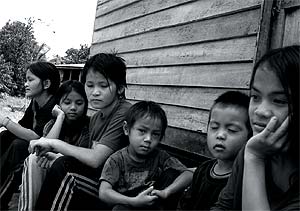 In my years of field research, I have never come across any Penan families that cite “
perkahwinan cacamarba
” or messy marriages as a reason for not wanting to register the birth of their children.
Thirdly, the Metro Ahad reporter also concocted a connection between these imaginary incestuous marriages and the all-too-real Penan rape cases reported in 2008.
Metro wrote: “When asked if they were raped by the loggers as was hyped (sic) by the NGOs previously, (the Penan) denied it and said instead that the child was a product of their own marriage.”
Ethics of journalism
Is it not incredibly rude and insensitive to ask a random girl if any timber workers had raped her? Would anyone in his or her right mind answer that kind of question from a stranger?
Was there any understanding of the ethics of journalism that this reporter was supposed to abide by? It is mind-boggling that the reporter attempted to link the two separate and unrelated incidents.
Was the reporter questioning the reliability of the National Taskforce Report published in 2009 that confirmed the incidents of sexual violence and exploitation of the Penan women and girls by loggers in Sarawak?
In case the Metro Ahad reporter had forgotten, this National Task Force was set up by the federal Ministry of Women, Family and Community Development. Was the reporter implying that the report was “ digembar-gemburkan ” or hyped by the ministry?
The Metro Ahad report was an example of the worst excesses of tabloid newspapers.
The report had no solid basis and was packed with factual errors. I can only see this article as a deliberate attack on Penan customs and culture - things which the reporter obviously knew nothing about.
However, the story’s sadistic attempt to link entirely unsubstantiated Penan incest or sexually deviancy with the well-documented Penan rapes does provide a clue to its motive of manipulation and propaganda - smearing the Penan who have opposed logging.
This must be condemned in the strongest possible terms. I urge all fair-minded people, and the professional journalists among us, to speak out publicly against such unacceptable garbage by Metro Ahad .
KELVIN EGAY is an anthropology lecturer at Universiti Malaysia Sarawak.


Report this comment
Are you sure you want to delete this comment?
This action cannot be undone.