




50 days later: Why 'Occupy Dataran' still on
Coming to two months on, the 'Occupy Dataran' camp has become something of a permanent sight in the landscape of Dataran Merdeka.
Coming to two months on, the 'Occupy Dataran' camp has become something of a permanent sight in the landscape of Dataran Merdeka.
A small group has occupied a small space opposite the Bangunan Sultan Abdul Samad since April 14, in what they described as a movement to reclaim public space.
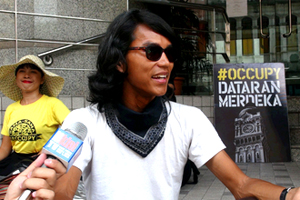 While this, to the powers that be, may be seen as a violent attempt to overthrow the government, for many others, the idea of ‘reclaiming public space' carries little resonance.
This, Occupy Dataran activist Fahmi Reza, 35, ( left ) admits is a challenge in attempting to gain public support.
"It is easier to gain support from the public if the issues are negative in nature, for example if you are anti-something, but for something positive like reclaiming public space, it is harder," he said in an interview with Malaysiakini .
Access to public space, Fahmi said, is indirectly related to democratic space which includes the freedom of expression and assembly.
"It doesn't come cheap or free, you have to fight for it and this is our way of doing it," he said.
True to their ideals the group conducts routine activities every night, such as the People's Assembly - a grass root version of Parliament - and lectures on citizen rights.
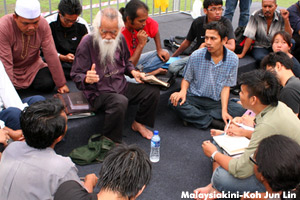 The Occupy Dataran activists had joined in the protest after student activists decided to camp at Dataran Merdeka following the
anti-PTPTN protest
on April 14 for two weeks until the Bersih 3.0 rally.
The Occupy Dataran activists had joined in the protest after student activists decided to camp at Dataran Merdeka following the
anti-PTPTN protest
on April 14 for two weeks until the Bersih 3.0 rally.
"The students sparked it by putting up the tents but once Occupy Dataran came in we added the strategic element. It has lasted this long partly because Occupy Dataran has the experience," he said.
Unlike the student activists which wrapped up their campaign after the Bersih 3.0 protest, the Occupy movement has continued the encampment - 50 days now - as the group feels that their goal has yet to be achieved.
"Dataran Merdeka is about our independence and democratic space, that's why it's important for us to fight for it... the authorities are acting like colonialists (on Dataran Merdeka)," he said.
‘Unjust laws are meant to be fought'
The group also face constant raids from the Kuala Lumpur City Hall (DBKL) for illegally setting up the structures, with another raid the morning just before this interview.
 Asked if the raids were justified as they had violated local council bylaws, Fahmi responded: "Rules are made, there are just rules and unjust rules, If it is unjust, then you fight it", adding that only with awareness can the laws be changed.
The pre-Bersih encampment had placed a spotlight on the movement but it has not always been for the better, when in the wee hours of April 19, thugs attacked their encampment, injuring some of them.
However, Fahmi took the incident positively, stating: "Even thugs came down here. Of course we were hoping for positive engagement instead of violence but the fact is we've create awareness about this space which has existed for a long time but is largely ignored," he said.
This space which the movement created has seen people of various cultural and religious backgrounds coming to support, added the freelance graphic designer.
Fahmi is also behind the student power public lecture project which presents lectures about student activism in the 1960s to local universities and the Chow Kit Kita project, a community mapping project by local teenagers.
"What we are doing now is not just merely idealism, we are trying to put into place the kind of democracy that we want to see through the way we do things and make decisions in this movement," he said.
Fahmi said that under the current democratic system, elected representatives are only responsive during election time - and then proceed to do as they please after the polls.
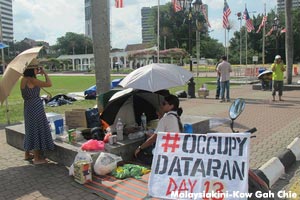 Therefore the group is advocating for a democracy where private citizens would be more concerned and participate in the decision making process.
"Instead of having powers in the hands of small group of elites, our vision is for power to be decentralised, for example, more responsibility should be given to local government where citizens can participate," he said.
Asked how long will the group be staying at Dataran Merdeka, Fahmi said: "We are out here to reclaim public space, are we not?
"Yes and no. By camping here we've reclaimed it but does it mean it is already ours?
"The government is still dictating (terms), we will be here as long as it is necessary to be here, we don't put a deadline, why put a deadline on democracy?"


Report this comment
Are you sure you want to delete this comment?
This action cannot be undone.