




Non-Malay PM: Khoo says nay, Malay politicos say aye
A broadcast forum on the possibility of a non-Malay Prime Minister helming the Malaysian government took an awkward turn last night, as two opposing Malay politicians on the panel agreed that it is a possibility allowed for by the constitution, while the sole Chinese historian on board was against it.
A broadcast forum on the possibility of a non-Malay Prime Minister helming the Malaysian government took an awkward turn last night, as two opposing Malay politicians on the panel agreed that it is a possibility allowed for by the constitution, while the sole Chinese historian on board was against it.
 "This is because the constitution was based on the reality which was established long ago," eminent historian professor Khoo Khay Kim (
left
) said when asked why the charter is silent on the race of the PM, seemingly allowing a non-Malay to rise to lead the country.
Speaking at the forum organised by Bernama Radio at the national news agency's headquarters in Kuala Lumpur, he was referring to article 43 of the highest law of the land which did not specify that a PM must be Malay, only that he or she must enjoy majority support from the elected members of the Dewan Rakyat.
Khoo believes that the weight of history made it so that only a Malay can lead any Malaysian government at present despite the constitutional silence, an artifact of British rule which put Malays above other races in the then crown colony and existing social conditioning which seems to magnify the racial division in Malaysia.
 The historian argued that the Malays were elevated to this special preference because they are subjects of the Malay rulers, even Malays from Indonesia are clapped together with other Malayans, with non-Malays only becoming citizens after the formation of the federated states in 1948.
He related that this special position of the Malays was bestowed by our once British masters whose research on peninsular Malaya has concluded that this was the ancestral homeland of the Malays embodied in the Malay states, and as personified by the Malay rulers.
"In 1927 when Sir Hugh Clifford was governor and high commissioner in the Federal Council, he explained: That they were, they are and must remain Malay states. They were when entering into cooperation with our government unelected Mohammedan (Muslim) monarchies, we have neither the right nor the desire to vary the system."
Why one, not the other
Khoo added that this was further confirmed by another high commissioner Sir Cecil Clementi in 1961 during the durbar (Federated Malay States Rulers Conference) when he confirmed "Malaya for the Malays".
Proof of this, he claimed, is again evident when the British talked about the Malayan Union, they spoke with the Malay rulers, because they rule over the Malays, they also talked to Umno and not PKMM (Parti Kebangsaan Melayu Malaya) as Umno members were all subjects of the rulers (Malays) while PKMM members were mostly other Malayans.
Khoo also brushed aside suggestions that a non-Malay Muslim may lead, adding that while constitutionally speaking a Malay must be Muslim, a Muslim is not necessarily a Malay.
 This safeguard, he explained, was created during the rubber rush of 1910 which saw foreigners buying up land in Malaya to plant rubber trees.
Worried by the possibility that the entirety of Malaya will be bought up by foreigners displacing the Malays, the British instituted the Malay Reserve Land and codified the definition of a Malay.
In Malaysian law inherited from British times, a Malay must be a Muslim, speak Malay and practice Malay customs, and only a Malay can own Malay Reserve Land.
But the racial profiling and Malay dominance we inherited from British rule is only one part of the problem ,claimed Khoo, pointing a finger at the rakyat too.
"Inhabitants of the country like to be segregated. We put great store in ethnicity, that is the problem, every time asked, we put ethnicity first before our nationality," argued the professor further, adding that previous British efforts to unify the Malays, Chinese and Indians failed miserably.
Khoo said that even up till today the Malaysian mindset is still unrealistic, based on socialisation since children where their minds "are poisoned by the adults" who are mostly ignorant themselves about their own history and culture.
A fact he said was proven in the 1949 thesis by Malaysian educator Hoo Seng On whose PHD dissertation on Malaysian society found diversity but no unity in Malaya.
The situation, Khoo alleged, is worse today.
"What is democracy? It is a government of the people, by the people and for the people. If the rakyat was asked to vote on can a non-Malay be PM, what is the result? 60 percent are Malays. If the Malays do not agree, is it possible?" he asked.
But Khoo conceded that things may change if the rakyat were to wise up from their racial induced stupor, a possibility which he does not believe yet possible however.
Sharp counter argument
"They (Malaysians) must all go back to school," he jibed, adding that it is too late for politicians though, those too dead set in their racial ways.
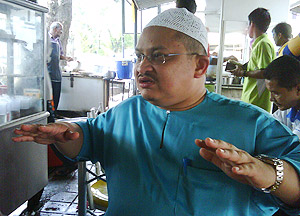 His view was countered by PKR Youth chief Shamsul Iskandar Md Akin (
right
) and Umno supreme council member Saifuddin Abdullah who both uncharacteristically agree that the silence of the constitution speaks volumes of future possibilities of a non-Malay PM, if and when society feels it is ready for it.
"In the constitution it is not specifically defined that only a Malay can be PM... From the context of the constitution, the person who enjoys parliamentary majority becomes PM, it does not need to be chosen by the monarchy, as we are a constitutional monarchy.
"It is a possibility that when society has matured and reverts back to the constitution, it may be accepted," reasoned Shamsul Iskandar though he related that the political realities and political statistics today dictate that the Malays who form the majority will always end up with the majority of seats and thus the PM will be Malay.
The facts he added, is not disproved by neither law nor the constitution, but accused Umno of playing up the issue to scare the Malays that they are going to lose political dominance in their own homeland.
But he conceded that Pakatan itself has agreed to disagree on the matter of a Malay or non-Malay PM, as they cannot collectively come up with a firm answer, though this confluence if diverging views he said is based on a consensus that Anwar will still be the first Pakatan Rakyat PM should they win in the next general election.
 Echoing the PKR Youth leader, Saifuddin (
left
) said that constitutionally a non-Malay PM is a possibility.
"It depends on the polls, which we don't know when yet. Who will represent who in the Dewan Rakyat. Which side is more numerous. If the Malays are not the majority in the Dewan Rakyat, this question begs a million possibilities.
Though he said that in BN especially Umno, the matter was never brought up as they have faith in the wisdom of the rakyat to act in accordance with the accepted and unwritten tradition of Malay leadership that has always been practised in the country.
This unwritten practice he said was evident when Umno was de-registered by the Registrar of Society in the 1980s and the BN supreme council which met chaired by then MCA president Ling Liong Sik, still deferred to former PM Dr Mahathir Mohamed to lead as he was a Malay.
The same practice, Saifuddin claimed was present in Pakatan as Anwar, another Malay, was maintained as Opposition leader despite PKR holding fewer parliamentary seats then DAP, after a cohort of PKR MPs jumped ship to become BN-friendly independents.
All panelists, however, agreed that focus right now should not be on whether or not our PM should be a Malay, with Khoo saying that the bigger question is to promote national unity over racial division first and both Shamsul and Saifuddin agreeing that the leadership qualities of a person should be more important than his or her race.
The matter of a non-Malay PM was BN fodder for their campaigns and ceramah, using the racial undertone to remind Malays that Umno and hence BN which leads the coalition is the only political force that shall ensure Malay dominance in Malaysian politics.
Their music playing well to the Malays which made up the political majority, many still in rural areas of the country.
This was refuted by Pakatan, though what made matters worse for the opposition is that they themselves cannot come up with a consensus on the ethnicity of the PM.
PKR is mostly silent on the matter, afraid perhaps to anger either the Malays or non-Malays with a misstep, while some in the DAP had insisted that constitutionally a non-Malay PM is possible, and PAS will only accept a Muslim PM regardless of race.


Report this comment
Are you sure you want to delete this comment?
This action cannot be undone.