




Ling: Cabinet decisions a collective responsibility
Former transport minister Dr Ling Liong Sik, who took the witness stand in his defence, told the Kuala Lumpur High Court that any cabinet decision is a collective responsibility.
Former transport minister Dr Ling Liong Sik, who took the witness stand in his defence, told the Kuala Lumpur High Court that any cabinet decision is a collective responsibility.
Testifying as the first defence witness, Ling said former premier Dr Mahathir Mohamad, in chairing the cabinet meetings, would ask his ministers around the table whether they agreed with a particular decision or not.
“The cabinet’s decision is a collective responsibility. He (Mahathir) had stated that if any of the ministers do not approve of a decision, they can resign,” said the longtime transport minister.
Responding to questions from lead counsel Wong Kian Kheong, Ling said that at times, there would be an occasion where the cabinet decision is revisited, collectively.
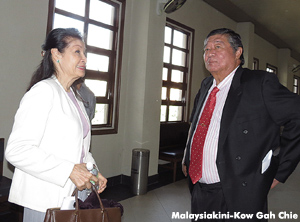 Giving an insight into how Mahathir ran the cabinet, Ling (
right in picture
), who was MCA president from 1986 until 2003, during which time he was also the transport minister, said there would be pre-cabinet meetings in his ministry, either on Monday or Tuesday, where senior officers would be called in to formulate transport policies.
Giving an insight into how Mahathir ran the cabinet, Ling (
right in picture
), who was MCA president from 1986 until 2003, during which time he was also the transport minister, said there would be pre-cabinet meetings in his ministry, either on Monday or Tuesday, where senior officers would be called in to formulate transport policies.
“I do not prepare any of the papers or memo as this is prepared by my senior staff who vetted the proposals. During the pre-cabinet meetings which I attended, I would chair, and the deputy minister, parliamentary secretary, secretary-general, deputy secretary-generals and heads of agencies would be present.
“In the meetings I would allow my staff to say whether they agreed to the proposal or want further suggestions or oppose. Upon agreement the proposal would be tabled to the cabinet via the Prime Minister’s Department. The cabinet would then meet on Wednesday morning and this is followed by the post-cabinet meeting.”
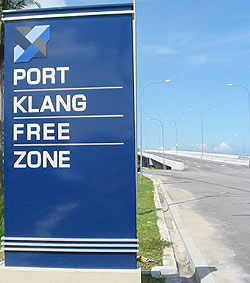
He said that in some of the decisions like the Port Klang Free Zone project, it has to involve various ministries and agencies as it may involve the Prime Minister’s Department, Finance Ministry, Economic Planning Unit and the Valuation and Property Services Department.
There was a funny moment before Ling began giving evidence, when he was asked to produce his identity card. He asked for it from his two sons present in court – but they forgot to bring it. Witnesses are required to produce their MyKad before testifying in court.
The court also had to stop once mid-way during Ling's testimony as the soft-spoken minister's voice came on very faintly on the courtroom's in-house recording system.
Move to make Port Klang a top port
On the Port Klang Free Zone project, Ling said it was his intention to transform Malaysia's main port to be among the top in the world.
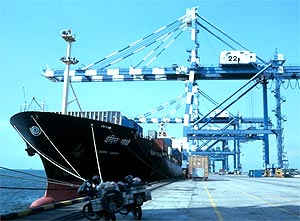 He said when he took over the Transport Ministry, Port Klang was placed number 57 in the world. When a port is not in the top 30, it is not listed.
“As transport minister, I wanted to see this improved and that is why the cabinet decided to build the North-South Expressway to improve transportation in the country and build bigger airports and ports as well to accommodate future demands.
“I wanted Port Klang to be one of the major ports in the Southeast Asian region and even better than Singapore. However, Singapore is placed No 1 in the world and it does not want to share its secrets with us,” Ling said.
As a result, he said, he had to find other examples in the world and he visited Rotterdam, Hong Kong, Dubai and even Singapore, where he said he “was harassed”.
Ling said Mahathir liked what he was doing and he was given a free hand to meet shippers or go overseas to visit shipping companies and ports to learn from their experiences.
 “The country and I realised how important ports are to boost our trade in the region and we took measures to improve them.
“That is when I proposed we follow the example of the Jebel Ali Free Trade Zone in Dubai, which is heavily engaged in the import and export or entreport trade, where huge desert lands were transformed to support industries.
“This is why I see Port Klang has the potential to be transformed into a regional port for the Southeast Asian region, like Jebel Ali is to the Middle East,” he said.
Ling said following this, he proposed land acquisition be done so that factories could be placed within the free zone, since time was crucial in the shipping of goods.
Within years, he said, and with Mahathir's staunch support, Port Klang took the No 11 place in terms of the volume of twenty-foot equivalent (TEU) container units handled.
Documents prepared by staff
Ling told the court that a document prepared by the ministry's principal assistant secretary (Maritime) P Chandrasekaran, for the purchase of 830 acres (332 ha) of land in Pulau Indah, was given to him for consideration sometime in March 1999.
“This proposal to purchase was made by the maritime department. I cannot remember whether there was a policy directive issued by me. I agree, however, that the land was leased back to the Port Klang Authority (PKA)after the purchase,” he said in replying to questions from Wong.
 He also said that he had seen a second memo made by the ministry's deputy secretary-general (planning) Abdul Rahman Mohd Noor, with some attachments for the acquisition of Pulau Indah.
“Yes it was a cabinet decision for the PKA and the Finance Ministry to acquire,” he said.
Asked by Wong whether the Finance Ministry, the portfolio that Mahathir held at that time, was in agreement with the deal from the beginning, Ling replied “Yes”.
The hearing before Justice Ahmadi Asnawi continues on Monday.
The defence is yet to reveal who will be called as its witnesses.
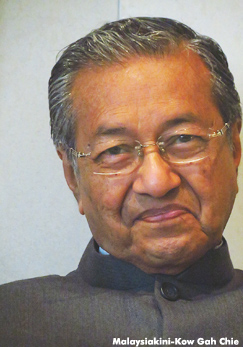
Among the people the defence team has interviewed as potential witnesses are Mahathir, former education minister Musa Mohamad and former women, family and community development minister Shahrizat Abdul Jalil.
Liong Sik begins defence in PKFZ trial


