




Riot police underwent 'anger management' courses
Drawing from lessons of past rallies, the FRU have taken ‘anger management' courses since early this year, its commanding officer told the Malaysian Human Rights Commission (Suhakam) public inquiry today.
Drawing from lessons of past rallies, the FRU have taken ‘anger management' courses since early this year, its commanding officer told the Malaysian Human Rights Commission (Suhakam) public inquiry today.
This consisted of standing under the hot sun while being verbally abused, said Supt Zahari Mohd Yusoff, who was in charge of all four FRU troops on anti-riot duty at the pro-electoral reform rally.
He had also accompanied one of the troops - Troop Four-Alpha - as it advanced along Jalan Raja Laut between 3pm to 5pm.
"I salute my subordinates. They have done as I wished," he said, adding that amongst his worries was the fear that they would take matters into their own hands.
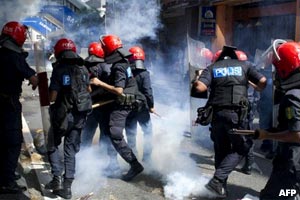 Despite working under the hot weather and being on the receiving end of insults and projectiles, he told the inquiry panel they had exercised restraint and there had been no physical contact between the FRU and protestors, nor had they shot tear gas shells directly at them as alleged.
However, Zahari stressed that the FRU's role that day was restricted to dispersing crowds only, not to arrest protestors. That was the responsibility of other branches of the police force.
In addition, although it would be against standard operating procedures (SOP) to do so, he said he could not verify whether the three other troops had aimed their tear gas launchers directly at the protestors.
There was also a separate anti-riot unit deployed to the rally. This was the General Operations Force's Public Order and Riot Unit (Poru) which was not under his command.
"We don't shoot directly at protesters. What has been alleged is beyond my knowledge," he said.
Some witnesses have previously claimed that the tear gas shells were launched directly at the crowd, resulting in one protester being blinded when a shell hit his eye.
'Perhaps protestors caused congestion'
Zahari also denied that the FRU had surrounded protesters and prevented them from dispersing, pointing out that Jalan Tunku Abdul Rahman, Jalan Raja Laut, and Jalan Tun Perak had many side-roads and alleys to escape into.
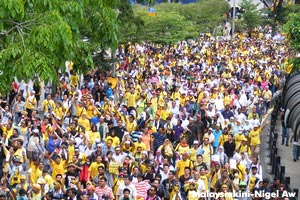 "Perhaps there were protesters who were curious about what was happening in the front, causing congestion," he said.
Zahari is the 23rd witness and the first police officer to testify to the Suhakam panel. He was grilled for about three hours by the panel and its observers, including a detailed description of the FRU's procedures and the orders given to the police.
Despite complaints from many media personnel of being harassed and their equipment either confiscated or destroyed, he told the panel that instructions were given during a briefing on the day before the rally not the interfere with the press or the Bar Council's observers.
He said he had relayed these instructions ‘down the line' to his subordinates.
When the Suhakam panel's chairperson Khaw Lake Tee asked whether the police were also told not to interfere with the commission's own observers, he said he was not aware of Suhakam's presence at the rally.
"However, the personnel have been made aware of Suhakam's findings regarding the Bersih 2.0 rally (last year) and were told not to repeat the mistake," he said.
He added that should mistakes recur, it would be the fault of the individual police officer and not his superiors.
'Hard to identify reporters'
When cross-examined by ACP Jamaluddin Abdul Rahman who was holding a watching brief for the police, Zahari said despite the instructions, it was still difficult to identify the reporters and Bar Council observers with certainty.
They would then be simply considered as members of the public.
He agreed to Jamaluddin's suggestion that it would be best if the Bar Council, the media, and the police hold a briefing prior to any rallies like Bersih so that there is common understanding on each other's procedures and identification.
Zahari also testified that, in spirit of recent changes to legislation including the Peaceful Assembly Act, the FRU did not carry rifles at Bersih 3.0.


Are you sure you want to delete this comment?
This action cannot be undone.