




Ong: MCA, Gerakan didn't have ear for policy work
INTERVIEW The DAP yesterday attempted to consolidate its professional image with the addition of political analyst Ong Kian Ming to its ranks of doctors, lawyers and former chief executive officers.
INTERVIEW The DAP yesterday attempted to consolidate its professional image with the addition of political analyst Ong Kian Ming to its ranks of doctors, lawyers and former chief executive officers.
Ong, 37, is well known for his work on the electoral roll and is the project director of the Malaysian Electoral Roll Analysis Project (Merap).
He has also contributed his critique of the Economic Transformation Programme (ETP) with the DAP-linked think tank Research for Social Advancement (Refsa).
However, it is not widely known that prior to joining DAP, the master of economics holder had a stint at the MCA’s think tank Institute Of Strategic Analysis And Policy Research (Insap) as well as Gerakan’s think tank Socio-Economic Development and Research Institute (Sedar).
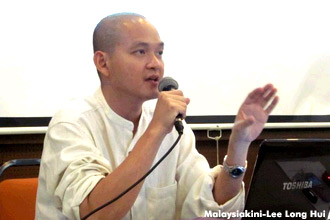 Idealistic about contributing to public policy, Ong left a consultancy firm for Insap in 2001 before subsequently joining Sedar in mid-2002. The stint however was not as Ong had hoped.
The experience had taught Ong of the difficulties of attempting to institute change from within the ruling coalition and eventually inched him towards the DAP.
"I found out that through my exposure to MCA and Gerakan, the policy component within the two parties, especially within MCA was not very strong.
“The fact was that the leaders were probably not that concerned about policy issues at that time because then (Barisan National) BN was in a very strong position, so they felt they could just go on with business as usual," he told Malaysiakini in an interview yesterday.
In 2004, Ong left for the United States (US) on a Fulbright Scholarship to pursue a PhD in political science at Duke University before returning to Malaysia six years later.
'Change from within near impossible'
Upon his return in 2010, Ong was offered to rejoin Sedar amid a very different political scene where Gerakan was wiped out from its home base of Penang in the 2008 general election.
"I think once I decided, it was quite clear to me when I came back from US that BN, because of many historical reasons and baggage, were not capable of changing.
"I saw that when I was working with the MCA and Gerakan-linked think tanks - that change from within, so to speak, was actually close to impossible.
"There were other priorities that the party leadership had that were to do with political concerns which perhaps were more selfish in nature rather than for the larger concerns of the country and community," he said.
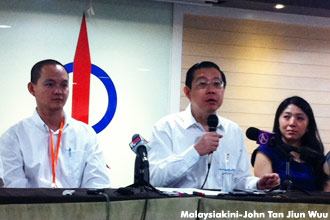 Also citing lack of confidence in the new Gerakan's leadership to genuinely reinvent itself after the electoral tsunami, Ong turned down the Sedar’s offer in favour of consulting work for the DAP.
"Frankly, the financial reward for actually working in Sedar would be much better than what I was being offered at the DAP. But doing research has never been about money but for a better country,” he added.
The leaders in DAP, Ong said he found, were more open to engaging young people and allowing them to contribute in meaningful ways.
“Meaningful in a way that they (DAP) want young people, not just for lip service or symbolism, but because they wanted to see and tap the ideas of the younger generation," he said.
While that set him on the path for research work with the DAP, the critical juncture came when Ong was offered a fellowship position in the US amid looming polls that has been predicted to be the most competitive in history.
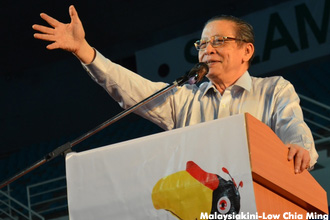 This prompted him to choose between academia and politics.
At DAP supremo Lim Kit Siang’s convincing, Ong decided to turn down the fellowship and step out of the sidelines of academia into politics.
His friendship with DAP secretary-general Lim Guan Eng and a blogging stint with Petaling Jaya Utara MP Tony Pua also helped nudged him into joining the party.
'Don't look at me, look at my work'
Ong admitted that the move into politics would cast doubt on his role as an academician, particularly on his critique on government policies and important research works which may be labeled as bias by political opponents.
However, he said people should ciriticise his work objectively including his Merap project will be soon completed and uploaded online for public scrutiny.
“Do not dismiss something just because I’m now in the DAP but look at the research… Scrutinise my research to their (the people’s) hearts desire and they can critique the validity and objectivity of the research based on what I published. That should be the key point,” he said.
Ong also conceded that being a political party member would mean toeing party lines but said DAP was broad enough to accept different views.
“But it has to be expressed in a way that is sensitive to the political situation and how it may affect the party.
“You are part of a larger team. You need to strengthen the team as a whole and I’m willing to do that,” he said.
Ong, who is appointed as the election strategist to the DAP secretary-general, said his role as an academician will have to take a back seat in the next six months as his focus would be on analysing the electoral roll for DAP-held constituencies and provide input on seat distribution for the coming general election.
Ong remains a UCSI University lecturer but has been on sabbatical leave since January while his consultancy firm would be "frozen" to avoid conflict of interests.
Asked if he was interested in contesting in the next general election, Ong said he was “open” to the idea but it was ultimately up to the party to decide.
Interview conducted by Ahmad Fadli KC and Nigel Aw.


Report this comment
Are you sure you want to delete this comment?
This action cannot be undone.