




'Gov't covered up instead of cleaning voters roll'
The government has not attempted to rectify past problems exposed in the electoral roll but had instead introduced laws to try to cover up any problems, said a Bersih leader.
The government has not attempted to rectify past problems exposed in the electoral roll but had instead introduced laws to try to cover up any problems, said a Bersih leader.
The electoral reform coalition’s co-chairperson Ambiga Sreenevasan.today cited how the courts had found the electoral roll in Likas, Sabah, to be tainted over a decade ago.
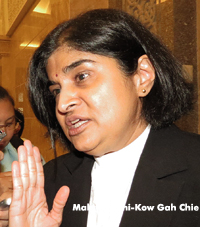 In wake that ruling, she said the government had introduced Section 9A into the Elections Act, which barred the courts from scrutinising the electoral roll.
“These things were happening to ensure that no one knew what happened in Sabah,” she said at a public talk in Bandar Utama, Selangor today.
She was referring to the hearing of the Likas election petition that followed the 1999 Sabah state election, which was heard at the High Court in Kota Kinabalu until it concluded on June 8, 2001.
“Justice Muhammad Kamil Awang actually found that the electoral roll was not clean and he set aside the elections.
“He found it not clean because of the same complaints (as the Sabah royal commission of inquiry, or RCI is hearing at present) - of foreigners being on the electoral roll,” she said.
Ambiga was recounting to the audience of about 50 people how the Election Commission (EC) shifted its tone since April last year, from claiming to have the “cleanest electoral world in the world” to conceding that “mistakes” had been made.
“How can they claim to have the cleanest electoral roll in the world knowing what happened in Sabah?” she said.
She therefore said that she was “shocked but not surprised” by the revelations of the ongoing RCI.
The former Bar Council president also expressed regret that the RCI would not be able to complete its work before the next general election, as it was important for the electoral roll to be cleaned up before the polls.
The Parliament’s mandate expires on April 28 and fresh elections must be called within two months from the date.
‘KL112 peaceful as police behaved’
In her speech, Ambiga also mentioned that the main reason the People’s Uprising Rally last week was peaceful was because the police were committed to the spirit of the Peaceful Assembly Act (PAA) by facilitating the rally, unlike the confrontational approach seen at the Bersih 3.0 rally last April.
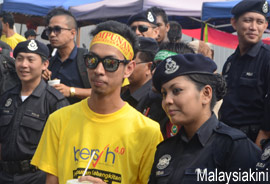 “Let’s talk about the PAA. It is a permissive legislation. It allows public assemblies and that is a first. So that Act was enforced.
“But more important than the Act, in my view, was the ‘software’, which is the mindset of the police. That is what made the difference.
“You can have all the Acts in the world but if people who enforce it are not committed to the spirit of the legislation, there is little you can achieve.
“So (in the People’s Uprising Rally) you have an excellent rally; no problems, and everything was peaceful,” she said, while stressing that she nevertheless still has misgiving about some provisions of the PAA such as its ban on street protests.
Elaborating this point at a press conference later, she expressed optimism that the police would be able to keep political violence under control in the next general elections.
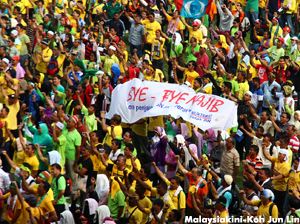 “It was the inspector-general of police (Ismail Omar) who made the call. If the IGP sticks to the idea that the police should be professional and non-partisan, I do not foresee any problems during the elections.
“The reason political violence is happening and continuing is because the police were not taking any action. They (political thugs) were behaving with impunity.
“That is what is so promising about the (People’s Uprising Rally): The police were behaving exactly as they should - professional and in accordance to the spirit of freedom of assembly,” she said.
'New gov’t should lead change'
In her speech earlier titled ‘Confronting the past’, she also outlined how various institutions such as the media, the education system, the Parliament had shaped public opinion, to the point where some members of society believe it is acceptable to make racist remarks and take a nonchalant attitude to corruption.
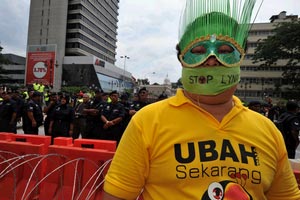 However, she said this is changing and whomever takes control of the next government would also be in charge of a “nation in transition”.
Hence, she suggested that the next government to take certain measures to ensure a bright future, such as to review current legislation and strengthen the rule of law, to tackle corruption “with a vengeance”, and to let educationist rather than politicians determine education policy.
“(African-American civil rights movement leader) Martin Luther King once said he had a dream. We don’t have to dream any more. We can actually see this bright future.
“As far as I am concerned, our bright future is within our grasp. It can be done... we should grasp the opportunity and we have to make sure our leaders get it done,” she said in concluding her speech.


Are you sure you want to delete this comment?
This action cannot be undone.