




'Smartphones present greatest danger in GE13'
A veteran media practitioner believes that the common smartphone, and its more than common capabilities, may cause trouble in the 13th general election (GE13), if authorities are not prepared for it.
A veteran media practitioner believes that the common smartphone, and its more than common capabilities, may cause trouble in the 13th general election (GE13), if authorities are not prepared for it.
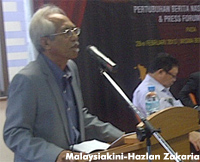 “This coming election may not be as smooth if the people involved in the process do not pay attention to the power of the smartphone,” said blogger and veteran editor A Kadir Jasin (
left
) at a forum on the changing landscape of media in the face of the upcoming general election in Kuala Lumpur today.
“In GE13 things can be complicated and go wrong if you don’t pre-empt. Unless you can ban the smartphone, there may be problems,” he argued.
Kadir said that this is because all sorts of rumours, chit-chat and false news can be conveniently spread on the devices which can lead to low voter turnouts or crisis situations.
He warned that a single picture of an alleged unverified incident somewhere going viral through smartphones may cause untold problems at the thousands of voting centres nationwide.
His views of the ascendancy of smartphones were shared by fellow forum panellist and The Star executive editor Wong Sai Wan, though with a different tack.
Instead of believing that smartphones are keys to chaos, Wong said that they are the kingmakers of GE13 which he argued will not be won by issues or debates but by a single picture of a political personality doing something controversial.
“Much like the photo of Tengku Razaleigh Hamzah which cost Semangat 46 quite a few votes,” recounted the senior journalist.
The 1990 photos of Razaleigh, popularly known as Ku Li, allegedly wearing a headdress with a the Christian cross on it caused a stir in Malaysian politics and brought down his hopes of victory in that year’s general election.
In GE13, either side may use this method and use the smartphones’ instantaneous means of information transfer to great effect, said Wong.
‘Info spread more effectively via handphones’
The viral nature of smartphone information transfer and its possible use to stir chaos or win elections, whether in a dirty way or not, is supported by findings made by the third member of the forum panel, Universiti Islam Antarabangsa (UIA) journalism doyen Syed Arabi Idid.
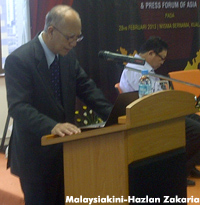 During his speech, Syed Arabi (
left
) said that information is spread more effectively via handphones rather than through newspapers or even radio and television.
He cited a case on the passing away of a prominent personality, when he said that most people found out about it almost immediately from handphone calls and word-of-mouth.
The almost instantaneous speed of information transfer available via gadgets in the numerous hands of the public has led to a sea-change in politics and campaigning, as instead of controlling its flow, even governments are at the mercy of social media and handphone-wielding members of the public.
Experts stress that information now is no longer for mass distribution but for individual consumption.


Report this comment
Are you sure you want to delete this comment?
This action cannot be undone.