




'Media under pressure as need to control info rises'
The Centre for Independent Journalism (CIJ) has expressed concern about 10 incidents that in the current election season are infringing on freedom of expression, especially freedom of the press.
The Centre for Independent Journalism (CIJ) has expressed concern about 10 incidents that in the current election season are infringing on freedom of expression, especially freedom of the press.
These include radio jamming targeting Radio Free Sarawak and Radio Free Malaysia and distributed denial of service (DDOS) attacks on their websites, accredited journalists being barred from entering the Sibuti nomination centre on nomination day, Harian Metro and Kosmo refusing to provide DAP quotations for advertising, as well as physical attacks on journalists.
“These are some of the concerns and pressures felt by the media in an environment where the need to control information gets heightened during an election campaign that is being seen as the ‘mother of all elections’,” said CIJ executive officer Masjaliza Hamzah at a press conference today.
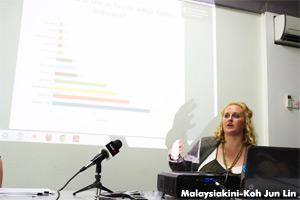 She was speaking after releasing the preliminary findings of a media monitoring study conducted in collaboration with the University of Nottingham Malaysia Campus.
The report reaffirmed the findings of the study’s first two preliminary reports, which among others, said that the online media is most equitable in providing coverage for the two opposing political coalitions, whereas newspapers and television news have a pro-BN bias.
This time, the findings are backed with two weeks’ worth of data beginning April 7, instead of just a week’s worth in the previous reports.
The newly published data also revealed that BN’s manifesto received triple the media coverage compared to Pakatan Rakyat’s manifesto. The make-up is 44.9 percent and 15.3 percent of all coverage of long-term policy issues, respectively.
 To a question, Masjaliza (
left
) said that journalists who found that their editors have 'doctored' their stories or have come under pressure to report unfairly, could raise the issue with the National Union of Journalists (NUJ) if he is a member.
She pointed out that the union had passed a resolution in March last year that members of the union shall seek to report fairly without fear or favour, so the issue can at least be recorded.
“I think there are a lot of violations that we don’t know about unless it comes out in the open, unless someone decides to whistle-blow, unless someone tells you and it goes through the grapevine, and then it gets reported.
“So a lot of these things are like an ice cap - what I mentioned is the tip of the iceberg. There is a lot more happening that we don’t know about, especially with stories being ‘doctored’ to suit a specific agenda,” she said.
She added that the CIJ plans to use the findings of the study, which runs until May 7, to advocate for media reform after the elections.
Other findings in the newly published report include:
- When divided by language, the Chinese-language media provides the most equitable coverage, as compared to the English-language and Malay-language media.
- The English-language media is found to be pro-BN and anti-Pakatan Rakyat in equal measure, whereas the Malay-language media is found to be “very strongly anti-Pakatan Rakyat”, with its politicians receiving 4.3 times more attacks and 5.6 times more negative coverage compared to their BN counterparts.
- Nearly half of policy issues raised in the media are regarding long-term policies and “visions”, such as party manifestos, and various transformation programmes. The remaining 24.5 percent are economic issues, while seven percent are about domestic policies relating to crime, security, and immigration.
- For non-policy issues, ethnic issues take centre stage with 28.5 percent of all non-policy coverage, followed by allegations of electioneering (23 percent) and mudslinging between politicians (20.1 percent).
This includes the publications in English, Malay, Chinese and Tamil, making it a total of 19,613 articles analysed.


Report this comment
Are you sure you want to delete this comment?
This action cannot be undone.