




What now for the abused Penan women?
COMMENT Our authorities have known about the vulnerability of Penan women and girls, such as Bibi (not her real name), to sexual violence and exploitation since the mid-1990s at least. Finally in 2008, after immense media spotlight on the issue, the Ministry of Women, Family and Community Development (MWFCD) put together a National Task Force to investigate these allegations.
A year later, the National Task Force released its report affirming that the allegations of sexual exploitation were true, documenting eight specific cases, including Bibi's.
Now, almost five years after the National Task Force was formed, nothing is clear about what action has resulted since its report was issued...
COMMENT " Bibi was 21 at the time of the interview. She was raped twice by a logger who she had first met when he gave her family a ride home after dropping her sibling off at school. Both times, he broke into her house and forced himself on her, and each time she got pregnant. The logger would occasionally bring food for Bibi and her family, and he claimed her for his wife, but she refused to accept him as he had two other wives already. Bibi is illiterate and was too scared to tell anyone about the rapes when they happened ." - From A Wider Context of Sexual Exploitation of Penan Women and Girls, 2010 , a report by The Penan Support Group, the Asian Forum for Human Rights and Development and the Asian Indigenous Women's Network.
Our authorities have known about the vulnerability of Penan women and girls, such as Bibi (not her real name), to sexual violence and exploitation since the mid-1990s at least.
Finally in 2008, after immense media spotlight on the issue, the Ministry of Women, Family and Community Development (MWFCD) put together a National Task Force to investigate these allegations.
A year later, the National Task Force released its report affirming that the allegations of sexual exploitation were true, documenting eight specific cases, including Bibi's.
Now, almost five years after the National Task Force was formed, nothing is clear about what action has resulted since its report was issued.
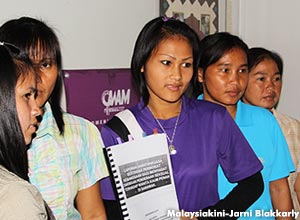 Last week, a group of five Penan women from Middle Baram in Sarawak travelled to Kuala Lumpur to ask the MWFCD about this. As far as they know, not much has been done.
The new Minister of Women, Family and Community Development, Rohani Abdul Karim - who is a Sarawakian - said last month that her ministry would get to the bottom of the allegations but "officers on the ground reported that the problems have been solved" as "there are no new cases.
Perhaps it is true that no new cases have been reported after the National Task Force investigation. But this does not mean that no new incident has occurred. According to the 1995 report of the American Medical Association, Sexual Assault in America, sexual violence, in particular rape, is considered one of the most under-reported of violent crimes.
Disempowered and made vulnerable
However, the Penan women and girls have been made more vulnerable due to additional circumstances, as highlighted in the National Task Force Report:
"The sexual abuse is extremely unaccepted by the Penan community; however, they are extremely vulnerable to the abuse because of:
a. Poverty;
b. Living far inland;
c. Over-dependency on logging companies for transport to obtain health services and get to school, as well as access to basic facilities, including water supply, power generators, etc;
d. Lack of confidence in the authorities, and
e. Negative perceptions and prejudices towards the Penan as being lazy, untruthful and alcoholics, causing them to feel isolated and inferior. This makes it difficult for them to deal with external parties."
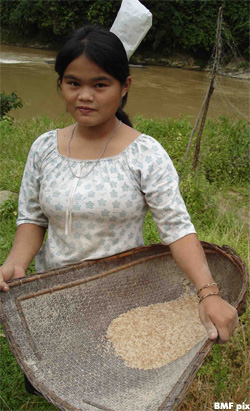 Recognising these additional circumstances, the report not only directly addressed sexual exploitation, it also addressed other challenges the Penan community faced, which contributed to their vulnerability and disempowerment, including difficulties in obtaining birth certificates and identity cards, poor access to healthcare and poor access to education.
This is not to say that the MWFCD has not done anything.
In June last year, the ministry funded a three-day "empowering rural women" course organised by the non-governmental organisation Sarawak Women for Women Society, which was attended by teachers from 13 primary and secondary schools, Marudi Hospital staff, health officers, government officers and Penan women and girls from 16 communities.
But other than this, it is not clear what else has been done. And the lived realities of the Penan women who visited Kuala Lumpur demonstrate that despite the National Task Force Report and its recommendations, their problems have not been solved, and in some instances, are getting worse.
In Long Item, a village of 30 families and 150 people, at least 15 villagers do not have identity cards, according to Amelia Balan, a Penan woman from the village.
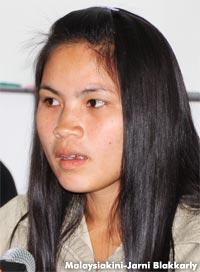 During her visit to Kuala Lumpur, Amelia (
right
) brought along the forms that she helped the 15 villagers fill out to apply for their identity cards.
The National Task Force Report recommended the conducting of joint registration operations, where various relevant government agencies would visit the Penan villages together to help the Penan get registered.
Unfortunately these visits did not take place in Long Item, and visits conducted by the Sarawak National Registration Department (NRD) to her village are scarce.
In some instances, NRD officers insisted that applicants provide a copy of their parents' identity cards and birth certificates, even though some villagers' parents do not have identity cards and birth certificates themselves.
Not being properly registered means restricted access to healthcare services, inability to sit for standardised exams and pursue higher education, and denial of the right to vote.
Access to healthcare a challenge
Access to healthcare also remains a challenge in Long Item. As an appointed community health representative, Tabita De' is provided with medication and other medical supplies to provide to villagers in between visits by a travelling doctor. However, the doctor's visits are not always regular, due to bad weather and unequal distribution of resources, and as a result Tabita often runs out of medication.
For villagers with high blood pressure or other conditions requiring a regular supply of medication, this interruption is especially dangerous.
Additionally, many villagers in Long Item have fallen sick as the village does not have access to clean water and proper sanitary facilities. Sungai Banau, the village's only source of water, has been polluted because of logging.
The community has been left with no choice but to use the polluted water for drinking, cooking, bathing and washing.
 Implementing the recommendations in the National Task Force Report will not be nearly enough to meet the needs of people in Amelia and Tabita's village, and the larger Penan community in Baram, whose struggles stretch beyond that covered in the report.
Decades of logging in their ancestral lands have diminished their sources of livelihood. And if built, Baram Dam will submerge an area nearly twice the size of Kuala Lumpur , displacing up to 20,000 natives in 26 villages, including Long Item.
A more comprehensive set of recommendations is laid out in the 2010 report "A Wider Context of Sexual Exploitation of Penan Women and Girls," not least of which are the protection of native customary rights, "ensure that logging, plantation, and other large-scale companies are held accountable" and to "ensure a genuine and transparent process as well as the full and effective participation of all segments of the Penan communities in decision-making processes that affect their lives".
Nonetheless, the implementation of the recommendations in the National Task Force Report will have a positive effect, and the Penan community and all Malaysians have the right to be informed of its progress.
Last week, in an official letter from her ministry dated June 17, Rohani indicated that she is willing to meet with the Penan women soon. Hopefully, this will be a definite commitment on the part of the government to work with the Penan community to achieve their goals.
PENAN SUPPPORT GROUP is a coalition of NGOs in East and West Malaysia dedicated to advocating the rights of the Penan. This article was written by Women's Aid Organisation, Sarawakians Access, All Women's Action Society, Pusat Kesedaran Komuniti Selangor, Suara Rakyat Malaysia and Women's Centre for Change .


Report this comment
Are you sure you want to delete this comment?
This action cannot be undone.